
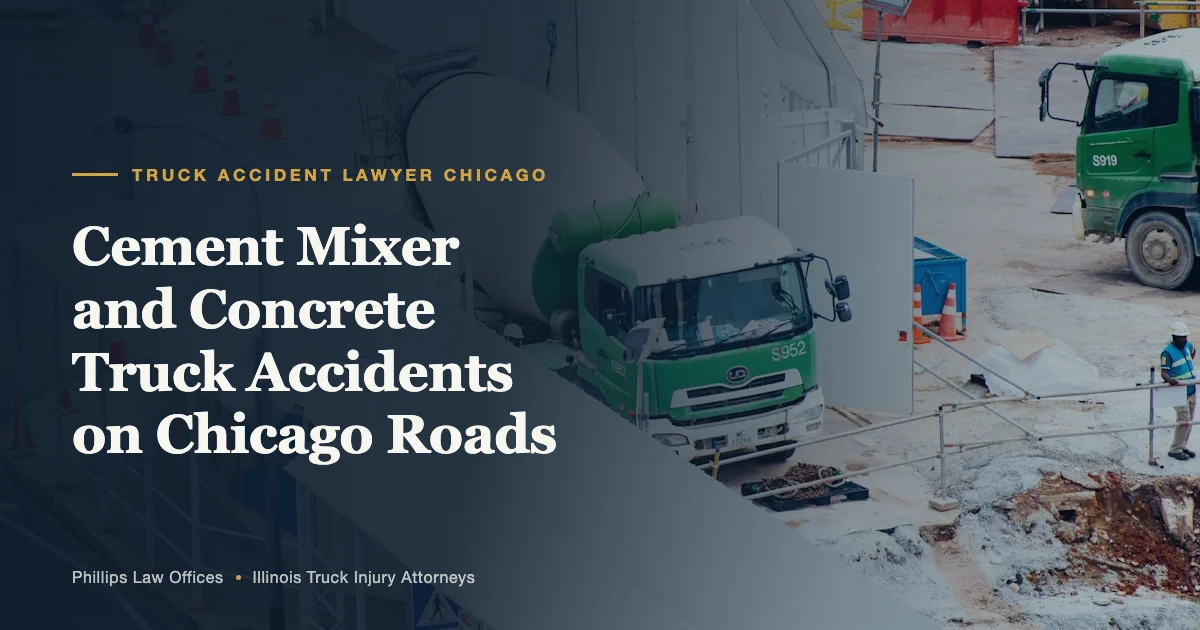
A cement truck accident claim is rarely straightforward. Ready-mix concrete trucks are among the heaviest commercial vehicles on Chicago roads, and when one strikes another vehicle, the consequences can be catastrophic. Under 49 CFR 390.5, ready-mix concrete trucks with a gross vehicle weight rating of 10,001 pounds or more are classified as commercial motor vehicles (CMVs), which means the full weight of federal trucking regulations applies to every aspect of their operation.
This article provides general legal information; consult a licensed Illinois attorney for advice specific to your situation.
Why Cement Trucks Are Especially Dangerous on Public Roads
A fully loaded ready-mix concrete truck can weigh 60,000 pounds or more. That weight is not static, the rotating drum that keeps the concrete mixed continuously shifts the vehicle center of gravity. FMCSA and NHTSA rollover research has documented that the combination of a high center of gravity and a moving internal load creates rollover dynamics that differ significantly from a standard flatbed or tanker truck. A driver who enters a highway ramp or a sweeping urban turn at a speed that would be safe in an ordinary truck may trigger a rollover in a ready-mix vehicle. These physics do not forgive driver error.
Stopping distance is a related concern. At highway speeds, a loaded cement truck traveling at 65 mph needs considerably more distance to stop than a passenger car. Traffic signal changes and sudden lane merges that a car driver handles without incident can become emergencies for a cement truck driver who is already managing a shifting load.
Public Road Crashes vs. Construction Site Accidents
This article covers collisions that happen on public roads: expressways, city streets, intersections, and loading areas adjacent to public right-of-way. If you were struck by a cement truck while driving, riding, cycling, or walking on a public street, your claim is the kind of case Phillips Law Offices handles.
On-site pours and construction site vehicle strikes, situations where the accident happens entirely within a private job site, raise different legal questions, including workers compensation and premises liability, that are handled through different practice areas. If you are unsure whether your accident happened on a public road or a controlled construction site, an attorney can help you draw that line.
Weight Limits and the Axle-Load Problem
625 ILCS 5/15-111 sets Illinois axle weight limits for vehicles operating on public roads. Fully loaded concrete trucks frequently approach or exceed those limits, particularly on routes that include older streets or bridges not rated for maximum commercial loads. When a truck is overweight, it becomes harder to stop, causes accelerated road surface damage that can affect traction, and is itself evidence of a compliance failure that a plaintiff attorney can use to establish negligence.
Carriers have an obligation under 49 CFR Part 396 to maintain inspection and maintenance records. If a truck was overloaded or its drum mechanism, braking system, or tires were not properly maintained, those records, or the absence of them, become critical evidence in a civil case.
Who May Be Liable in a Cement Truck Crash
Understanding truck accident liability in Chicago requires looking beyond the driver to the full chain of commercial relationships that put the truck on the road. In a ready-mix concrete accident, potentially liable parties typically include:
- The ready-mix company: As the motor carrier, it bears responsibility for driver qualification, hours-of-service compliance, vehicle maintenance, and load management under FMCSA regulations.
- The general contractor: If a contractor directed the delivery schedule, the route, or the loading process, and those decisions contributed to the crash, the contractor may share liability under Illinois law.
- An equipment broker or lessor: If the truck or drum mechanism was leased and the lessor retained maintenance responsibility, a defect in the equipment can create a separate claim against the broker or leasing company.
Municipal Contracts and the Tort Immunity Act
One complication that appears more often in cement truck cases than in ordinary commercial vehicle cases is the involvement of public works projects. When a ready-mix company is operating under a municipal contract, delivering concrete for a city street repair, a bridge project, or a public building, the 745 ILCS 10 Tort Immunity Act may come into play. The Act limits or immunizes certain governmental entities from claims, and its application can affect how a case is structured, who the proper defendants are, and what notice requirements apply.
This does not mean an injured person has no claim. Private contractors operating under municipal contracts generally do not share the government immunity. But the analysis is fact-specific, and getting it wrong early in a case can result in critical filing deadlines being missed.
Evidence to Preserve After a Cement Truck Crash
Ready-mix companies are required under 49 CFR Part 396 to keep inspection and maintenance records. Dispatch logs, delivery manifests, and load tickets showing the volume and weight of concrete carried are also important. Electronic control module data from the truck can show speed, braking, and throttle input in the moments before impact. Drum rotation logs, where available, can establish whether the load was within specification. Illinois courts treat spoliation of evidence as a serious matter. Preserving critical evidence early, starting with a prompt legal hold letter, can keep this documentation from being destroyed on a normal business retention schedule.
Talk to a Chicago Attorney – Free Consultation
Phillips Law Offices handles cement mixer and concrete truck accident claims throughout the Chicago area. If you were injured in a crash involving a ready-mix vehicle on a public road, call (312) 346-4262 or visit our free consultation page to schedule a free consultation. Attorney review of the facts of your case is the first step. No fees unless we recover for you.
Attorney Advertising. This page provides general information about Illinois law and is not legal advice. Reading it does not create an attorney-client relationship. Deadlines and outcomes depend on the specific facts of your case — speak to a licensed Illinois attorney about your situation.
Leave a Reply