
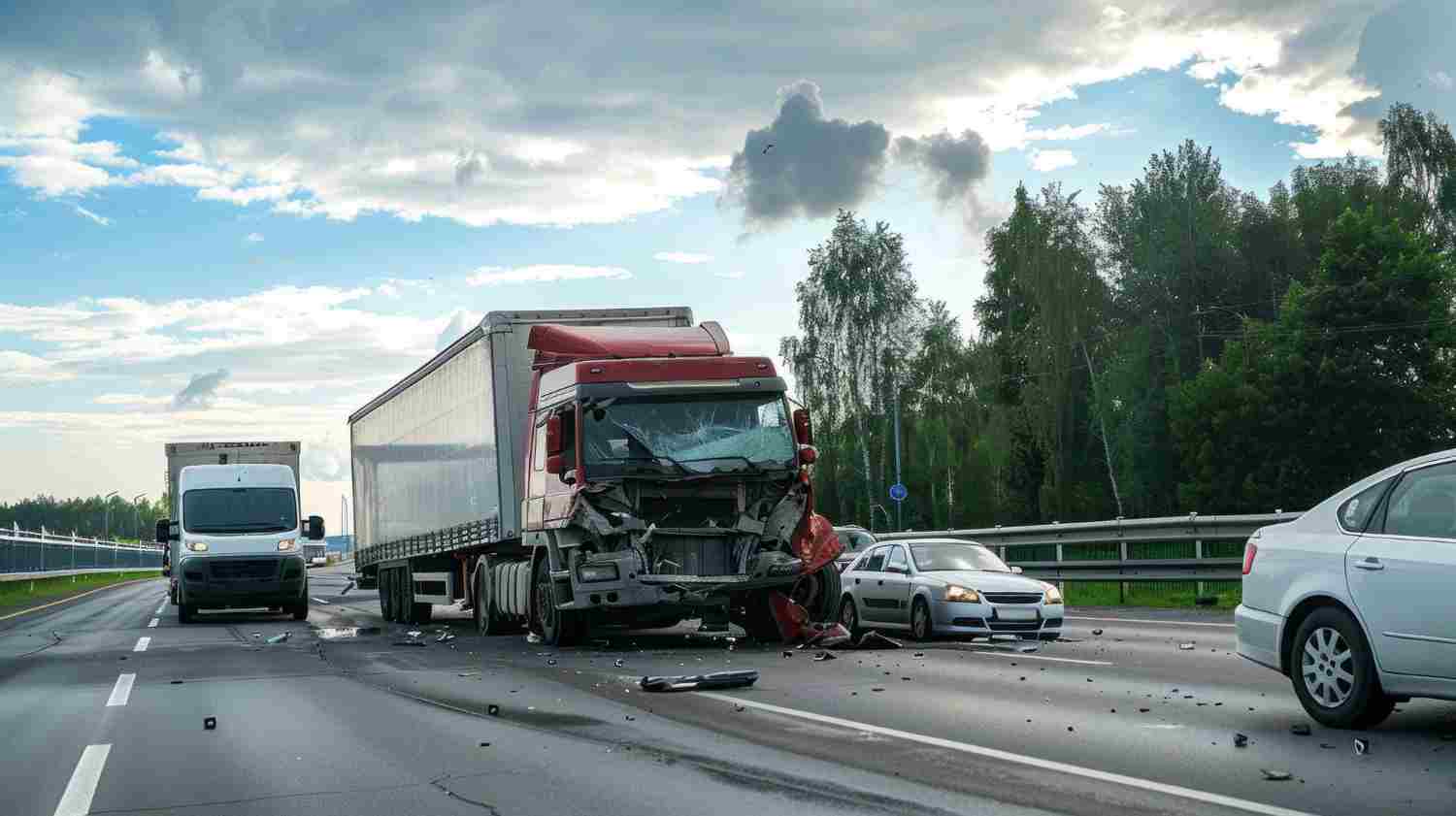
Unlike typical car accidents, truck crashes often involve multiple liable parties with deep pockets and aggressive legal teams. Knowing who can actually be held responsible is what determines whether you recover a fraction of your losses or the full value of your claim.
At Phillips Law Offices, we investigate every truck accident as if there are five defendants instead of one, because there usually are. That’s the difference between a settlement that covers your medical bills and one that covers your future.
Why Truck Accident Liability Is Complex
When two passenger cars collide, liability is usually simple. One driver ran the light, and that driver’s insurance pays.
Truck crashes rarely work that way. A single commercial truck can involve a driver, an employer, an owner, a shipper, a manufacturer, and a broker, and any combination of them might share the blame:
- The truck driver operating the vehicle
- The trucking company (motor carrier) that employs or contracts with the driver
- The truck’s owner (if different from the carrier)
- The cargo shipper or loader
- The truck or parts manufacturer
- Maintenance companies
- Freight brokers who arranged the shipment
Which of these actually owes you money depends on what went wrong and who made the decisions that caused it. That’s the investigation we run before we ever talk settlement.
Truck Driver Liability
The driver is the easiest party to blame, and often the least useful one to sue on their own.
Drivers are personally liable when their own negligence causes a crash, through:
- Speeding or reckless driving – Operating too fast for conditions or traffic
- Distracted driving – Using phones, eating, or programming GPS while driving
- Fatigued driving – Operating while drowsy in violation of Hours of Service rules
- Impaired driving – Driving under the influence of drugs or alcohol
- Failure to perform inspections – Missing required pre-trip safety checks
- Following too closely – Not maintaining safe following distance
- Improper lane changes – Failing to check blind spots before merging
Here’s the problem: most truck drivers do not have the personal assets to cover a catastrophic injury claim. A driver earning wages rarely carries enough insurance or net worth on their own to pay for a spinal injury or a wrongful death.
We name the driver as a defendant. We just do not stop there, because the money that actually pays your claim almost always sits further up the chain.
Trucking Company (Motor Carrier) Liability
The trucking company, called the motor carrier in federal regulations, usually carries the most responsibility and the deepest pockets in a truck accident case.
Motor carriers can be liable under several legal theories, and we typically pursue more than one at the same time.
Respondeat Superior (Vicarious Liability)
Respondeat superior is Latin for “let the master answer.” It is the doctrine that makes an employer responsible for what its employees do within the scope of their job, even when the employer itself did nothing wrong.
If a company driver runs a red light while hauling a scheduled load, the carrier answers for that negligence. Courts generally ask whether the driver was doing company work, following dispatch instructions, and driving company equipment at the time of the crash.
This doctrine has edges. A driver on a purely personal errand, unconnected to any delivery, can fall outside the scope of employment, and that can pull the carrier out of a respondeat superior claim. We pull trip logs and dispatch records early, before the carrier’s lawyers get a chance to build that argument.
Direct Negligence
Separate from respondeat superior, a trucking company can be directly liable for its own decisions:
- Negligent hiring – Failing to properly screen drivers before employment
- Negligent retention – Keeping drivers with known safety issues
- Negligent supervision – Failing to monitor driver compliance with regulations
- Negligent training – Inadequate safety and equipment training
- Negligent maintenance – Failing to properly maintain vehicles
- Negligent dispatch – Pressuring drivers to violate Hours of Service rules
Independent Contractor Issues
Many trucking companies label their drivers as independent contractors specifically because that label sounds like it should end the company’s liability. It does not, at least not automatically.
Courts look past the label to the actual working relationship. If the company controls how the work gets done, it can still be liable regardless of what the contract calls the driver.
The Federal Lease Rule That Can Override the Contractor Label
Federal regulations add another layer to this. Any motor carrier that leases a truck from an owner-operator has to sign a lease that meets the requirements of 49 CFR 376.12(c)(1).
That lease has to give the carrier “exclusive possession, control, and use” of the equipment and require the carrier to “assume complete responsibility for the operation of the equipment.” Courts have read that language to mean the carrier becomes the statutory employer of the driver for liability purposes, regardless of what the paperwork calls the relationship.
How strong that presumption is depends on where the case is filed. Some courts treat it as close to conclusive. Others let a carrier introduce evidence about how the lease actually operated in practice and argue around it. We do not assume this doctrine wins the case on its own, we build the factual record that makes it stick.
We cover this defense, and how carriers try to work around it, in our article on owner-operators and the independent contractor defense in truck cases.
Truck Owner Liability
Sometimes the company operating the truck is not the company that owns it. Trucks get leased, subleased, and shuffled between corporate entities more often than most people expect.
Under the doctrine of negligent entrustment, an owner who hands the keys to a driver it knew, or should have known, was unqualified or unsafe can be held liable when that driver causes a crash.
A prior DUI, a suspended CDL, or a documented pattern of Hours of Service violations are exactly the kind of facts that turn a negligent entrustment theory from a long shot into a real claim.
Cargo Shipper and Loader Liability
Companies that load cargo onto trucks may be liable when improper loading causes accidents:
- Overloading – Exceeding weight limits that affect braking and handling
- Improper weight distribution – Causing rollovers or loss of control
- Inadequate securement – Allowing cargo to shift during transport
- Failing to disclose weight – Providing inaccurate cargo information
A shipper that builds a delivery schedule only workable if the driver skips required rest breaks can share liability for the fatigue crash that follows.
Truck and Parts Manufacturer Liability
When a mechanical defect causes the crash, product liability claims may be brought against:
- Truck manufacturers – For design or manufacturing defects in the vehicle
- Parts manufacturers – For defective brakes, tires, steering components, or other parts
- Trailer manufacturers – For defects in trailer design or construction
Design Defects, Manufacturing Defects, and Failure to Warn
Illinois recognizes strict products liability. That means an injured person does not have to prove the manufacturer was careless, only that the product was unreasonably dangerous when it left the manufacturer’s hands.
That claim usually takes one of three shapes. A design defect means the entire product line was engineered dangerously, a fuel tank prone to rupture in a rear impact, for example. A manufacturing defect means one unit came off the line built wrong, even though the design itself was sound, like a batch of brake pads made with the wrong compound. A failure to warn claim means the product was fine as designed and built, but the manufacturer failed to adequately warn about a known danger, such as a tire rated for a specific speed and load with no clear warning about what happens outside that range.
Brake failures, tire blowouts, steering malfunctions, and inadequate underride guards (the steel bars meant to stop a car from sliding underneath a trailer in a rear-end crash) are the defect claims we see most often. None of them prove themselves. We bring in accident reconstructionists and mechanical engineers early, before the evidence gets repaired, scrapped, or lost.
Maintenance Company Liability
Third-party companies that service trucks may be liable for negligent maintenance:
- Failing to identify worn brake components during inspections
- Improper tire replacement or repairs
- Incomplete mechanical repairs
- Using substandard replacement parts
Freight Broker Liability
Freight brokers do not drive trucks or own them. They match shippers who need freight moved with carriers who move it, for a fee.
That distance from the crash used to make brokers a hard target to sue. The Supreme Court closed that gap in 2026, ruling that negligent-hiring claims against brokers are not shielded by federal preemption. A broker may share liability if it:
- Failed to verify the carrier’s safety record before hiring
- Selected carriers with known safety violations
- Created delivery schedules requiring unsafe driving practices
We cover the full story, including the Supreme Court case that settled it, in our full breakdown of suing a freight broker after a truck crash.
How We Identify All Liable Parties
At Phillips Law Offices, we run the same investigation on every truck case, because skipping a step is how liable parties get missed:
- Obtain the driver’s qualification file – Reveals hiring practices and violation history
- Review Hours of Service records – Shows fatigue violations and dispatch pressure
- Examine maintenance records – Identifies negligent maintenance issues
- Analyze black box data – Documents speed, braking, and mechanical function
- Investigate the trucking company – Reviews safety history and prior violations
- Identify all corporate relationships – Determines which entities bear responsibility
- Engage expert witnesses – Analyzes mechanical issues and accident reconstruction
Why Multiple Defendants Matter
Identifying every liable party increases your potential recovery by:
- Accessing multiple insurance policies
- Preventing gaps in coverage
- Creating pressure for settlement when multiple defendants face liability
- Ensuring you recover even if one defendant has limited assets
How Illinois Divides Fault Between Multiple Defendants
Naming five defendants does not mean five separate paydays split evenly. Illinois has specific rules for dividing fault once percentages get assigned to each defendant.
Under 735 ILCS 5/2-1117, a defendant found less than 25% at fault for your injury only pays its own share of the non-medical damages. That’s called several liability. A defendant found 25% or more at fault can be forced to pay the full judgment on those damages if the other defendants cannot, under joint and several liability.
Your medical expenses work differently, and it is easy to miss this distinction. Under 735 ILCS 5/2-1116, medical costs stay fully recoverable from any defendant regardless of that defendant’s percentage of fault. The 25% threshold only affects damages outside of medical bills, things like lost income and pain and suffering.
In practice, this means the identity of the deepest-pocketed defendant, usually the trucking company or its insurer, matters enormously. If a driver’s $50,000 policy and a carrier’s $2 million policy are both on the table, whichever one crosses that 25% fault line can be made to cover a shortfall left by the other.
That’s a separate question from whether you share any fault yourself. Illinois follows its own modified comparative negligence rule for that, which we break down in our guide to the Illinois 51 percent rule.
For more on what damages may be available, see our overview of pain and suffering damages under Illinois law.
Federal Minimum Insurance Requirements
One reason multiple defendants matter so much is that federal law forces motor carriers to carry real money behind their trucks. Under 49 CFR 387.9, interstate carriers hauling general freight must maintain at least $750,000 in liability coverage. That minimum jumps to $1,000,000 for carriers hauling oil, and up to $5,000,000 for carriers hauling other hazardous materials.
Compare that to Illinois’s minimum auto liability requirement for an ordinary passenger vehicle, which sits at a fraction of that amount. A driver’s personal policy might not cover a fraction of a catastrophic injury. The motor carrier’s federally-mandated policy usually can. That gap is exactly why we chase the carrier’s insurance, not just the driver’s, on every case we take.
How Long You Have to File a Liability Claim
Identifying every liable party does not matter if the claim against them is filed too late. Illinois gives injury victims two years from the date of the crash to file a lawsuit under 735 ILCS 5/13-202. That clock runs the same way whether you are suing the driver, the carrier, the manufacturer, or all three together.
There is one sharp exception worth knowing early. If a government entity is a potential defendant, for example a municipal delivery truck, a CTA vehicle, or a Tollway maintenance truck, Illinois law under 745 ILCS 10/8-101 requires the lawsuit itself to be filed within one year, not two. Waiting to sort out which private companies to name can quietly run out the clock on a government defendant you did not realize was in the mix.
A Hypothetical: How Fault Spreads Across a Single Crash
Here is an illustrative, non-case-specific example of how this plays out. A delivery driver, running behind schedule because dispatch built an unrealistic route, rear-ends a stopped car on I-290. Discovery later shows the truck’s brake pads were replaced eight months earlier by a third-party shop using a substandard part, and the carrier’s own logs show the driver was on hour 12 of a shift with no logged break.
In a case built on those facts, liability could realistically spread across the driver (fatigued driving), the carrier (negligent dispatch, respondeat superior), and the maintenance company (a defective repair). Three separate insurance policies, not one, become available to satisfy a judgment. That is the exact investigation this firm runs before ever discussing settlement value.
Frequently Asked Questions
Can I sue more than one party for the same truck accident?
Yes. Illinois law allows a plaintiff to name multiple defendants in a single lawsuit when the facts support liability against each one, and doing so is standard practice in truck accident cases specifically because of how many parties can be involved.
What if the trucking company blames the driver entirely?
Carriers often try to shift all blame to the driver to limit their own exposure. That is exactly why hiring records, dispatch logs, and maintenance history matter, they can show the carrier’s own decisions contributed to the crash regardless of what the driver did in the moment.
Does it matter if the driver was an independent contractor?
Not automatically. Courts look at the real working relationship and, separately, at whether the carrier’s lease with an owner-operator met the federal control requirements under 49 CFR 376.12(c)(1). Either path can make the carrier answerable even when the driver is technically a contractor.
How soon do I need to identify all liable parties?
As soon as possible. Evidence like black box data, dispatch records, and maintenance logs can be routinely destroyed or overwritten within weeks. Waiting to sort out every defendant risks losing the evidence needed to prove liability against any of them.
What if a government vehicle was involved?
Notify our office immediately. The one-year deadline to file suit under 745 ILCS 10/8-101 is half the standard two-year window, and missing it can bar a claim against that defendant entirely even while claims against private defendants remain open.
Contact Phillips Law Offices for a Comprehensive Investigation
If you’ve been injured in a truck accident, don’t assume the driver is the only responsible party. At Phillips Law Offices, we have the resources and experience to investigate complex trucking cases and identify all liable parties.
Contact us today for a free consultation at (312) 346-4262. We’ll examine your case, identify who’s responsible, and fight to recover maximum compensation from every available source.
Attorney Advertising. This page provides general information about Illinois law and is not legal advice. Reading it does not create an attorney-client relationship. Deadlines and outcomes depend on the specific facts of your case, speak to a licensed Illinois attorney about your situation. Prior results do not guarantee a similar outcome; every case is decided on its own facts.
Leave a Reply