Tag: truck accident injuries

  • Cement Mixer and Concrete Truck Accidents on Chicago Roads

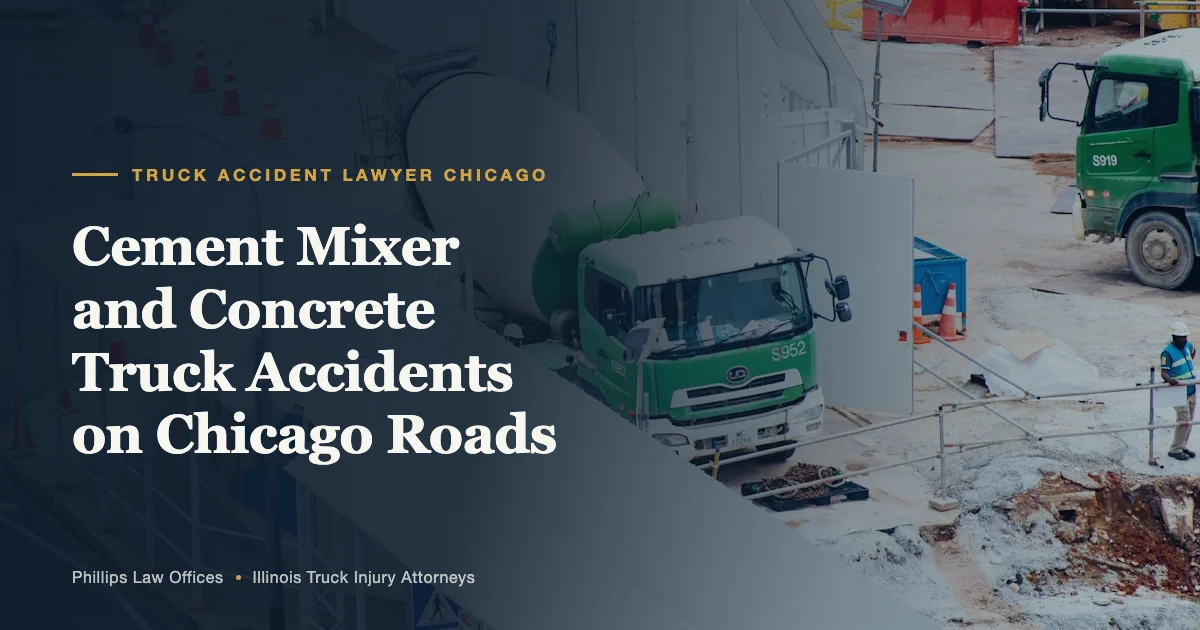
    Cement Mixer and Concrete Truck Accidents on Chicago Roads

    A cement truck accident claim is rarely straightforward. Ready-mix concrete trucks are among the heaviest commercial vehicles on Chicago roads, and when one strikes another vehicle, the consequences can be catastrophic. Under 49 CFR 390.5, ready-mix concrete trucks with a gross vehicle weight rating of 10,001 pounds or more are classified as commercial motor vehicles (CMVs), which means the full weight of federal trucking regulations applies to every aspect of their operation.

    This article provides general legal information; consult a licensed Illinois attorney for advice specific to your situation.

    Why Cement Trucks Are Especially Dangerous on Public Roads

    A fully loaded ready-mix concrete truck can weigh 60,000 pounds or more. That weight is not static, the rotating drum that keeps the concrete mixed continuously shifts the vehicle center of gravity. FMCSA and NHTSA rollover research has documented that the combination of a high center of gravity and a moving internal load creates rollover dynamics that differ significantly from a standard flatbed or tanker truck. A driver who enters a highway ramp or a sweeping urban turn at a speed that would be safe in an ordinary truck may trigger a rollover in a ready-mix vehicle. These physics do not forgive driver error.

    Stopping distance is a related concern. At highway speeds, a loaded cement truck traveling at 65 mph needs considerably more distance to stop than a passenger car. Traffic signal changes and sudden lane merges that a car driver handles without incident can become emergencies for a cement truck driver who is already managing a shifting load.

    Public Road Crashes vs. Construction Site Accidents

    This article covers collisions that happen on public roads: expressways, city streets, intersections, and loading areas adjacent to public right-of-way. If you were struck by a cement truck while driving, riding, cycling, or walking on a public street, your claim is the kind of case Phillips Law Offices handles.

    On-site pours and construction site vehicle strikes, situations where the accident happens entirely within a private job site, raise different legal questions, including workers compensation and premises liability, that are handled through different practice areas. If you are unsure whether your accident happened on a public road or a controlled construction site, an attorney can help you draw that line.

    Weight Limits and the Axle-Load Problem

    625 ILCS 5/15-111 sets Illinois axle weight limits for vehicles operating on public roads. Fully loaded concrete trucks frequently approach or exceed those limits, particularly on routes that include older streets or bridges not rated for maximum commercial loads. When a truck is overweight, it becomes harder to stop, causes accelerated road surface damage that can affect traction, and is itself evidence of a compliance failure that a plaintiff attorney can use to establish negligence.

    Carriers have an obligation under 49 CFR Part 396 to maintain inspection and maintenance records. If a truck was overloaded or its drum mechanism, braking system, or tires were not properly maintained, those records, or the absence of them, become critical evidence in a civil case.

    Who May Be Liable in a Cement Truck Crash

    Understanding truck accident liability in Chicago requires looking beyond the driver to the full chain of commercial relationships that put the truck on the road. In a ready-mix concrete accident, potentially liable parties typically include:

    • The ready-mix company: As the motor carrier, it bears responsibility for driver qualification, hours-of-service compliance, vehicle maintenance, and load management under FMCSA regulations.
    • The general contractor: If a contractor directed the delivery schedule, the route, or the loading process, and those decisions contributed to the crash, the contractor may share liability under Illinois law.
    • An equipment broker or lessor: If the truck or drum mechanism was leased and the lessor retained maintenance responsibility, a defect in the equipment can create a separate claim against the broker or leasing company.

    Municipal Contracts and the Tort Immunity Act

    One complication that appears more often in cement truck cases than in ordinary commercial vehicle cases is the involvement of public works projects. When a ready-mix company is operating under a municipal contract, delivering concrete for a city street repair, a bridge project, or a public building, the 745 ILCS 10 Tort Immunity Act may come into play. The Act limits or immunizes certain governmental entities from claims, and its application can affect how a case is structured, who the proper defendants are, and what notice requirements apply.

    This does not mean an injured person has no claim. Private contractors operating under municipal contracts generally do not share the government immunity. But the analysis is fact-specific, and getting it wrong early in a case can result in critical filing deadlines being missed.

    Evidence to Preserve After a Cement Truck Crash

    Ready-mix companies are required under 49 CFR Part 396 to keep inspection and maintenance records. Dispatch logs, delivery manifests, and load tickets showing the volume and weight of concrete carried are also important. Electronic control module data from the truck can show speed, braking, and throttle input in the moments before impact. Drum rotation logs, where available, can establish whether the load was within specification. Illinois courts treat spoliation of evidence as a serious matter. Preserving critical evidence early, starting with a prompt legal hold letter, can keep this documentation from being destroyed on a normal business retention schedule.

    Talk to a Chicago Attorney – Free Consultation

    Phillips Law Offices handles cement mixer and concrete truck accident claims throughout the Chicago area. If you were injured in a crash involving a ready-mix vehicle on a public road, call (312) 346-4262 or visit our free consultation page to schedule a free consultation. Attorney review of the facts of your case is the first step. No fees unless we recover for you.

  • Dump Truck Accidents on Chicago Streets

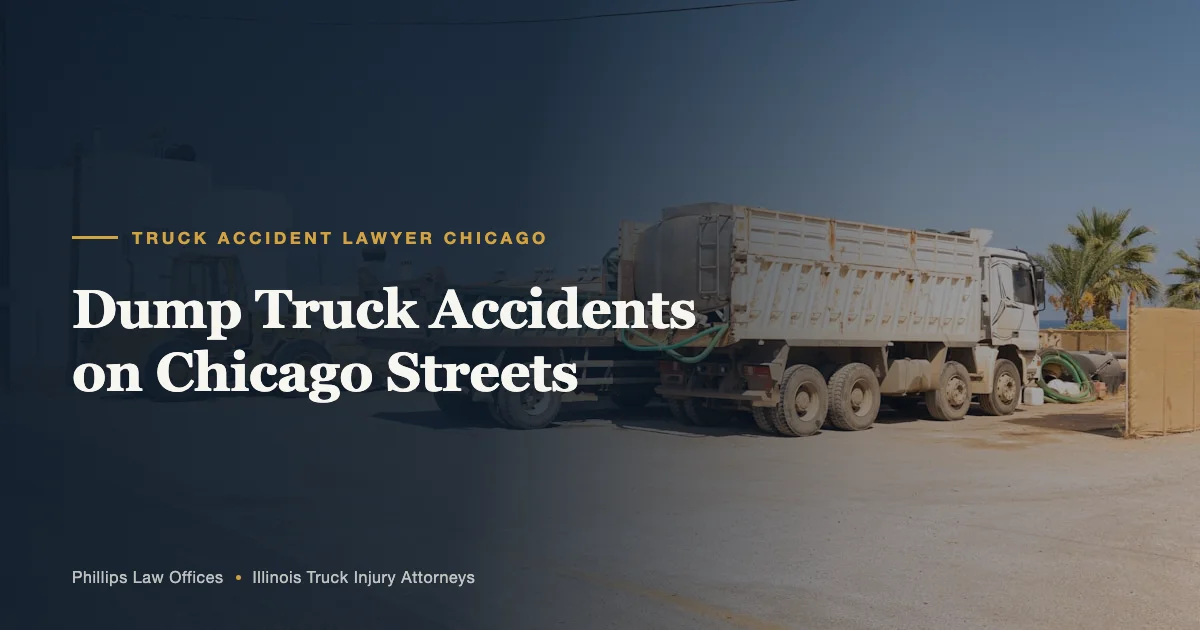
    Dump Truck Accidents on Chicago Streets

    Dump trucks travel Chicago streets every day, hauling construction debris, dirt, aggregate, and demolition waste. When one of those trucks causes a crash on a public road, the liability picture looks different from a typical semi-truck accident. If you were hurt in a dump truck accident, understanding who controls the truck, what the truck was carrying, and what law governs the situation is the starting point for any Illinois dump truck accident claim.

    This article provides general legal information; consult a licensed Illinois attorney for advice specific to your situation.

    An Important Boundary: Public Roads vs. Construction Sites

    This article focuses on dump truck crashes that happen on public roads in Chicago. That includes crashes at intersections, on expressways, on city streets during transport to or from a job site, and in residential areas. Accidents that happen entirely inside a construction site, where a dump truck strikes a worker or another vehicle within the fenced or controlled work zone, fall under different legal frameworks, including workers’ compensation and construction site liability law. If your crash happened on a public street or while the dump truck was in transit on public roads, this article applies to your situation.

    Weight Limits and Overloaded Trucks

    625 ILCS 5/15-111 sets Illinois weight limits for vehicles on public roads, covering both individual axle weights and gross vehicle weight. These limits exist to protect road surfaces and bridges, and to ensure that vehicles remain controllable. Dump trucks are among the commercial vehicles most frequently found operating overweight, a loaded truck carrying more material than its legal limit is harder to stop, puts more stress on axles and tires, and creates greater risk of catastrophic brake failure or rollover.

    When a dump truck crash involves an overloaded vehicle, the violation of 625 ILCS 5/15-111 becomes part of the liability analysis. Under Illinois law following Kalata v. Anheuser-Busch Companies, Inc., 144 Ill. 2d 425 (1991), a statutory violation is evidence of negligence where the plaintiff is within the class the statute was designed to protect. Other drivers on the road are exactly the class that weight limits protect, overloaded trucks pose a direct danger to everyone sharing the road with them.

    Load Securement and Falling Debris

    A separate category of dump truck crash involves loose material falling from the truck’s bed while it is in motion. Gravel, chunks of concrete, asphalt, and demolition debris can come off an unsecured or improperly covered load and strike following vehicles. Under 49 CFR 393.100, federal load securement requirements apply to the transportation of loose materials, including requirements that loads be contained or covered to prevent material from escaping the vehicle.

    When falling debris causes a crash or injury, the question is whether the load was properly secured or covered at the time of the incident. The condition of the tailgate, the presence or absence of a tarp, and whether the truck was overfilled are all relevant. Physical evidence from the scene, witness accounts, and inspection of the truck itself can establish whether the securement requirements were met.

    Who Can Be Liable for a Dump Truck Crash

    Dump truck accidents often involve more than one potential defendant. Working through the liability map requires understanding who controlled the truck and what contract or relationship put it on the road. For background on truck accident liability in Chicago, the same multi-party analysis that applies to semi-trucks generally applies to dump trucks as well, with some additional considerations.

    The hauler is the company or individual that owns and operates the dump truck. The hauler is responsible for the truck’s maintenance, the driver’s conduct, and compliance with weight and securement laws. If the hauler is an independent owner-operator, that relationship affects how liability flows.

    The general contractor on a construction project often hires or directs dump trucks to and from job sites. If the general contractor specified the load, directed the driver, or controlled how the truck was loaded, the contractor may share liability for what went wrong.

    Freight brokers and dispatch intermediaries who arrange dump truck transportation without directly employing the driver have faced increasing scrutiny in Illinois courts. Where the broker exercised control over how the haul was conducted, not just whether it was completed, courts have found grounds for broker liability.

    Municipal or government contractors present a more complex picture. If the dump truck was working under a city or government contract at the time of the crash, the Tort Immunity Act (745 ILCS 10) may provide the contractor or the municipality with immunity for certain acts. Government contractor immunity is not absolute, willful and wanton conduct falls outside the immunity, and the specific facts of the contract and the alleged conduct determine whether immunity applies. Cases involving municipal contract work require a close analysis of the contract terms and the specific conduct alleged before drawing conclusions about immunity.

    What to Do After a Dump Truck Crash in Chicago

    The steps after a dump truck crash are similar to any commercial truck accident, but with some additional preservation priorities. If the truck was overloaded, that evidence can disappear quickly, the load may be redistributed or the truck may be back in service before anyone investigates. An attorney who handles commercial vehicle cases can send preservation letters to the trucking company, request inspection records, and issue litigation holds on electronic data including weigh tickets, dispatch records, and GPS logs.

    Weigh tickets from the dump site and delivery site can establish what the truck was carrying and whether it exceeded legal weight limits at the time of the crash. Those tickets are standard operating records in the hauling industry and can be requested in discovery.

    Talk to a Chicago Attorney, Free Consultation

    If you were hurt in a dump truck crash on a Chicago street, Phillips Law Offices is available to review your case at no charge. Call us at (312) 346-4262 or visit our free consultation page to get started. We handle dump truck and commercial vehicle accident claims throughout the Chicago area, and there is no fee unless we recover compensation for you. Attorney review is recommended before you communicate with the trucking company, contractor, or their insurers.

  • Questions to Ask a Truck Accident Lawyer at Your Free Consultation

    Questions to Ask a Truck Accident Lawyer at Your Free Consultation

    Choosing who handles your truck accident case is one of the most consequential decisions you will make. Not every personal injury lawyer has the knowledge base required for commercial vehicle cases, and a free consultation is your opportunity to find out whether a firm does. Knowing the right questions to ask a truck accident attorney, including questions that could disqualify a firm, is what separates an informed choice from a costly mistake.

    This article provides general legal information; consult a licensed Illinois attorney for advice specific to your situation.

    Why Truck Cases Require Specific Experience

    Truck accident cases involve a regulatory framework that does not apply to ordinary car accidents. Federal Motor Carrier Safety Administration rules govern hours of service, drug and alcohol testing, maintenance recordkeeping, driver qualification, and cargo loading. Building a strong truck accident case often depends on understanding which FMCSA regulations apply, how to obtain records carriers are required to keep, and how to read those records once you have them.

    Illinois Rules of Professional Conduct 1.4 requires attorneys to keep clients reasonably informed about their case. Rule 1.5 governs fee agreements. At your consultation, you are entitled to clear answers on both. An attorney who cannot explain their fee structure in plain language, or who deflects specific questions about their experience, is giving you useful information about how they will handle your case.

    Questions That Can Disqualify a Firm

    These are not hostile questions. They are appropriate due diligence for a case that may take years and involve complex expert testimony. Any attorney who balks at them is not the right fit for a commercial vehicle case.

    Have you handled cases involving FMCSA-regulated carriers? General personal injury experience is not the same as trucking litigation experience. Ask specifically whether the attorney has handled cases where Part 382 (drug and alcohol testing) or Part 395 (hours of service) records were at issue in discovery. If the answer is vague or qualified, press for specifics.

    Can you issue a preservation letter to the carrier today? Electronic logging device data, driver qualification files, vehicle inspection records, and dashcam footage are all subject to destruction, either through routine overwriting or intentional spoliation. A firm that cannot send a preservation demand immediately is not positioned to handle a trucking case. This question reveals whether the firm has systems in place for the time-sensitive opening phase of these cases.

    Who pays for accident reconstruction and expert witnesses? Truck accident cases often require accident reconstruction experts, medical experts, and sometimes former FMCSA safety officials. These experts cost money, sometimes significant money. Understand whether the firm advances these costs, how they are handled if the case does not settle, and whether cost advances affect the fee arrangement under the contingency agreement.

    What is your trial record specifically in commercial vehicle cases? Settlement rates and verdicts from car accident cases tell you very little about how a firm performs in trucking litigation. Ask whether the attorney has taken a commercial vehicle case to verdict, and what the outcome was. An attorney who has never tried a truck case is disadvantaged in negotiations, because defense counsel knows there is no credible trial threat behind the demand.

    Questions About the Specific Facts of Your Case

    Beyond evaluating the firm, the consultation is an opportunity to get preliminary analysis of your facts. Ask the attorney directly: based on what you have heard, who are the likely defendants? The answer should go beyond the driver, a knowledgeable attorney will identify the motor carrier, potentially a freight broker, possibly a shipper, and ask about vehicle maintenance history before answering.

    Ask what evidence is most at risk of disappearing and what steps need to happen in the first 48 hours. Ask what the statute of limitations is for your specific claim, in Illinois, the general personal injury limitations period is two years, but the clock, the defendants, and any notice requirements may vary depending on the facts. Ask whether any government entity (a city, county, or municipality) may be involved, which carries different notice requirements under Illinois law.

    Fee Agreement Questions

    Under Illinois Rules of Professional Conduct 1.5, fee agreements in contingency cases must be in writing and must explain how the percentage is calculated, whether it changes if the case goes to trial, and whether it is calculated before or after costs are deducted. Ask for the written fee agreement before the consultation ends, and read it. Ask specifically what happens to advanced costs if the case does not result in recovery.

    A firm that resists putting fee terms in writing at the consultation stage, or whose written agreement does not match what was said verbally, is a firm to be cautious about. Clarity on fees at the outset is a basic professional obligation under Rule 1.5, not a favor to the client.

    What to Bring to the Consultation

    Bring the police report if you have it, contact information for any witnesses, photos from the scene, medical records and bills you have received so far, and any communications you have had with the carrier’s insurer. If you have received any written correspondence from a trucking company rapid response team, investigators who often arrive at the scene before families have retained counsel, bring that as well. Do not sign anything from the carrier or its insurer before speaking with an attorney.

    The Chicago truck accident lawyers at Phillips Law Offices handle FMCSA-regulated carrier cases and can address every question on this list at your initial consultation.

    Talk to a Chicago Attorney, Free Consultation

    Phillips Law Offices represents truck accident victims in Chicago and throughout Illinois. If you have questions about a crash involving a commercial carrier, call (312) 346-4262 or visit our free consultation page to schedule a free consultation. There is no cost and no obligation.

  • Hospital Liens and Your Truck Accident Settlement in Illinois

    When you settle a truck accident case in Illinois, you do not walk away with the full number in the settlement letter. Hospitals, doctors, Medicare, and Medicaid can all stake a claim on that money before it reaches you.

    We have seen clients open a check they were counting on to solve real problems, only to find a third of it already gone to liens nobody told them to watch for. That gap between the settlement number and the number you actually keep is where this gets serious.

    Three separate lien systems can apply to a single truck accident case in Illinois: a state law covering hospitals and providers, a federal Medicare reimbursement rule, and a separate Illinois Medicaid lien. Each one works differently. Missing one can cost you later.

    This article offers general legal information. For advice specific to your situation, talk to a licensed Illinois attorney.

    Illinois Health Care Services Lien Act: 770 ILCS 23

    Illinois hospitals and medical providers collect from your settlement under one specific law: the Health Care Services Lien Act, 770 ILCS 23. Any hospital, physician, dentist, or other licensed health care provider that treated you after the crash can assert a lien against your settlement, judgment, or award.

    That lien attaches automatically. You do not sign anything to create it.

    Here is the part most people misunderstand. The Act caps all health care liens combined at 40 percent of your gross settlement or judgment.

    Not 40 percent per provider. Forty percent total, shared among every hospital, physician, and specialist who treated you.

    If three different providers billed you, they are not each entitled to 40 percent. They are splitting one 40 percent pool.

    Hypothetical example (for illustration only): Say your truck accident case settles for $100,000. Under the Act, every health care provider combined can claim at most $40,000, even if their bills add up to $90,000. This is a hypothetical only. Your case will depend on its own facts, its own settlement amount, and which liens actually apply to it.

    A lien only holds up if the provider did the paperwork right. The provider has to serve written notice on you, on your attorney, and on every defendant and insurer in the case.

    Skip that step, and the lien can fail entirely. We track every lien notice that comes in on a case and check that each one was served the way the law requires. Providers miss this more often than you would expect.

    The Act also builds in a reduction for shared fault. If you bear some percentage of blame for the crash, and your recovery is reduced because of it, the lien amount gets reduced along with it.

    Medicare Secondary Payer Act: 42 U.S.C. § 1395y(b)(2)

    If you are on Medicare, a different set of rules kicks in entirely. This one runs on federal law, not Illinois law, and it does not care about the 40 percent cap above.

    Under the Medicare Secondary Payer Act, 42 U.S.C. § 1395y(b)(2), Medicare is what the statute calls a “secondary payer.” When someone else, like the truck accident defendant’s insurer, is legally responsible for your medical bills, Medicare is not supposed to be the one footing them.

    In practice, Medicare often pays anyway, as what is called a conditional payment, so your treatment does not get held up while liability gets sorted out. That payment is conditional because Medicare expects it back once you settle.

    The agency that tracks these payments is the Benefits Coordination and Recovery Center, known as the BCRC. Before any settlement closes, your attorney has to contact the BCRC directly, get a conditional payment amount, and wait for a final demand.

    Here is where it gets uncomfortable. Failing to reimburse Medicare does not just create a debt. It can expose you and your attorney to double-damage liability under federal law.

    And this obligation stands apart from the 40 percent state cap described above. Medicare’s claim is a federal one. The Health Care Services Lien Act limit does not touch it.

    Resolving a Medicare lien usually means negotiating the conditional payment amount down, especially when the available insurance coverage cannot stretch to cover everything. That negotiation takes real time. It has to be built into your settlement timeline from the start, not tacked on at the end.

    Because this involves truck accident insurance and compensation at the federal level, it takes close, ongoing coordination between your attorney and the BCRC to resolve cleanly.

    Illinois Medicaid Lien: 305 ILCS 5/11-22

    There is a third lien to watch for. If the Illinois Department of Healthcare and Family Services, which runs Medicaid, paid for any part of your treatment, it has its own statutory right to reimbursement under 305 ILCS 5/11-22.

    This lien attaches to any tort settlement or recovery you receive. It is not the same obligation as the private provider liens under 770 ILCS 23, and it does not share that 40 percent pool. It is a separate statutory claim, and the Department has to receive specific notice before your settlement can close.

    Medicaid lien amounts can sometimes be negotiated down, particularly when the settlement is not enough to cover everything you lost. We reach out to the Department early, get a current lien figure, and find out whether a compromise is realistically on the table. Waiting until the end of a case to ask is how people get stuck with a number nobody can move.

    How Lien Negotiation Affects Your Net Recovery

    Put these three systems together, state provider liens capped at 40 percent, federal Medicare reimbursement, and the separate Medicaid obligation, and you can see why the settlement figure by itself tells you almost nothing about what actually lands in your account.

    The settlement is only half the negotiation. The liens are the other half, and they get negotiated too.

    Most health care providers will accept a reduced lien amount if that is what it takes to let the case settle within the insurance limits available. They would rather take less than take nothing from a case that never resolves.

    Medicare works differently but moves in the same direction. It applies a formula that accounts for procurement costs, meaning your attorney fees and litigation expenses, and that formula can bring the reimbursement number down.

    Get this wrong, or miss a lien entirely, and the consequences tend to show up at the worst possible time. A surprise deduction at closing. Personal liability that follows you after the case is over. Malpractice exposure for the attorney who missed it.

    Sit with that for a second. This is not something you want to discover after the money is already gone. It is one of the few parts of a truck accident case where legal representation is not simply helpful. It is what protects the number you actually get to keep.

    Talk to a Chicago Attorney: Free Consultation

    Lien resolution in a truck accident case is detailed work, and the consequences of getting it wrong land on your recovery, not ours. We handle hospital lien negotiations, Medicare coordination, and Medicaid compliance as part of representing truck accident victims across the Chicago area.

    We work on contingency. No fees unless you recover.

    Call (312) 346-4262 or visit our contact page to speak with a Chicago truck accident attorney at no charge.

  • Hit by Falling Cargo or Truck Debris on the Highway

    When cargo falls off a truck and hits your vehicle, figuring out who’s responsible isn’t simple. The driver, the trucking company, and sometimes the business that loaded the truck can all share the blame. If you were hit by falling debris or cargo on an Illinois highway, federal safety rules and state law give you a real framework for figuring out who dropped the ball.

    This article is general legal information, not a substitute for advice from a licensed Illinois attorney about your specific situation.

    Federal Cargo Securement Standards: 49 CFR Part 393, Subpart I

    The Federal Motor Carrier Safety Administration spells out exactly how cargo has to be secured. The rules live in 49 CFR Part 393, Subpart I, sections 393.100 through 393.136, and the baseline requirement is simple: cargo has to be immobilized so it can’t shift, fall, or blow off the vehicle.

    From there the rules get specific. Section 393.106 dictates how many tie-downs a load needs and where they go, based on weight and length. Section 393.102 requires that every tie-down assembly actually be in good working order, not just present. And there are separate securement methods spelled out for specific cargo types: logs (§ 393.116), metal coils (§ 393.120), intermodal containers (§ 393.124), flatbed loads, and dozens more.

    Here’s why that level of detail matters. When a regulation lays out this much specificity, a violation isn’t just carelessness. It’s a documented failure to follow a rule written for exactly this situation.

    Drivers have inspection duties too, under § 393.100(b). Before the trip starts, and again within the first 50 miles, the driver has to check the cargo and the securement devices. Then it’s every three hours or 150 miles after that, whichever comes first. If a tie-down fails or the load shifts, the driver is supposed to stop and fix it before going any further.

    We’ve seen cases where a carrier pressured a driver to skip these checks or keep driving with a load that was clearly shifting. That’s not just the driver’s problem anymore. Once a company leans on someone to cut corners on safety, it’s taken on liability of its own.

    Illinois Law: 625 ILCS 5/15-109

    Illinois has its own rule on top of the federal one. Under 625 ILCS 5/15-109, a vehicle cannot be driven on a public highway unless its load is fastened securely enough that nothing falls, blows loose, or otherwise escapes onto the road. That responsibility falls on both the driver and whoever operates the vehicle.

    This statute matters in more than theory. If we can show a defendant violated it, that violation is relevant evidence of negligence in a civil case. It helps establish that the defendant breached a duty owed to you and everyone else on the road.

    Three Potential Defendants in a Falling Cargo Case

    Falling cargo cases usually involve three distinct parties, and figuring out what each one did wrong is how you build a complete claim.

    One note on scope. This is about securement failures and falling debris, not overload violations or axle weight issues. Those involve a different set of rules entirely.

    The Driver. The driver is on the hook for pre-trip and en-route cargo inspections under 49 CFR § 393.100(b). Skip those inspections, notice shifting cargo and keep driving anyway, or re-secure a load poorly after a stop, and that’s personal negligence. In Illinois, a driver operating with an unsecured load is also violating 625 ILCS 5/15-109, a separate statutory duty.

    The Carrier. The trucking company has its own obligations, separate from the driver’s. It has to train drivers on cargo securement, keep securement equipment in working order, and run real inspection protocols, not just a policy that exists on paper.

    We’ve seen carriers that never audited how drivers actually secured loads, ignored reports of damaged tie-down equipment, or built routes so tight that drivers had no real time for required stops. Every one of those is a decision that made a cargo failure more likely.

    Carriers can also be held liable for what their drivers do, under a legal doctrine called respondeat superior, which holds an employer responsible for an employee’s negligence committed on the job.

    The Shipper. Sometimes the driver never loaded the truck at all. A separate business, the shipper, loaded and sealed it before the driver ever saw it.

    That raises a real question: who’s responsible if the loading itself was defective? Courts have addressed this through what’s called the shipper-loading doctrine. The idea is that a carrier’s liability can be limited when the shipper loads and seals a trailer without giving the carrier any real chance to inspect it.

    That protection has limits, though. It doesn’t cover a carrier that knowingly accepted a trailer it knew was loaded wrong. And Illinois courts still ask whether the driver should have caught the problem during a normal inspection, shipper-loaded or not.

    How Truck Accident Liability Works in These Cases

    If you were hurt by falling cargo, you’re not limited to picking one defendant. You can pursue truck accident liability claims against the driver, the carrier, and the shipper at the same time, if the facts support it.

    Illinois follows what’s called modified comparative fault, under 735 ILCS 5/2-1116. In plain terms: you can still recover as long as your share of the blame is under 51 percent, and whatever you recover gets reduced by your percentage of fault.

    Sit with that for a second, because it matters here specifically. If you were just driving behind a truck when its cargo came loose, your share of fault is usually zero. This isn’t a case where the defense has much room to point back at you.

    Evidence collection can’t wait. Cargo securement records, pre-trip inspection logs, bills of lading, and loading instructions are the documents that prove what actually happened.

    Here’s where it gets uncomfortable. Carriers and shippers aren’t required to hold onto these records forever, and once they’re gone, they’re gone. A preservation letter sent soon after the crash puts them on notice not to destroy anything relevant, before that becomes a problem.

    Injuries Caused by Falling Debris

    Falling cargo and road debris don’t cause one kind of injury. They cause several, and none of them are minor.

    A windshield impact can cause serious head and eye injuries. Swerving hard to avoid debris in your lane causes rollovers and multi-vehicle pileups. Debris lodged under a vehicle can take away your control of the car entirely, at highway speed.

    We’ve seen victims face months of recovery: surgery, physical therapy, time away from work they can’t get back. Illinois law lets you recover for all of it, including medical costs, lost income, and pain and suffering.

    Talk to a Chicago Attorney for a Free Consultation

    Falling cargo cases move fast, and so does the evidence that proves them. Preserving inspection records and identifying every responsible party is work that has to happen early, before the trail goes cold.

    We investigate commercial truck crashes throughout the Chicago area, and we take these cases on contingency. You don’t pay us unless we win.

    Call (312) 346-4262 or visit our contact page to schedule a free consultation today.

  • Wide Right Turn Truck Accidents in Chicago

    Wide Right Turn Truck Accidents in Chicago

    A wide right turn crash is one of the most predictable collisions on Chicago’s freight corridors. It’s also one of the most preventable. Yet it keeps injuring cyclists, pedestrians, and passenger vehicle occupants at intersections across the city.

    We’ve handled these cases. Understanding how the crash happens, what Illinois law requires of a truck driver at an intersection, and who ends up liable makes a real difference if you or someone you love was hurt in one.

    This article provides general legal information; consult a licensed Illinois attorney for advice specific to your situation.

    How the Squeeze-Play Crash Happens

    A loaded semi-truck can’t turn right the way your car does. The trailer’s rear wheels don’t follow the same path as the front of the cab. They track inward, cutting the corner. To keep the trailer from riding up over the curb, the driver has to swing the cab left first, before turning right.

    That maneuver opens a gap between the right side of the cab and the curb, or the bike lane. It looks like open road. It isn’t.

    Here’s how it usually unfolds. The truck approaches the intersection positioned in the through lane, sometimes even left of center. A cyclist, a motorcyclist, or a driver in a compact car sees that open space to the right and moves into it, assuming the truck is going straight or changing lanes. Then the truck swings right. The trailer’s rear wheels pivot toward the curb, and whoever is in that gap gets caught between the trailer and the curb, a parked car, or the corner of the intersection itself.

    Crash investigators have a name for this: the squeeze play, or the right hook. It is consistently one of the deadliest intersection crashes involving large trucks.

    We see this pattern most on Chicago’s freight-corridor intersections, especially along established truck routes on the Near West Side, the South Side, and the industrial corridors feeding the expressway system.

    What Illinois Law Requires of Truck Drivers at Right Turns

    Illinois law is specific about how a right turn is supposed to happen. Under 625 ILCS 5/11-801, a driver making a right turn must approach the intersection in the far-right lane and complete the turn as close as practicable to the right-hand curb or edge of the roadway.

    That requirement applies to every vehicle on the road, including an 80,000-pound truck. Swinging left before turning right doesn’t hand a truck driver a free pass to occupy another lane without warning. The physics of the trailer explain why the swing happens. They don’t excuse what happens next.

    Commercial driver training standards build on this. A driver is allowed to swing wide to make the turn, but that swing comes with a duty: continuous yielding to any traffic lawfully positioned to the driver’s right during the maneuver. Swinging wide doesn’t give the truck a claim on that space. It creates a heightened duty to watch for what’s already there.

    A separate provision of the Illinois Vehicle Code covers the duty to yield to cyclists and pedestrians in the path of a turning vehicle. A driver turning at an intersection must yield to a pedestrian lawfully in a crosswalk, and to a cyclist lawfully in a bike lane or on the roadway. That statute matters most in exactly the crash we’re describing here: a cyclist caught in the squeeze gap.

    Who Is Liable in a Wide-Turn Truck Crash?

    Liability rarely rests with one party. A driver who doesn’t check mirrors, doesn’t signal early enough, or fails to yield to a cyclist lawfully positioned to the right carries direct fault under the statutes above. But the analysis doesn’t stop at the driver.

    The trucking company can be liable too, under a legal doctrine called respondeat superior. In plain terms, an employer answers for the negligent acts of an employee acting within the scope of the job. Beyond that vicarious liability, the carrier can carry its own independent fault. Maybe it never trained the driver on proper wide-turn technique. Maybe it sent the driver down an unfamiliar route through tight urban intersections with no guidance. Maybe it dispatched an oversized load without a route survey. We look at the carrier’s training and dispatch systems, not just the driver’s actions behind the wheel, when we build a truck accident liability case.

    A municipality can also carry partial responsibility, if a traffic signal phase, an intersection’s geometry, or signage failed to account for known truck-turning constraints at that location. Municipal liability under Illinois law comes with its own procedural hurdles under the Local Governmental and Governmental Employees Tort Immunity Act, including a filing deadline far shorter than the standard two years. An attorney can tell you exactly what that Act requires for a claim against a city.

    Evidence That Matters in Wide-Turn Cases

    Reconstructing a squeeze-play crash means moving fast on evidence. Here’s what we look for: the truck’s onboard event data recorder, or “black box,” which captures speed, braking, and steering input in the seconds before impact. Dashcam footage, from the truck’s own cab or a nearby intersection camera. The driver’s daily logs and dispatch records, showing the route assignment and the schedule pressure the driver was under. Inspection and maintenance records for mirrors and turn signals. And physical evidence at the scene: tire marks, gouge patterns, where everything came to rest.

    Truck event data can get overwritten fast, and physical evidence degrades by the day. That’s why acting early matters. We can send a litigation hold letter to the carrier within days of the crash, demanding that every electronic and paper record be preserved before routine deletion wipes it out.

    Talk to a Chicago Truck Accident Attorney

    If you or someone you love was injured in a wide right-turn truck accident in Chicago or anywhere in Illinois, the investigation is going to involve multiple parties, more than one regulatory standard, and evidence that doesn’t wait around. Phillips Law Offices handles truck accident cases throughout the Chicago area, and a consultation costs you nothing.

    Call (312) 346-4262 or visit our contact page to speak with a truck accident attorney today. No fee unless we recover for you.

  • Rear-Ended by a Semi: Why These Claims Are Not Like Car Cases

    If a semi-truck rear-ended you, your first instinct might be to treat it like any other car crash. Don’t.

    A semi rear-end collision runs through a completely different legal and regulatory framework than two passenger cars trading paint. The truck driver and the company that employs them answer to federal oversight, specific maintenance duties, and layers of commercial liability that never enter the picture when one car hits another.

    This article is general legal information. Talk to a licensed Illinois attorney about the specifics of your situation.

    Why Physics Makes Semi Rear-End Crashes So Dangerous

    The Federal Motor Carrier Safety Administration publishes stopping-distance data, and it tells you why these crashes are so violent.

    At 65 mph, a fully loaded 80,000-pound semi needs roughly 40 percent more room to stop than a passenger car going the same speed. A car can usually stop in about 316 feet under those conditions. A loaded truck needs closer to 525 feet.

    That extra 200-plus feet is not a technicality. It is the difference between a driver who has time to react and one who does not.

    When the truck driver is following too closely, distracted, speeding, or running on worn brakes, that gap closes in seconds. What is left is catastrophic.

    Illinois law accounts for this. Under 625 ILCS 5/11-710, a driver cannot follow another vehicle more closely than is reasonable and prudent, given the speed of traffic, road conditions, and the size of the vehicles involved.

    That last part matters. A semi is not a sedan, and the statute’s own language, factoring in vehicle size, gives courts room to hold commercial drivers to a tighter standard. A following distance that would be fine for two cars can be reckless for a truck that needs far more room to stop.

    Federal Brake Regulations Are Central to Every Semi Rear-End Case

    One of the biggest differences in a semi rear-end claim comes down to brakes. Under 49 CFR Part 396, commercial carriers must systematically inspect, repair, and maintain every part of the vehicle, brake systems included, in safe operating condition.

    That is not a vague duty of care. It is a specific, documented, federally mandated obligation, and carriers have to keep the paperwork proving they met it.

    Those inspection and maintenance records become critical evidence the moment a truck’s brakes contribute to a crash. We have seen cases turn on a single missed inspection entry.

    If an investigation turns up worn brakes, brakes out of adjustment, or a failed inspection that was never fixed, the carrier is on the hook for more than the driver’s conduct. It is on the hook for its own failure to maintain the vehicle.

    That layer of institutional accountability does not exist in a car-versus-car crash. There is no maintenance department to blame when two sedans collide.

    Hazardous Conditions and the Duty to Reduce Speed

    Federal regulations also require truck drivers to slow down when conditions turn bad. Under 49 CFR 392.14, when roads are slippery from snow, ice, rain, or anything else, a commercial driver must reduce speed and, if conditions call for it, stop until it is safe to keep going.

    Here is where it gets uncomfortable for the defense: a semi driver who rear-ends someone during a winter storm on the Kennedy Expressway cannot just say everyone was doing the speed limit. The regulation required the driver to read the conditions and adjust, posted limit or not.

    Violating a federal safety regulation like this one counts as evidence of negligence in Illinois civil litigation. We pull weather records, dispatch logs, and the truck’s onboard data to find out whether the driver actually complied before the collision happened.

    Employer Liability and the Trucking Company’s Role

    In a car accident, you sue the driver. In a semi rear-end case, the trucking company usually belongs on that list too.

    Under respondeat superior, an employer is liable for the negligent acts of an employee acting within the scope of the job. That is one path.

    The other is direct liability: the company negligently hired, trained, supervised, or retained a driver it knew was a risk, or it pressured that driver to break hours-of-service rules to hit a delivery deadline.

    Understanding truck accident liability in these cases means looking at the full employment and dispatch relationship, not just the moment of impact.

    Was the driver actually an employee, or an independent contractor set up that way to shift liability off the company? Did dispatch records show the driver was pushed through unsafe conditions to stay on schedule?

    We investigate these questions from day one, because the answers usually decide who ends up paying.

    Black Boxes, EDR Data, and Evidence Preservation

    Modern commercial trucks carry electronic logging devices and event data recorders, sometimes called black boxes. Together they capture speed, braking input, engine RPM, hours of service, and GPS position in the seconds before a crash.

    That data is powerful evidence. It can show exactly how fast the truck was going, the moment the driver first hit the brakes, and whether the truck was running legally under federal hours-of-service rules at the time of the crash.

    Here is the problem: that data can be overwritten or lost within days.

    Trucking companies know this. Many send rapid-response teams to the crash scene who start preserving evidence in ways that protect the carrier, not you.

    That is why we send a litigation hold and preservation letter to the carrier immediately. Wait a few days and the electronic evidence you need may already be gone.

    The Severity of Injuries and What That Means for Your Claim

    Think about the physics again. The force that hits the occupants of a car struck from behind by an 80,000-pound truck is not in the same category as a typical car-on-car rear-end.

    Traumatic brain injuries. Spinal cord damage. Multiple fractures. Internal organ injuries. We see these again and again, and they carry long treatment timelines, real lost income, and lasting changes to how someone lives their daily life.

    Because the damages in these cases run high, insurers and defense counsel fight harder to dispute liability and shrink injury claims. The commercial carrier’s insurer typically carries policy limits far above a personal auto policy.

    Sit with that for a second: bigger limits do not mean an easier case. They mean a better-funded opponent.

    That is why a complete liability case, built on federal regulations, maintenance records, and black-box data, is what it takes to hold the right parties accountable.

    Talk to a Chicago Attorney for a Free Consultation

    If you or someone in your family was hurt, we are ready to help. Call (312) 346-4262 or contact us online for a free, no-obligation consultation.

  • Blind Spot Truck Accidents: Who Is at Fault?

    Every commercial truck on Illinois roads travels with wide zones where the driver simply cannot see you. When a crash happens in one of these areas, insurers and defense lawyers have a favorite move: blame the person who couldn’t be seen. The Federal Motor Carrier Safety Administration calls these areas “No-Zones.” What they are, and what duty they create, is exactly what decides fault in a semi truck blind spot accident once fault is disputed.

    This article is general legal information. For advice about your specific situation, talk to a licensed Illinois attorney.

    What Are the FMCSA No-Zones?

    The FMCSA runs a driver-training and safety-awareness campaign called No-Zone. It maps four blind-spot areas around a commercial truck where crashes cluster, and the map isn’t guesswork. It comes straight from the geometry of the vehicle: how high the cab sits, how long the trailer runs, where a mirror simply can’t reach:

    • Front No-Zone: About 20 feet directly ahead of the cab. Truck cabs sit high off the ground, so a car that cuts back in too close after passing can vanish from the driver’s line of sight completely.
    • Rear No-Zone: About 30 feet behind the trailer. A passenger car has a rear-view mirror. A truck doesn’t. Follow too closely and you’re simply not there, as far as that driver can tell.
    • Left (driver’s side) No-Zone: One lane wide, running from the cab back to roughly the midpoint of the trailer. Smaller than the right side, but the gap is still real.
    • Right (passenger’s side) No-Zone: Two lanes wide, running the full length of the truck. This is the biggest blind area on the vehicle, and in our experience, it’s where we see the most serious blind-spot crashes.

    That diagram, published on fmcsa.dot.gov, gets used constantly in truck litigation. Safety trainers rely on it. Expert witnesses rely on it. So do we, when we’re reconstructing where each vehicle actually sat in the seconds before impact.

    The “You Were in My Blind Spot” Defense, and Why It Fails

    We see this argument in nearly every blind-spot case. The truck driver’s insurer says you were in a No-Zone, so you took the risk of not being seen. That’s the pitch. It’s also wrong, in two specific ways.

    First: a driver’s blind spot doesn’t shrink the driver’s duty. Federal rule 49 CFR Part 392.2 requires every commercial driver to follow the traffic laws of the state they’re driving in, blind spot or not. Illinois law, at 625 ILCS 5/11-703, requires a driver overtaking another vehicle to make sure the lane is actually clear before finishing the move. Neither rule comes with a waiver for wide trailers or tall cabs.

    Second: professional drivers are held to a professional standard. The FMCSA’s Large Truck Crash Causation Study points to driver recognition failures as a leading factor in commercial vehicle crashes, exactly the kind of failure that missing a vehicle in a blind spot represents. A CDL holder is trained to check mirrors on a rhythm, signal early, and confirm the lane is clear before moving into it. Here’s where it gets uncomfortable for the defense: “I didn’t see you” isn’t an excuse when seeing you was the job.

    Who Can Be Held Liable After a Blind Spot Crash?

    Fault in a commercial truck crash is rarely just one driver’s problem. Determining truck accident liability in Illinois often means working through several layers of the trucking business:

    • The truck driver can be liable for a missed mirror check, a skipped signal, or a lane change made without confirming the lane was clear.
    • The trucking company can be liable under respondeat superior, a legal doctrine that holds an employer responsible for what an employee does on the job, or directly, for hiring poorly, training thinly, or ignoring its own safety rules.
    • A third-party contractor can share liability if the driver was an independent owner-operator working under another motor carrier’s operating authority.
    • A vehicle maintenance company can bear responsibility if a broken or badly adjusted mirror went unnoticed before the truck went back on the road.

    Illinois uses a modified comparative fault system. Translation: even if an investigation puts some of the blame on you for being in a No-Zone, you can still recover damages, as long as your share of fault stays at 50 percent or below. That’s exactly why we push back on an insurer’s first-draft version of events instead of accepting it.

    Evidence That Matters in Blind Spot Accident Claims

    A strong claim depends on evidence that has a shelf life. Trucks today are rolling data centers, and what’s stored on and around them can decide the case, if someone gets to it before it’s gone:

    • Electronic logging device (ELD) and ECM data: the truck’s speed, braking, and turn signal activity in the seconds before impact, all logged automatically.
    • Dashcam and external camera footage: a lot of trucks on the road now carry forward and side cameras, and they may have caught the whole thing.
    • Driver qualification file: training records, past violations, and hours-of-service logs. Patterns show up here that a single crash report never will.
    • Truck maintenance records: mirror adjustment logs and inspection reports that show whether the safety equipment was actually working.
    • Eyewitness accounts and police reports: independent accounts of where each vehicle was and how the lane change unfolded. These can confirm the blind spot defense, or take it apart.

    Trucking companies move fast after a crash. Their legal teams are often on scene within hours. One of the first things we do is send a legal hold letter, a formal demand that all electronic data, logs, and footage be preserved, because a lot of this evidence gets overwritten or discarded on a routine schedule if nobody stops it.

    Illinois Law and Your Right to Recover

    Under 625 ILCS 5/11-703, Illinois drivers have to confirm a lane change can be made safely before making it. When a truck driver merges into or across a lane where another vehicle already is, failing to check first is strong evidence of fault under that statute. Add federal rule 49 CFR Part 392.2 on top of that, and a crash victim usually has more than one legal standard working in their favor.

    Illinois does not cap compensatory damages in most personal injury cases. That means victims of a blind spot truck accident can pursue economic damages (medical bills, lost wages, future care costs) and non-economic damages (pain and suffering, loss of normal life) both. Sit with what these crashes actually do to a body: full-body side impacts, underride situations where a car goes under the trailer. The medical bills and the recovery time tend to reflect that.

    Talk to a Chicago Attorney for a Free Consultation

    If a blind spot truck crash has touched your family, in Chicago or anywhere else in Illinois, our team at Phillips Law Offices wants to hear from you. Call (312) 346-4262 or contact us online for a free, no-obligation consultation. We dig into these cases hard. We move on the trucking data before it disappears. And when the other side says “I didn’t see you,” we’re ready with the evidence that answers it.

  • Common Truck Accident Injuries

    Common Truck Accident Injuries

    Truck accidents are among the most catastrophic events on the road, often leading to devastating consequences for those involved. Due to the sheer size and weight of commercial trucks, collisions with smaller vehicles frequently result in severe injuries that can have long-lasting physical, emotional, and financial impacts. Understanding the types of injuries commonly sustained in truck accidents is crucial for prevention and preparedness.

    Types Of Truck Accident Injuries

    In a truck accident, injuries can vary widely depending on the circumstances and severity of the collision. Here’s a breakdown of internal and external injuries associated with truck accidents:

    Injured person receiving medical care after a truck accident
    Truck accidents are very common in high-speed highways.

    Internal Injuries:

    Traumatic Brain Injuries (TBI)

    Traumatic Brain Injuries (TBI) are a significant concern in truck accidents and other serious collisions. These injuries occur when an external force impacts the head, disrupting normal brain function.

    Here are some key points about TBIs:

    Types of TBIs

    • Concussion: A mild form of TBI often characterized by temporary confusion, headache, and dizziness. It may or may not involve loss of consciousness.
    • Contusion: A bruise on the brain’s surface, caused by direct impact to the head.
    • Diffuse Axonal Injury (DAI): Widespread injury to the brain’s nerve fibers, often caused by rapid deceleration or rotational forces in accidents.
    • Penetrating Injury: Occurs when an object penetrates the skull and damages brain tissue.

    Symptoms

    • Physical Symptoms: Headaches, nausea, vomiting, dizziness, blurred vision, sensitivity to light or sound.
    • Cognitive Symptoms: Confusion, memory problems, difficulty concentrating, slowed thinking.
    • Emotional and Behavioral Changes: Irritability, mood swings, anxiety, depression, changes in sleep patterns.

    Spinal Cord Injuries

    Spinal Cord Injuries (SCI) are another serious consequence of truck accidents and can lead to significant physical and functional impairment.

    Here’s an overview of spinal cord injuries:

    Types of Spinal Cord Injuries

    • Complete SCI: Complete loss of sensation and motor function below the level of injury.
    • Incomplete SCI: Partial loss of sensation and motor function, varying in severity depending on the extent of damage to the spinal cord.

    Levels of Injury

    • Cervical (neck) region: Injuries here can affect the arms, hands, trunk, legs, and pelvic organs.
    • Thoracic (upper back) region: Injuries typically affect the chest, abdominal muscles, and legs.
    • Lumbar (lower back) region: Injuries affect the legs, bowel, bladder, and sexual function.
    • Sacral (lowest part of the spine): Injuries impact the hips, thighs, buttocks, and pelvic organs.

    Symptoms

    • Loss of sensation: Numbness or tingling below the injury site.
    • Loss of motor function: Paralysis or weakness in affected muscles.
    • Loss of bowel and bladder control: Incontinence or retention issues.
    • Difficulty breathing: Depending on the level and severity of the injury.

    Organ Damage

    Organ damage in the context of a truck accident can be severe and life-threatening. It refers to any injury that affects the internal organs due to the force and impact of the collision.

    Here are some common types of organ damage that can occur:

    • Internal Bleeding: This occurs when blood vessels inside the body are damaged, leading to blood leaking into surrounding tissues or body cavities. It can be difficult to detect initially but can be life-threatening if not treated promptly.
    • Punctured Organs: Organs such as the liver, spleen, kidneys, or intestines can be punctured or lacerated by broken bones, penetrating objects, or the force of impact. These injuries often require surgical intervention to repair.
    • Crushed Organs: In severe collisions, organs can be crushed between bones or against other structures in the body, leading to significant damage and sometimes irreversible injury.
    • Contusions and Hematomas: Blunt force trauma can cause contusions (bruises) on organs or hematomas (collections of blood outside blood vessels), which can impair organ function and lead to complications.
    • Functional Impairment: Even without visible damage, the functioning of organs like the heart, lungs, or kidneys can be impaired due to the stress and shock of the accident, requiring monitoring and medical intervention.

    Crush Injuries

    Crush injuries occur when a part of the body is subjected to intense pressure or compression, often in accidents involving heavy machinery or vehicles like trucks.

    Here are some key points about crush injuries:

    Causes

    • Accidents: Such as being caught between two objects, like a vehicle and a solid surface, or
      being pinned by heavy equipment.
    • Natural Disasters: Collapse of buildings or structures during earthquakes, hurricanes, etc.
      Industrial Accidents: Involving machinery or equipment malfunction.

    Types of Injuries

    • Soft Tissue Injury: Damage to muscles, tendons, and ligaments due to compression.
      Bone Fractures: Breaks or splintering of bones under pressure.
    • Compartment Syndrome: Swelling within a muscle compartment can lead to reduced blood flow and nerve damage.
    • Crush Syndrome: A serious condition that can occur when large amounts of muscle tissue break down due to prolonged compression, releasing toxins into the bloodstream and potentially leading to kidney failure and other systemic complications.

    Whiplash

    Whiplash is a common injury that occurs when the head and neck are suddenly forced backward and then forward, similar to the cracking of a whip. It is frequently associated with rear-end car collisions but can also occur during sports accidents or falls.

    Symptoms of Whiplash:

    • Neck Pain and Stiffness: The primary symptom is often neck pain that may worsen with movement.
    • Headaches: Often felt at the base of the skull and may radiate towards the forehead.
    • Shoulder and Upper Back Pain: Pain and stiffness in the shoulders and upper back are common due to the neck muscles being strained.
    • Dizziness and Fatigue: Some people experience dizziness, fatigue, or difficulty concentrating.
    • Other Symptoms: Numbness or tingling in the arms, blurred vision, and ringing in the ears can also occur.

    External Injuries

    Lacerations

    Lacerations are cuts or tears in the skin and underlying tissue caused by a sharp object or forceful impact. In the context of a truck accident, lacerations can occur due to broken glass, metal fragments, or contact with objects inside the vehicle or on the road.

    Here are some key points about lacerations:

    • Causes: Lacerations in a truck accident can be caused by shattered windshield glass, metal edges, debris, or impact with interior components like dashboards or seats.
    • Severity: Lacerations can range from minor cuts that require simple cleaning and bandaging to deep wounds that may involve significant bleeding and tissue damage.

    Abrasions

    Abrasions, also known as scrapes or road rash, are superficial injuries to the skin caused by friction or rubbing against a rough surface. In the context of a truck accident, abrasions can occur when a person’s skin contacts the road, vehicle surfaces, or other rough objects during the collision.

    Here are some key points about abrasions:

    • Causes: Abrasions in a truck accident can result from contact with pavement, gravel, metal surfaces, or debris. They typically occur when skin is scraped or dragged across a rough or abrasive surface.
    • Appearance: Abrasions appear as shallow wounds with scrapes or grazes on the outer layer of the skin. They may range from mild redness and irritation to deeper wounds that expose underlying layers of skin.

    Burns

    Burn injuries in truck accidents can result from various factors, such as fires, explosions, or contact with hot surfaces. Here are some key points about burns in the context of truck accidents:

    Types of Burns

    • Thermal Burns: These are the most common and occur due to contact with flames, hot surfaces, or heated objects during a truck accident.
    • Chemical Burns: Exposure to hazardous chemicals or substances carried by the truck can cause chemical burns on the skin or internally if inhaled or ingested.
    • Electrical Burns: In accidents involving power lines or electrical equipment on the truck, electrical burns can occur due to contact with live wires or electrical currents.

    Severity of Burns

    Burns are classified into degrees based on their severity:

    • First-Degree Burns: Affect the outer layer of skin (epidermis) and cause redness, pain, and swelling.
    • Second-degree burns: Involve both the outer layer and the underlying layer of skin (dermis), causing blisters, severe pain, and possible scarring.
    • Third-degree burns: The most severe type, affecting deeper tissues, nerves, and even bones. The skin may appear charred or white, and the damage can be extensive, often requiring skin grafts and long-term medical care.

    Bruises

    Bruises are common injuries in truck accidents and other types of collisions. They occur when small blood vessels under the skin rupture due to blunt force trauma, causing blood to leak into the surrounding tissues.

    Here are some key points about bruises:

    • Appearance: Bruises often appear as dark, discolored areas on the skin, ranging from blue or purple to yellow or green as they heal.
    • Causes: In truck accidents, bruises can result from impact with seat belts, airbags, steering wheels, or other objects inside the vehicle. They can also occur from contact with external objects during the accident.
    • Symptoms: bruises are tender to the touch and may be accompanied by swelling or mild pain at the site of injury.

    Fractures and Traumatic Amputations

    Fractures and traumatic amputations are significant injuries that can occur in truck accidents due to the force and impact involved.

    Here’s more detail on each:

    Fractures

    Fractures, or broken bones, can vary in severity depending on the force of the impact and the area of the body affected.

    In truck accidents, common types of fractures include:

    • Long Bone Fractures: These are fractures in the long bones of the body, such as the femur (thigh bone), tibia and fibula (lower leg bones), humerus (upper arm bone), and radius and ulna (forearm bones).
    • Compression Fractures: Often seen in the spine due to the impact of the collision, which can lead to fractures in vertebrae.
    • Compound Fractures: Where the bone breaks through the skin, potentially leading to infections and complications.
    • Stress Fractures: These can occur due to repetitive stress or sudden trauma, often affecting weight-bearing bones like those in the legs and feet.

    Traumatic Amputations

    Traumatic amputations involve the partial or complete loss of a body part due to severe injury. In truck accidents, these injuries can happen when body parts are crushed or severed during the collision.

    Commonly affected areas include:

    • Limbs: Arms, legs, hands, and feet are vulnerable to traumatic amputations in accidents where there is significant force or crushing injuries.
    • Digits: Fingers and toes can also be amputated or severely damaged in truck accidents.

    Treatment for Truck Accident Injuries

    Common truck accident injuries treated at a Chicago hospital
    Doctors examined the patient after being rescued from a truck accident.

    • Emergency Care: Immediate medical attention is crucial for severe injuries sustained in truck accidents. Paramedics provide on-site stabilization, including controlling bleeding, immobilizing fractures, and ensuring airway and breathing support.
    • Hospitalization: Victims are often transported to hospitals for further evaluation and treatment, which may involve surgery for internal injuries, fractures, or traumatic amputations.
    • Surgical Interventions: Depending on the injury, surgeries can range from setting and stabilizing broken bones to repairing internal organ damage or performing amputations.
    • Rehabilitation: Post-surgery, rehabilitation is essential for recovery. This includes physical therapy to restore mobility and strength, occupational therapy to regain daily functioning, and psychological support to address trauma and mental health issues.
    • Pain Management: Pain relief is managed through medications, nerve blocks, or other therapies to ensure comfort during recovery.
    • Follow-Up Care: Regular medical follow-ups are necessary to monitor healing, manage any complications, and adjust treatments as needed. Comprehensive care plans tailored to individual needs ensure the best possible recovery outcomes for truck accident victims.

    FAQs

    1. What should I do immediately after a truck accident?

    Seek medical attention immediately, even if you feel fine. Adrenaline can mask symptoms of serious injuries. Call emergency services and get a thorough evaluation from medical professionals.

    2. What types of injuries are common in truck accidents?

    Common injuries include fractures, traumatic amputations, soft tissue injuries, traumatic brain injuries, spinal cord injuries, and internal organ damage.

    3. How are fractures treated after a truck accident?

    Treatment may involve immobilization with casts or braces, pain management, and surgery to set and stabilize the bones. Physical therapy is often required for recovery.

    4. What is the treatment for traumatic amputations?

    Immediate treatment includes controlling bleeding and preventing infection. Surgery may be necessary to clean the wound and possibly reconstruct the limb. Rehabilitation and prosthetics are part of long-term care.

    5. How are soft tissue injuries managed?

    Soft tissue injuries are treated with rest, ice, compression, and elevation (RICE), along with pain management and physical therapy. Severe cases may require surgical intervention.