
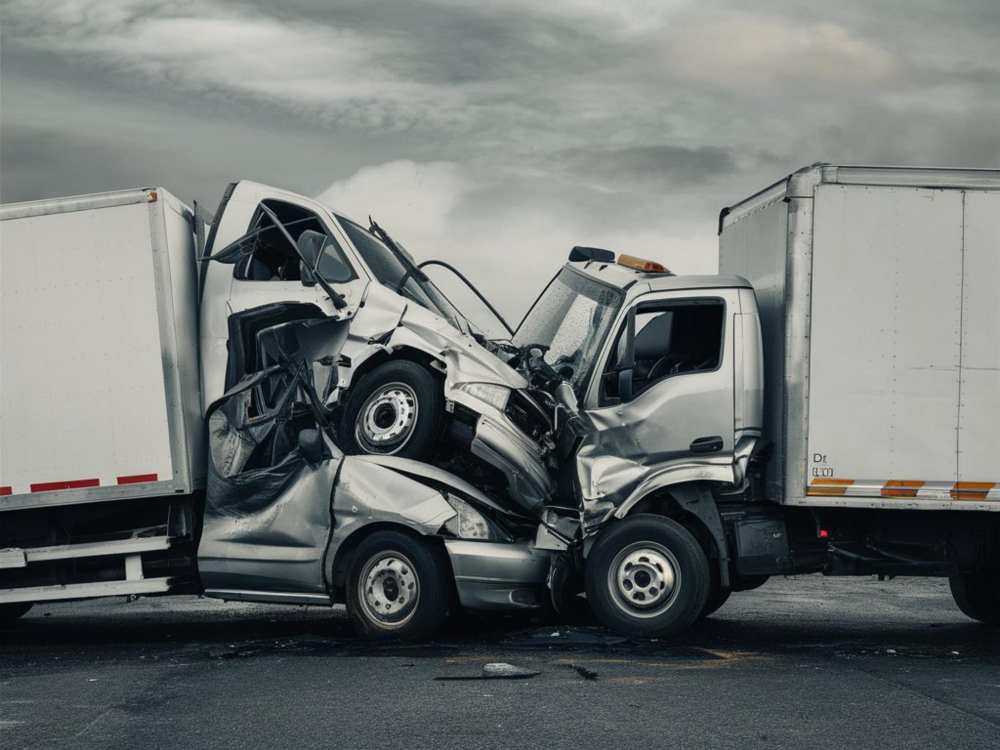
A loaded semi weighs up to 80,000 pounds. A sedan weighs around 4,000. When the two collide, the physics aren’t close, and the injuries that follow usually reflect that gap. Some victims walk away bruised. Others don’t walk away at all, not for months.
This page breaks down what those injuries actually look like, medically and financially, and what they mean for a claim under Illinois law.
Internal Injuries
Traumatic Brain Injuries
A traumatic brain injury happens when force to the head disrupts normal brain function. It doesn’t require a skull fracture. A hard jolt is often enough.
- Concussion. The mildest form. Confusion, headache, dizziness. Loss of consciousness is possible but not required for a diagnosis.
- Contusion. A bruise on the brain’s surface from direct impact.
- Diffuse axonal injury. Widespread damage to nerve fibers, usually from the rapid deceleration or rotation a truck crash produces.
- Penetrating injury. An object breaches the skull and damages tissue directly.
Symptoms range from headaches and blurred vision to memory gaps, slowed thinking, and mood swings that show up weeks after the crash, not on day one. That delay matters. Insurers use it against claimants who didn’t get imaging done right away.
Spinal Cord Injuries
A complete spinal cord injury means total loss of sensation and motor function below the injury site. An incomplete injury leaves some function intact, varying by how much of the cord was damaged.
Where the injury sits on the spine determines what it costs a person, functionally:
- Cervical (neck): can affect arms, hands, trunk, legs, and pelvic organs.
- Thoracic (upper back): chest, abdominal muscles, legs.
- Lumbar (lower back): legs, bowel, bladder, sexual function.
- Sacral: hips, thighs, buttocks, pelvic organs.
Numbness. Paralysis. Loss of bowel or bladder control. Breathing difficulty, in the worst cases. These injuries are rarely temporary, and the lifetime cost of care is one of the largest damage categories in any truck case.
Organ Damage
Internal bleeding is the dangerous one because it’s invisible. Blood vessels rupture, blood pools into tissue or a body cavity, and nothing shows on the outside until a person collapses. Punctured organs, liver, spleen, kidneys, intestines, usually need surgery. Crushed organs happen when the body is pinned between structures during the collision. Even without a visible wound, the shock of a crash alone can impair heart, lung, or kidney function enough to require monitoring.
Crush Injuries
Crush injuries come from sustained pressure, not a single impact. Being pinned between a vehicle and a solid surface, or under equipment that shifted in the crash.
Soft tissue damage. Fractures. Compartment syndrome, where swelling inside a muscle compartment cuts off blood flow and damages nerves. In the worst cases, crush syndrome: muscle tissue breaks down under prolonged pressure and releases toxins into the bloodstream, which can shut down the kidneys.
Whiplash
The head snaps backward, then forward. Neck pain and stiffness. Headaches at the base of the skull. Shoulder and upper back pain from the strained muscles. Some people also get dizziness, fatigue, numbness in the arms, or ringing in the ears.
Whiplash gets dismissed constantly, by insurers and sometimes by the person who has it. It’s real, and in a truck collision the forces involved are usually well beyond what causes whiplash in a typical fender-bender.
External Injuries
Lacerations and Abrasions
Broken glass, metal edges, road debris, or the dashboard itself can cut skin and tissue. Severity ranges from a shallow cut that needs a bandage to a deep wound with major bleeding.
Abrasions, road rash, happen when skin drags across pavement or a rough surface. Mild cases look like scraped redness. Severe cases expose the layers underneath and carry real infection risk.
Burns
Thermal burns come from flames or hot surfaces after a crash. Chemical burns happen when a truck is hauling hazardous cargo that spills. Electrical burns are rarer, tied to downed power lines or damaged electrical systems.
Doctors grade burns by depth. First-degree: redness, pain, swelling, limited to the outer skin layer. Second-degree: blistering and more severe pain, reaching into the dermis. Third-degree: the deepest tissue, nerves, sometimes bone. Skin can appear charred or white. Grafts and long-term care usually follow.
Bruises
Small blood vessels rupture under the skin. Blood leaks into surrounding tissue. Dark purple, fading to yellow-green as it heals. In a truck accident, bruising typically comes from seat belts, airbags, the steering wheel, or contact with the vehicle interior during impact.
Fractures and Amputations
Long bone fractures, femur, tibia, fibula, humerus, radius, ulna. Compression fractures in the spine. Compound fractures, where the bone breaks through skin and infection risk climbs sharply. Stress fractures from repetitive or sudden trauma to weight-bearing bones.
Traumatic amputation is the most severe outcome short of death. Limbs and digits get crushed or severed in the collision itself, not in a hospital. Recovery involves not just the initial surgery but prosthetics, rehabilitation, and often a permanent change in earning capacity.
Psychological Injuries
Not every injury shows up on an X-ray. Post-traumatic stress disorder shows up after a truck crash more often than most people expect, especially when the collision involved a fire, a rollover, or being trapped in the wreckage.
Flashbacks. Nightmares. A flinch every time a semi passes in the next lane. Some survivors stop driving on highways altogether, which has its own cost if the job requires it.
Depression and anxiety often follow serious physical injury too, not because the person is weak but because chronic pain, lost independence, and financial strain wear a person down over months. A treating psychologist’s notes carry real weight in a claim, the same way an orthopedic surgeon’s notes do. Insurers tend to discount psychological injury more than physical injury, which is exactly why documentation from a licensed mental health provider, not just a general practitioner’s mention of “stress,” strengthens that part of the claim.
Catastrophic Injury and Wrongful Death Claims
Some of the injuries above heal. Others don’t, and the law treats that difference seriously. A “catastrophic injury” isn’t a specific diagnosis, it’s a legal and medical shorthand for harm severe enough to permanently change how a person lives and works: paralysis from a spinal cord injury, an amputated limb, a traumatic brain injury with lasting cognitive deficits, third-degree burns covering a large portion of the body, or organ damage that requires ongoing medical management for life. Every one of those outcomes is described in the sections above. What changes at the catastrophic end of the spectrum isn’t the injury itself, it’s the scale of what a claim has to account for: a lifetime of medical care, home modifications, attendant care, adaptive equipment, and an earning capacity that may never return to what it was.
Wrongful Death From a Truck Accident
When a truck accident kills someone, the injury claim that person could have brought becomes two separate legal actions. The Illinois Wrongful Death Act, 740 ILCS 180/1 et seq., allows the deceased’s personal representative to bring a claim on behalf of the surviving spouse and next of kin for the losses their death caused: lost financial support, lost services, and the loss of the relationship itself. Alongside it, the Illinois Survival Act, 755 ILCS 5/27-6, preserves whatever personal injury claim the victim could have brought had they survived, filed through the estate. That claim covers what the victim went through before death: conscious pain and suffering, and medical bills incurred between the crash and the death. A family that pursues only one of the two statutes leaves part of the available recovery unclaimed.
A wrongful death claim generally has to be filed within two years, but the clock runs from the date of death rather than the date of the crash, which matters when a victim survives for a period of time after the collision before succumbing to their injuries. For a full breakdown of how these deadlines work and where they diverge from an ordinary injury claim, see our guide to how long you have to file a truck accident lawsuit in Illinois.
Wrongful death claims arising from a truck crash can also include punitive damages where the trucking company’s own conduct, not just the driver’s, rose to the level of willful and wanton misconduct, a change Illinois law only adopted for wrongful death and survival claims in 2023. See our detailed guide on punitive damages against trucking companies in Illinois for how that claim gets built and what leave of court under 735 ILCS 5/2-604.1 requires.
What These Injuries Mean for a Claim
Medical bills are the easy part to calculate. Add up the ER visit, the surgery, the imaging, the physical therapy. The harder part is everything else: lost wages during recovery, reduced future earning capacity if the injury is permanent, and pain and suffering, which Illinois law recognizes as compensable but doesn’t attach a fixed formula to.
A concussion that resolves in six weeks and a spinal cord injury that changes someone’s life for good are not valued the same way, even though both started with the same kind of collision. The medical trajectory drives the number. That’s why documentation from day one, not day thirty, matters so much.
Illinois does not cap compensatory damages in most personal injury and wrongful death cases, including truck accident claims. That matters most at the catastrophic end of the injury spectrum, where the cost of a lifetime of care can run into the millions. There is no ceiling a jury or a settlement negotiation has to work under; the number has to be proven with evidence, not measured against a statutory limit. For how these larger truck claims tend to differ from an ordinary car accident case, see our comparison of truck accident settlements versus car accident settlements.
How Insurance Adjusters Respond to Different Injury Types
Soft tissue injuries like whiplash get the most pushback. No fracture on an X-ray, no surgery, so adjusters often argue the injury is minor or unrelated to the crash. Fractures and organ damage get less argument on causation but heavy argument on the value of future care. Brain injuries sit in a strange middle ground, imaging can look normal even when cognitive symptoms are severe, and adjusters lean on that gap.
None of this means a claim is weak. It means the medical record has to do the talking, consistently, from the first visit through the last.
Illinois Deadlines and Comparative Fault
Illinois gives injury victims two years from the date of the crash to file a personal injury lawsuit (735 ILCS 5/13-202). Miss it, and the claim is generally barred regardless of how strong the medical evidence is.
Illinois also follows a modified comparative negligence rule (735 ILCS 5/2-1116). If a victim is found more than 50% at fault for the crash, they recover nothing. Below that threshold, compensation is reduced by their percentage of fault. In a multi-vehicle truck collision, fault gets contested hard, which is exactly why early evidence preservation, dashcam footage, black box data, witness statements, carries so much weight.
That two-year clock applies to an injury claim brought by the survivor. A fatal crash starts a related but separate clock under the Wrongful Death Act, discussed above, generally running from the date of death rather than the date of the crash.
Documenting Lost Wages and Future Earning Capacity
A pay stub only proves what someone earned before the crash. It doesn’t prove what a spinal cord injury or an amputation costs them over the next thirty years of a working life, and that second number is usually the bigger one in a serious truck accident claim.
For hourly workers, missed shifts are straightforward: gather the pay stubs, get a letter from the employer confirming the dates missed. Self-employed contractors and gig workers have a harder time, tax returns and invoices from before the crash have to stand in for a pay stub, and insurers scrutinize that evidence harder.
Permanent injuries raise a different question entirely: not what was lost, but what will be lost going forward. That’s where a vocational expert and an economist usually get involved, one to assess what work the injured person can still physically do, the other to translate that gap into a dollar figure over a projected career span. Illinois courts allow this kind of expert testimony, and in cases involving amputation, paralysis, or severe brain injury, it often represents the largest single component of the damages claimed.
In a catastrophic injury case, the number a vocational expert and economist produce sometimes exceeds what the trucking company’s insurance policy actually covers, which raises a separate question: how much coverage was in place to begin with, and whether more than one policy or defendant is available to satisfy a judgment. Federal law sets minimum insurance requirements for motor carriers, and our guide to how much insurance trucking companies have to carry explains what those minimums are and why they rarely tell the whole story in a serious injury case.
When the Crash Itself Triggers a Federal Report
Federal law requires motor carriers to log certain crashes in an accident register under 49 CFR 390.15, specifically ones involving a fatality, an injury requiring transport away from the scene for treatment, or a vehicle towed from the scene with disabling damage. Most serious truck accident injury cases meet at least one of those triggers.
That register, along with the driver’s post-accident drug and alcohol testing records required under 49 CFR 382.303, becomes discoverable once a claim is filed. It’s a separate document trail from the police report, and trucking companies don’t always volunteer it without a formal request. An attorney who knows to ask for the FMCSA-required accident register early, before records get purged on a routine retention schedule, closes off one more way an insurer can dispute what actually happened.
Treatment for Truck Accident Injuries
- Emergency care. Paramedics stabilize the patient on-site: bleeding control, immobilization, airway support.
- Hospitalization. Further evaluation, often surgery for internal injuries, fractures, or amputations.
- Surgical intervention. Ranges from setting bones to repairing organ damage to amputation itself.
- Rehabilitation. Physical therapy for mobility and strength, occupational therapy for daily functioning, and psychological support for trauma.
- Pain management. Medication, nerve blocks, or other therapies during recovery.
- Follow-up care. Ongoing monitoring, adjusted treatment plans, and documentation that later supports the claim.
A Realistic Scenario
Picture a delivery driver rear-ended by a semi merging onto I-90. No visible wound at the scene, she declines an ambulance, drives herself home. Two days later: headaches, blurred vision, trouble concentrating at work. An MRI eventually shows a mild traumatic brain injury.
Because she didn’t seek care immediately, the trucking company’s insurer argues the injury came from something else. This is the single most common way otherwise strong claims lose value, not because the injury isn’t real, but because the paper trail has a gap in it. Same-day medical evaluation closes that gap before it opens.
Why the Hospital You’re Taken To Matters
Cook County runs several Level I trauma centers built to handle exactly the kind of injuries a truck crash produces, Stroger Hospital, Northwestern Memorial, University of Chicago Medicine, and Advocate Christ Medical Center in Oak Lawn among them. Paramedics triage severe truck accident victims to these facilities specifically because they have trauma surgeons, neurosurgeons, and blood banks on standby around the clock.
That matters for a claim in a practical way. A trauma-team workup, imaging, surgical consults, ICU admission, generates a thick, detailed medical record from the first hour. That record does more to establish the severity and cause of an injury than anything written weeks later ever could.
If a victim was stabilized at a smaller community hospital and later transferred, the transfer record itself is worth pulling. It shows the receiving trauma team judged the injury serious enough to require a higher level of care, which is its own form of evidence.
Frequently Asked Questions
What should I do immediately after a truck accident?
Get evaluated by a medical professional the same day, even if you feel fine. Adrenaline masks pain, and a same-day record is hard for an insurer to argue with later.
What types of injuries are most common in truck accidents?
Fractures, traumatic brain injuries, spinal cord injuries, internal organ damage, and soft tissue injuries like whiplash. Severity tends to run higher than in typical car-to-car collisions because of the size and weight difference.
How are fractures treated after a truck accident?
Immobilization with a cast or brace for simple breaks, surgery for compound or complex fractures, followed by physical therapy. Recovery timelines vary widely by bone and severity.
What happens if my injury doesn’t show up until days later?
It’s common, especially with brain injuries and soft tissue damage. Seek medical attention as soon as symptoms appear and tell the doctor the injury is connected to the crash, that connection needs to be in the medical record, not just in your memory.
Do I still have a claim if I was partly at fault?
Possibly. Illinois allows recovery as long as you’re 50% or less at fault, with your compensation reduced by your share of fault. Being 51% or more at fault bars recovery entirely.
How long do I have to file a claim in Illinois?
Two years from the date of the accident in most personal injury cases. Government-involved claims can carry much shorter notice deadlines, so it’s worth confirming early rather than assuming the standard two years applies.
Will my case settle, or does it go to trial?
Most truck accident claims settle before trial. Serious injury cases with disputed liability or high damages are more likely to see litigation, at least until settlement talks progress further along the process.
What does hiring a lawyer cost upfront?
Personal injury cases are typically handled on contingency, no fee unless there’s a recovery. That arrangement lets injured people pursue a claim without paying legal fees out of pocket during treatment and recovery.
Does the trucking company have to report my accident to federal regulators?
Often yes. Under 49 CFR 390.15, motor carriers must maintain an accident register for crashes involving a fatality, an injury treated away from the scene, or a towed vehicle with disabling damage. That register and related post-crash drug testing records can become evidence in a claim.
Can psychological injuries like PTSD be part of my compensation?
Yes. Illinois law recognizes emotional and psychological harm as compensable damages, provided it’s documented by a treating mental health professional rather than described only in passing. Anxiety, PTSD, and depression tied to the crash are treated the same as any other diagnosed physical condition.
What if I can’t return to my old job because of my injuries?
That’s a lost earning capacity claim, separate from missed paychecks during recovery. A vocational expert can evaluate what work remains realistic given the injury, and an economist can project the income gap over a working career. Illinois law allows recovery for that difference, not just for time missed on the job so far.
What is the average settlement for a traumatic brain injury in a truck accident?
There isn’t a meaningful average, and any number quoted without reviewing your medical records deserves skepticism. A mild concussion that resolves in weeks and a severe TBI with permanent cognitive deficits are valued on completely different scales, driven by the medical evidence, the permanency of the symptoms, and the impact on future earning capacity, not by a formula tied to the diagnosis alone.
Does Illinois cap the damages I can recover in a truck accident case?
No. Illinois does not impose a statutory cap on compensatory damages in truck accident or wrongful death cases. The claim has to be proven through medical records, expert testimony, and documented losses, but there is no ceiling on what a jury can award once it is proven.
How long do I have to file a wrongful death claim after a fatal truck accident?
Generally two years from the date of death under the Illinois Wrongful Death Act, which can fall later than two years from the date of the crash if the victim survived for a period before passing. If a government-owned vehicle was involved, a much shorter notice deadline can apply, so confirm the timeline early rather than assuming the standard rule fits your case.
What qualifies as a “catastrophic injury” in a truck accident claim?
There’s no single legal definition, but the term generally describes an injury that permanently and substantially changes how a person lives and works: paralysis, amputation, a severe traumatic brain injury, extensive burns, or organ damage requiring lifelong management. These cases typically involve a larger claim for future medical care and lost earning capacity than injuries expected to fully resolve.
Can I still recover compensation if a spinal cord injury leaves me paralyzed?
Yes. Paralysis claims typically include the full range of damages: past and future medical care, home and vehicle modifications, attendant care, lost earning capacity, and pain and suffering. Because the cost of lifetime care is so high, these claims usually involve vocational and life-care-planning experts to document what the future actually costs.
Is compensation available for scarring and disfigurement from a burn injury?
Yes. Illinois law allows recovery for disfigurement and scarring as part of pain and suffering and loss of normal life, separate from the medical costs of treating the burn itself. Documentation from a treating physician or plastic surgeon about the permanency and visibility of scarring supports this part of a claim.
Every injury on this list changes the value and difficulty of a claim differently, and a catastrophic injury or a wrongful death changes it more than any other. If you’re dealing with any of them after a Chicago truck accident, get the medical evaluation first, then talk to someone who handles these cases before you talk to the trucking company’s insurer.
Talk to a Chicago Attorney for a Free Consultation
Phillips Law Offices represents truck accident victims and families across Chicago and Illinois, from soft tissue injuries to catastrophic and fatal crashes. Call (312) 346-4262 or contact us online for a free, no-obligation consultation.
Attorney Advertising. This page provides general information about Illinois law and is not legal advice. Reading it does not create an attorney-client relationship. Deadlines and outcomes depend on the specific facts of your case, speak to a licensed Illinois attorney about your situation. Contingency fees cover legal fees only. Clients may remain responsible for case costs and expenses such as filing fees, expert witnesses, and medical records.
Leave a Reply