
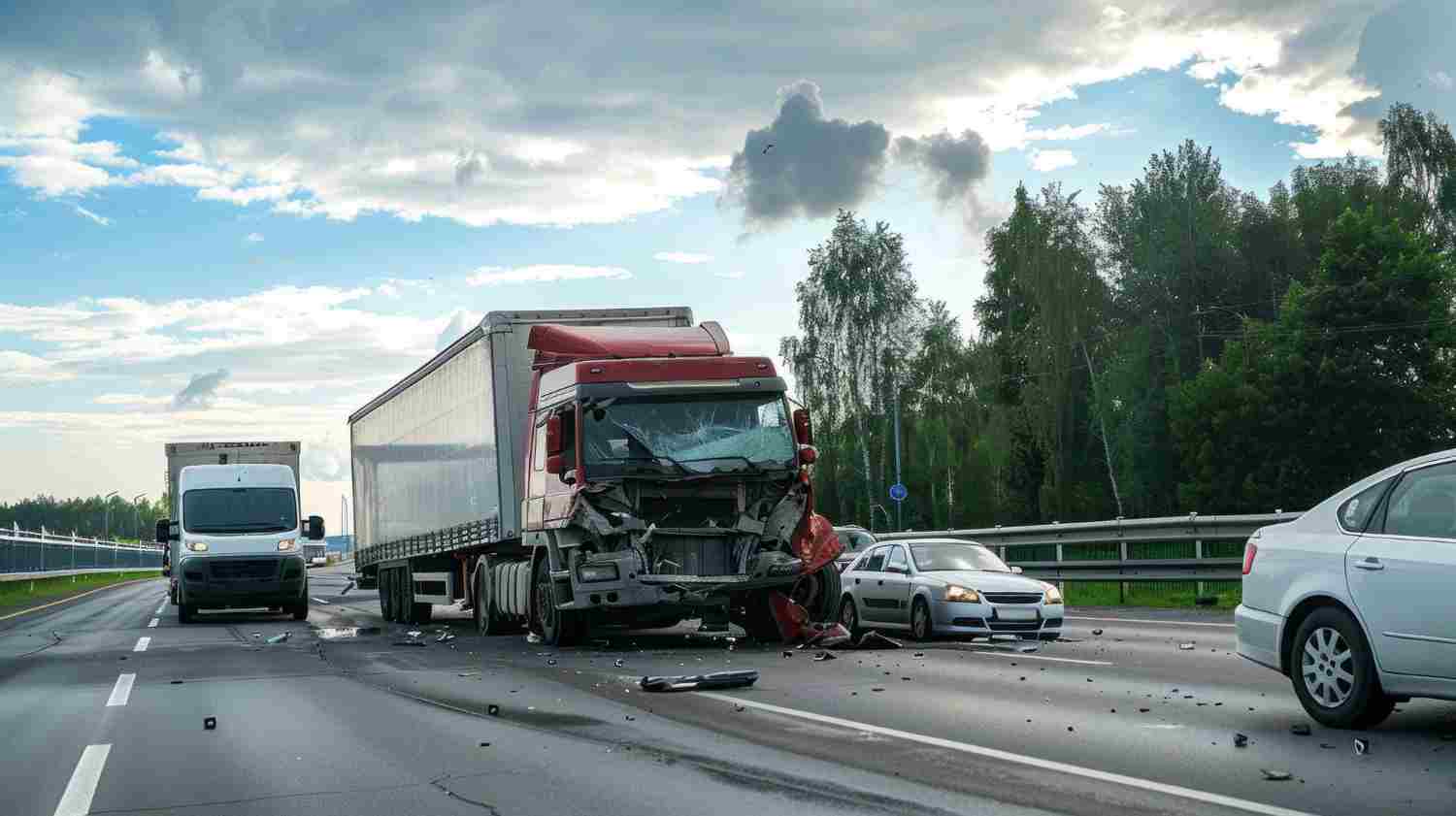
Most people assume liability after a truck accident is simple, the driver was driving, so the driver is at fault. It’s rarely that clean. Behind most semi-trucks sits a network of companies, contractors, and insurers, and more than one of them can share the blame.
Getting this right changes the outcome. Here’s how liability actually gets sorted out under Illinois law.
Start With the Driver, But Don’t Stop There
The first question is always about the person behind the wheel. Distracted? Fatigued? Speeding? Under the influence?
A driver can be held liable for violating traffic laws, ignoring FMCSA Hours of Service rest requirements, driving impaired, or using a phone while driving, prohibited under 625 ILCS 5/12-610.2. But in most cases the driver works for someone else. That’s where liability expands, not ends. See What To Do After a Truck Accident in Chicago for how early evidence connects to this question.
The Trucking Company Is Often the Real Target
Hiring. Training. Maintenance schedules. Dispatch pressure. All of it sits with the carrier, and all of it affects road safety.
A trucking company can be held liable for hiring or retaining unqualified drivers, failing to maintain its fleet, pushing schedules that cause fatigue, ignoring DOT/FMCSA safety standards, or neglecting cargo weight and securement rules. This is vicarious liability, an employer answering for its employee’s actions.
Companies frequently try to dodge this by labeling a driver an independent contractor instead of an employee. That label doesn’t always hold up once dispatch records, pay structures, and internal contracts get pulled. Once the employment relationship is established, the company’s commercial insurance, usually far larger than any individual driver’s policy, comes into play. More on how that gets pursued in The Truck Accident Claim Process.
Mechanical Failure: Manufacturer and Maintenance Liability
Not every crash starts with human error. Brake failure, tire blowouts, and defective steering systems cause real wrecks on I-90 and Lake Shore Drive every year.
When mechanical failure is the cause, liability can shift to the manufacturer for a defective part or design, the maintenance provider for negligent inspection or repair, or the parts supplier if a faulty component made it into the vehicle. Worn brake pads that should have been replaced at the last service interval, for instance, are exactly the kind of maintenance failure that shows up in service logs once they’re pulled and reviewed. That’s why requesting maintenance and inspection records is one of the first steps in any case involving equipment failure.
Cargo Loaders and Shipping Companies
Improperly loaded freight causes trailer imbalance, rollovers, cargo spills, and loss of control on turns, more often than most people assume.
If a separate shipping or logistics company handled the loading, liability can extend to them under federal cargo securement regulations (49 CFR sections 393.100-136). A single shipment often passes through the carrier, a freight broker, and a warehouse loader, and any of them can carry partial responsibility. Sorting that out usually takes accident reconstruction and forensic review to pinpoint where the failure started. See The Truck Accident Claim Process for how that evidence fits into a claim timeline.
When the Road Itself Is a Factor
Sometimes it isn’t the truck. Poor road design, missing signage, unrepaired potholes, or malfunctioning traffic signals can put a city or state agency partially on the hook.
Claims against government entities move on a much tighter clock than standard injury claims, and which clock applies depends on the entity. A city, county or CTA vehicle falls under 745 ILCS 10/8-101(a): one year to file suit, with no separate pre-suit notice required. A State vehicle, such as an IDOT truck, goes to the Illinois Court of Claims instead, where notice is generally due within one year under 705 ILCS 505/22-1 unless suit is filed inside that year. Waiting to investigate whether a government agency’s negligence played a role is one of the more costly delays a truck accident victim can make.
Shared Fault and Comparative Negligence
Illinois follows modified comparative fault (735 ILCS 5/2-1116). Under 50% at fault, you still recover, reduced by your percentage. At 50% or more, you recover nothing.
Say total damages come to $200,000 and a victim is found 20% at fault. The recovery becomes $160,000, not zero. This is exactly why insurers push hard to inflate a victim’s share of blame, every percentage point they add directly reduces what they owe. Dashcam footage, witness statements, and reconstruction reports are what push back against that.
A Realistic Example
A box truck merges without checking its blind spot and sideswipes a sedan on the Kennedy Expressway. The truck is owned by a regional delivery company, but the driver behind the wheel had been leased to that company by a separate staffing agency for the day.
Untangling who employed the driver, the delivery company that controlled the route and schedule, or the staffing agency that issued the paycheck, becomes its own investigation. Illinois courts look past the paperwork to who actually directed the work: who set the route, who could fire the driver on the spot, who owned the truck. In this case, dispatch records showed the delivery company controlled every aspect of the shift, which made it the liable employer despite the staffing agency’s name on the pay stub.
That kind of layered employment relationship is common in trucking, temp drivers, leased trucks, subcontracted routes, and it’s exactly why the first liability question in any case is never as simple as looking at who signed the paycheck.
Freight Brokers Can Now Be Held Liable Too
A 2026 Illinois Supreme Court ruling in Montgomery v. Caribe Transport II LLC opened a new avenue that didn’t exist a few years ago: freight brokers, the companies that connect shippers with carriers but don’t own trucks themselves, can be held liable for negligently selecting an unsafe carrier.
Before that ruling, brokers argued federal law preempted any state negligent-hiring claim against them. Illinois courts rejected that argument, at least for claims based on how the broker vetted the carrier’s safety record before booking the load. If a broker matched a shipper with a carrier that had a documented history of FMCSA violations, that broker’s own liability insurance can become part of the recovery.
Owner-Operators Complicate the Employee Question
Roughly a third of commercial trucks on Illinois highways are driven by owner-operators, drivers who own their own rig but lease it to a carrier under that carrier’s operating authority. Federal leasing regulations (49 CFR 376.12 and 390.5) generally make the carrier responsible for the leased truck’s operation regardless of who technically owns it, specifically to prevent carriers from using ownership structure to dodge liability.
That doesn’t mean the owner-operator is automatically off the hook. If the owner-operator skipped required maintenance on equipment they personally owned, that negligence can still attach directly to them, separate from whatever liability flows to the carrier through the lease. Both angles usually get investigated in parallel rather than one replacing the other.
When Punitive Damages Enter the Picture
Most truck accident cases settle on compensatory damages alone, medical bills, lost wages, pain and suffering. Illinois allows punitive damages in a narrower set of cases involving willful and wanton conduct, not ordinary negligence.
Falsified driver logs to hide hours-of-service violations. A carrier that kept a driver on the road after multiple documented safety complaints. Deliberately ignoring a known mechanical defect to avoid downtime. These fact patterns move a case from simple carelessness into something closer to conscious disregard for safety, and Illinois courts treat that difference as meaningful when punitive damages are on the table.
How an Attorney Investigates a Multi-Party Case
Building a liability case against several parties starts with requests that have to go out fast: preservation letters to the carrier, the broker if one was involved, and any maintenance contractor named in service records. ELD data and dashcam footage can be gone within weeks if nobody asks for it in writing.
From there, the investigation typically runs in parallel tracks. One track pulls the driver’s qualification file, employment history, and any prior safety violations on record with FMCSA. Another pulls maintenance and inspection logs going back months, sometimes years, looking for a pattern rather than a single missed service. A third looks at the load itself, who packed it, who inspected the securement, whether the bill of lading matches what was actually on the trailer.
None of these tracks move especially fast on their own. Records requests get delayed, companies claim documents were routine and discarded, insurers slow-walk cooperation until a formal demand or lawsuit forces the issue. That’s normal, and it’s also why starting the investigation in the first weeks after a crash, rather than months later once memories and paper trails have faded, tends to produce a much stronger case than waiting to see how the injuries play out before deciding who to pursue.
Following the Insurance Money
Multiple policies typically apply to a single truck accident claim. Illinois requires commercial vehicles to carry higher liability limits than passenger cars, often ranging from $750,000 up toward $5 million depending on cargo type, particularly hazardous materials.
A thorough investigation maps every layer: the driver’s personal policy, the carrier’s commercial policy, any umbrella or excess coverage, cargo insurance if freight was damaged, and sometimes broker or shipper coverage on top of that. Missing a layer means leaving compensation on the table. See How Is Compensation Determined After a Semi-Truck Wreck for how these layers factor into settlement value.
The Evidence That Actually Proves Liability
Electronic logging device and black box data. Driver qualification files. Maintenance logs. Cargo manifests. GPS and cell phone records. Witness statements. Dashcam footage.
None of it proves anything on its own. Together, it reconstructs a timeline that shows what actually happened, not just who was holding the wheel when it did.
Prior Safety Violations as Evidence of a Pattern
A single speeding ticket doesn’t prove much on its own. A pattern does. FMCSA maintains a public Safety Measurement System score for every registered carrier, tracking hours-of-service violations, vehicle maintenance citations, and crash history over a rolling 24-month window.
Pulling a carrier’s safety history before litigation starts often reveals whether a crash was a one-off mistake or the predictable result of a company running drivers past legal limits or skipping inspections for months at a time. That history becomes especially important in a negligent hiring or negligent retention claim, where the question isn’t just what the driver did on the day of the crash but what the company knew, or should have known, before putting that driver back on the road.
Courts weigh this kind of pattern evidence heavily, both for establishing liability and for the punitive damages question when conduct crosses from careless into reckless.
Filing Against Multiple Defendants in Cook County
Once liability investigation identifies more than one responsible party, the lawsuit itself typically names all of them jointly, the driver, the carrier, and any broker, maintenance contractor, or cargo loader whose negligence contributed to the crash. Illinois allows joint and several liability in many personal injury contexts, meaning each defendant can be held responsible for the full judgment, not just their proportional share, though the specifics depend on how fault gets allocated at trial.
Cook County’s Law Division handles the bulk of these multi-defendant truck cases, and out-of-state carriers frequently try to remove the case to federal court under diversity jurisdiction once multiple parties from different states are involved. That doesn’t change the underlying Illinois law that applies, but it does change the procedural rules, discovery deadlines, and sometimes the jury pool.
None of this happens automatically. A plaintiff’s attorney has to make the strategic call on who to name, when to file, and whether removal to federal court helps or hurts the case, decisions that get made well before a jury ever hears the facts.
How Multiple Liable Parties Change Settlement Value
A case against one driver caps out at that driver’s insurance limits. A case that correctly identifies the carrier, a maintenance contractor, and a cargo loader as jointly liable opens up multiple policies at once, which is often the difference between a settlement that covers a fraction of the damages and one that covers all of them. This is the main reason liability investigation happens before, not after, settlement talks begin.
Holding Every Liable Party Accountable
Once liability across multiple parties is clear, the next step is filing against all of them, not just the most obvious one. That can mean a multi-defendant lawsuit, coordinated negotiations with several insurers at once, and trial preparation if any of them deny fault. The goal isn’t just proving liability; it’s making sure every negligent party actually contributes to the recovery.
Frequently Asked Questions
Can more than one party be liable for the same truck accident?
Yes, and it’s common. Driver, carrier, maintenance provider, and cargo loader can all carry a share of fault in the same crash.
What if the trucking company says the driver was an independent contractor?
That label gets tested, not accepted automatically. Pay structure, dispatch control, and equipment ownership often tell a different story than the paperwork does.
How is fault determined when the evidence is disputed?
Through a combination of physical evidence, electronic data (ELD, black box, dashcam), witness accounts, and often accident reconstruction analysis when the dispute is significant.
Does it matter if I was partly at fault?
Under Illinois’s modified comparative fault rule, you can still recover as long as you’re not more than 50% at fault, with your award reduced proportionally.
How long do I have to identify a government entity’s role in the crash?
Much less time than a standard claim. One year to file against a local public entity under 745 ILCS 10/8-101(a); a State claim goes to the Court of Claims with its own one-year notice rule. Investigate this possibility early.
Why does insurance coverage layering matter so much in truck cases?
Because commercial trucking claims routinely exceed what a single policy can cover. Identifying every applicable policy is often what makes full compensation possible instead of a capped, partial recovery.
Can a carrier’s FMCSA safety score really be used against them in court?
Yes, though it usually comes in through the underlying violation records rather than the summary score itself. A documented pattern of hours-of-service or maintenance violations in the two years before a crash can support a negligent hiring or retention claim against the carrier, especially when the same violation type recurs across multiple inspections rather than showing up once. Isolated incidents carry less weight; recurring ones start to look like a policy of looking the other way.
Can I sue the company that arranged the shipment even if they don’t own any trucks?
Sometimes. Following the 2026 Illinois Supreme Court ruling, freight brokers can face liability for negligently selecting a carrier with a poor safety record, separate from the carrier’s own liability for the crash itself.
What if the truck was leased to the carrier by its actual owner?
Federal leasing rules generally place responsibility on the carrier operating under its own authority, regardless of who owns the truck, though the owner-operator can still carry separate liability for maintenance failures on equipment they controlled.
What happens if two companies both point fingers at each other?
That’s common, and it’s exactly the kind of dispute a lawsuit resolves through discovery rather than negotiation. Naming both as defendants preserves the claim against whichever one the evidence ultimately points to, rather than gambling on picking the right party upfront.
Liability in a truck accident case isn’t guesswork, it’s built from logbooks, contracts, and maintenance records, cross-checked against what actually happened on the road. The parties responsible rarely announce themselves; someone has to go find them. Call (312) 346-4262 for a free case review.
Attorney Advertising. This page provides general information about Illinois law and is not legal advice. Reading it does not create an attorney-client relationship. Deadlines and outcomes depend on the specific facts of your case — speak to a licensed Illinois attorney about your situation. Prior results do not guarantee a similar outcome; every case is decided on its own facts.
Leave a Reply