
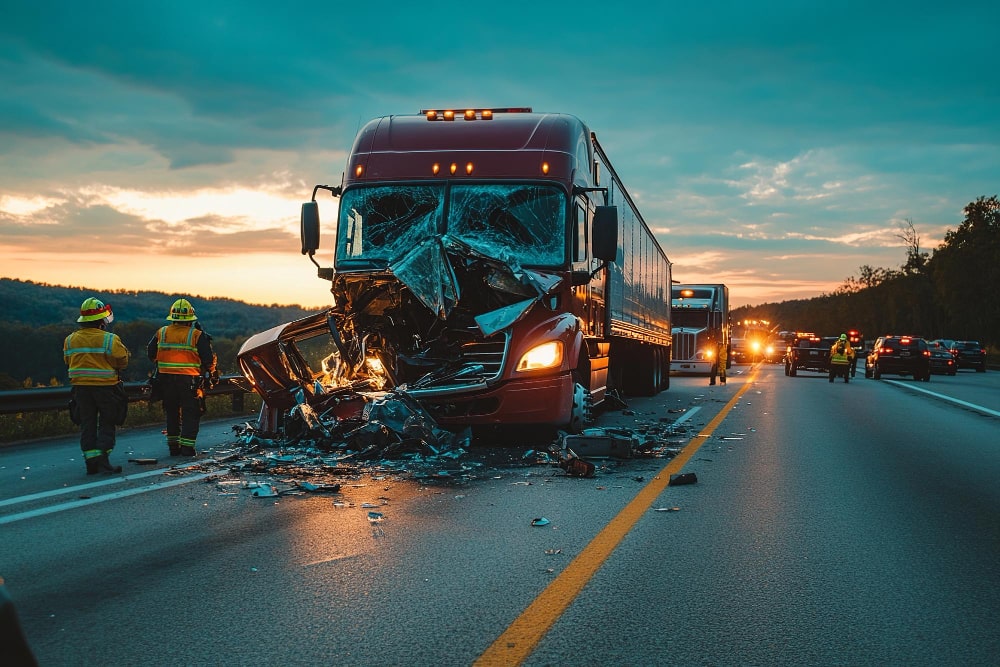
When a commercial truck causes a crash, the trucking company’s own compliance record often becomes the strongest evidence in the case. The Federal Motor Carrier Safety Administration writes the rules that govern how a truck driver’s day is supposed to work, from the hours behind the wheel to the condition of the brakes. When a carrier breaks those rules, the violation doesn’t just sit quietly in a file somewhere. It becomes evidence.
A regulation violation by itself doesn’t win a case. What wins a case is turning that violation into proof that the carrier failed to act the way a reasonably careful trucking company would have acted. That’s the bridge we build in every FMCSA violation case we take on.
The Regulatory Framework Behind Every Trucking Case
The Federal Motor Carrier Safety Regulations (49 CFR Parts 350-399) cover nearly every operational decision a carrier makes: how long a driver can stay on the road, how often a truck gets inspected, who gets hired to drive it, and how cargo gets tied down. Each rule addresses one specific risk on its own. Together, they form a single evidentiary framework we draw from when building a negligence case.
We treat these violation categories as connected, not separate. A driver logbook that doesn’t match GPS data, a brake system flagged twice in six months, a driver file missing a required background check, none of these are isolated incidents. They’re threads in the same argument: this carrier operated with disregard for the rules meant to keep other drivers safe.
That overlap is often where a case gets stronger, not weaker. A carrier that skips brake inspections is frequently the same carrier that pushes drivers past their HOS limits to hit a delivery window, because both violations come from the same underlying decision to prioritize schedule over safety. Once we see one category of violation, we go looking for the others.
Hours of Service Violations (49 CFR Part 395)
Fatigued driving remains one of the leading causes of serious truck crashes. The Hours of Service (HOS) regulations set hard limits on how long a driver can be behind the wheel:
- 11-Hour Driving Limit: Drivers may drive a maximum of 11 hours after 10 consecutive hours off duty
- 14-Hour Window: All driving must occur within 14 hours of coming on duty
- 60/70-Hour Limit: No driving after 60/70 hours on duty in 7/8 consecutive days
- 30-Minute Break: Required after 8 cumulative hours of driving
Electronic Logging Devices, mandatory under 49 CFR 395.8, create a digital, time-stamped record of a driver’s hours, which makes HOS violations some of the easiest FMCSA violations to prove. We cover the mechanics of that data, and how it holds up in court, in our guides on Electronic Logging Device data and truck driver fatigue. Here, the point that matters is simpler: an HOS violation before a crash is direct evidence the driver, and often the carrier that scheduled him, ignored a known safety limit.
Vehicle Maintenance Violations (49 CFR Part 396)
The vehicle maintenance regulations require carriers to systematically inspect, repair, and document the condition of every commercial vehicle in the fleet:
- Pre-Trip Inspections (396.13): Drivers must inspect vehicles before each trip
- Post-Trip Reports (396.11): Written reports required for any defects
- Periodic Inspections (396.17): Annual inspections by qualified inspectors
- Brake Systems (396.3): Specific requirements for brake maintenance and adjustment
Brake failures, tire blowouts, lighting defects, and steering problems account for a large share of maintenance-related crashes. Under 49 CFR 396.3(b), a carrier has to keep those maintenance records for as long as the vehicle stays under its control, plus one more year after it leaves the fleet. If a carrier can’t produce them when we ask, that gap tells its own story about how the company was run.
Driver Qualification Violations (49 CFR Part 391)
The driver qualification standards exist to keep unqualified drivers out of the cab in the first place:
- Medical Certification (391.41-391.49): Drivers must pass DOT physical exams
- Drug & Alcohol Testing (391.81-391.87): Pre-employment and random testing required
- Background Checks (391.23): Carriers must investigate driver history
- Road Tests (391.31): Required before hiring
If a carrier put a driver with a history of DUIs, license suspensions, or prior crashes behind the wheel, the company can be liable for negligent hiring, a claim that stands on its own regardless of whether the driver was also negligent that day.
Drug and Alcohol Testing Violations (49 CFR Part 382)
Federal rules require carriers to test drivers for drugs and alcohol before hiring them and at random throughout their employment. Under 49 CFR 382.303, post-accident testing is also mandatory when a crash involves a fatality, or when the driver is cited for a moving violation and the crash caused an injury requiring treatment away from the scene or damage serious enough to require a tow-away.
Carriers also have to check the FMCSA Drug and Alcohol Clearinghouse, a national database of commercial drivers who’ve failed a test or refused one, before putting a driver on the road and again once a year after that. A driver who shows up in the Clearinghouse with an unresolved violation shouldn’t be driving at all. If a carrier put that driver behind the wheel anyway, that’s about as direct a link to negligence as this area of law gets. We go deeper on impaired driving cases specifically in our guide on drunk and drugged truck drivers.
Cargo Securement Violations (49 CFR Part 393)
The cargo securement rules (49 CFR 393 Subpart I) exist to keep loads from shifting or falling off a moving truck:
- Working Load Limits: Tie-downs must have adequate strength for cargo weight
- Number of Tie-Downs: Minimum requirements based on cargo length
- Commodity-Specific Rules: Special requirements for logs, metal coils, heavy equipment
Improperly secured cargo can shift during turns or hard braking, causing rollovers or spilled loads that create hazards for everyone else on the road. A citation for a securement violation, even one issued weeks before the crash we’re investigating, can show the carrier had a habit of cutting corners on load safety.
Post-Crash Roadside Inspections and Out-of-Service Orders
A serious crash almost always triggers a post-accident roadside inspection under 49 CFR Part 396, separate from any police investigation. An inspector examines the truck’s brakes, tires, lights, and driver credentials on the spot, sometimes within hours of the collision.
If the inspector finds a defect serious enough to meet FMCSA’s Out-of-Service Criteria, the truck can be pulled from the road immediately, before it ever gets repaired or moved. An out-of-service order issued at the scene of a crash is powerful evidence, because it means a federal inspector independently found the vehicle unsafe to operate at the exact moment it caused an injury. We request this inspection report as a matter of course in every serious truck crash case, since it often exists before we’re even retained.
Out-of-service rates also feed directly into a carrier’s FMCSA safety scores. A carrier with an out-of-service rate well above the national average for its vehicle category is a carrier FMCSA itself has already flagged as higher risk, and that history can be relevant to how the crash happened even when the specific defect that triggered the order wasn’t the direct cause of the collision.
From Violation to Verdict: Building the Evidentiary Bridge
FMCSA doesn’t just write the rules, it tracks compliance with them. Every roadside inspection, whether it results in a citation or a clean pass, becomes part of a carrier’s record.
That record feeds FMCSA’s Safety Measurement System (SMS), which groups a carrier’s violation and crash history into safety categories covering things like unsafe driving, hours-of-service compliance, vehicle maintenance, and driver fitness. Carriers with weak scores in these categories tend to draw more roadside stops and more regulatory scrutiny, and that history is exactly what we go looking for once we take on a new case.
Some of this data is public, and we pull it before we ever file suit. The rest, internal safety audits, driver coaching files, and any DataQs challenges the carrier filed to dispute a violation on its record, comes out through discovery once litigation starts. A carrier that fought to have a violation removed from its record is effectively telling us it knew about the problem at the time.
One Violation vs. a Pattern: Why Repeat Offenders Face Bigger Exposure
A single missed inspection might be an oversight. Ten missed inspections across eighteen months is a business decision.
Illinois allows punitive damages against a trucking company when its conduct rises to willful and wanton misconduct, not ordinary carelessness, but a conscious disregard for the safety of others. A pattern of FMCSA violations the company knew about and didn’t fix is often exactly the kind of proof that gets a case there. Our guide on punitive damages against trucking companies walks through how that standard plays out in Illinois courts.
The difference between a single violation and a pattern matters practically, too. A one-off HOS violation is evidence a driver made a bad choice on a given day. A pattern of HOS violations across multiple drivers is evidence the company’s dispatch schedules made compliance nearly impossible, which shifts the negligence conversation from the driver to the carrier that built the schedule.
A pattern also changes how the case moves. Insurance adjusters value a claim differently once they see a driver’s HOS violation sitting next to three prior citations for the same thing, or a maintenance defect that mirrors a complaint the carrier settled the year before. A jury reacts the same way: one bad day invites sympathy for the driver, a documented pattern invites accountability for the company that let it keep happening.
How Illinois Courts Treat FMCSA Violations
Illinois doesn’t require us to prove what a “reasonable” trucking company would have done once we show a federal regulation was violated and that the violation contributed to the crash. The violation itself is powerful evidence that the carrier failed to meet the standard of care owed to everyone else on the road.
That evidence still has to work within Illinois’s comparative fault rules. Under 735 ILCS 5/2-1116, you can recover damages even if you were partly at fault for the crash, as long as your share of fault is 50% or less; your recovery is reduced by your percentage of fault. If you’re found more than half responsible, you can’t recover at all. Our guide on Illinois’s 51 percent rule walks through how that math plays out in real cases.
Illinois also protects your medical expenses specifically. Under 735 ILCS 5/2-1117, your medical bills are fully recoverable regardless of your fault percentage, while the 25% fault threshold in that same statute determines whether the carrier is on the hook for the full judgment or only its own share when it comes to other categories of damages.
Preserving FMCSA Violation Evidence
Critical evidence in FMCSA violation cases includes:
- ELD/Log Book Data: Electronic records of driving hours
- Driver Qualification Files: Training, medical certs, background checks
- Maintenance Records: Inspection reports and repair orders
- Carrier Safety Ratings: FMCSA’s Safety Measurement System (SMS) data
- Post-Accident Drug Tests: Required under 49 CFR 382.303
Carriers aren’t required to hold onto all of this forever, and some records can legally be destroyed on a routine schedule if nobody stops it. Illinois treats spoliation, the destruction of evidence a party knew or should have known was relevant to a claim, as a form of negligence rather than a separate claim of its own, following Boyd v. Travelers Insurance Co., 166 Ill. 2d 188 (1995). In practice, that means the sooner we send a spoliation letter demanding preservation, the stronger our position if records go missing later.
Illinois Statute of Limitations
Under 735 ILCS 5/13-202, you generally have two years from the date of the crash to file a personal injury lawsuit in Illinois. For a deeper overview of deadlines, see our guide to the Illinois statute of limitations for personal injury. Investigating FMCSA violations, pulling inspection records, requesting Clearinghouse data, tracking down maintenance logs, takes real time, so the earlier we start, the more evidence we can lock down before it disappears.
Frequently Asked Questions
Does every FMCSA violation mean the trucking company is automatically liable?
No. A violation is strong evidence of a breach of the standard of care, but we still have to show the violation contributed to causing the crash and your injuries.
Can I find a carrier’s violation history myself?
Some FMCSA safety data is public and searchable. Interpreting what it means for a specific case, and pulling the non-public records that fill in the rest of the picture, is where legal help matters most.
What if the police report doesn’t mention any FMCSA violations?
Police officers investigating a crash scene aren’t FMCSA inspectors and don’t typically check hours-of-service logs or maintenance records. The absence of a violation on a police report doesn’t mean one didn’t exist.
Do these violations matter if the driver was an independent owner-operator?
Often yes. Many FMCSA duties, including drug testing and driver qualification checks, run through the motor carrier the driver was operating under, not just the individual behind the wheel.
How far back do you look at a carrier’s violation history?
It depends on the case, but we typically start with the two to three years before the crash, since that window tends to show whether a problem was isolated or ongoing.
Contact a Chicago Truck Accident Attorney
FMCSA violations can significantly strengthen your truck accident case, but proving them takes legal experience and fast evidence preservation. Call Phillips Law Offices at (312) 346-4262 for a free consultation to talk about how federal trucking regulations may apply to your case.
Attorney Advertising. This page provides general information about Illinois law and is not legal advice. Reading it does not create an attorney-client relationship. Deadlines and outcomes depend on the specific facts of your case, speak to a licensed Illinois attorney about your situation.
Leave a Reply