Category: Regulations & Compliance

  • Was That Semi Allowed on Your Street? Chicago Truck Route Rules

    Was That Semi Allowed on Your Street? Chicago Truck Route Rules

    If you were hit by a semi-truck on a residential street in Chicago, one of the first questions your attorney will ask is whether that truck was allowed to be there. Chicago has a designated truck-route system, and when a commercial vehicle goes off-route onto a prohibited street, that violation of Chicago truck routes restrictions can become direct evidence of negligence in your injury case.

    This article provides general legal information; consult a licensed Illinois attorney for advice specific to your situation.

    How Chicago’s Truck Route System Works

    Chicago Municipal Code Chapter 9-72 governs where large commercial vehicles can operate in the city. Section 9-72-020 bars freight-carrying vehicles from Chicago’s boulevards, and Section 9-72-030 authorizes the city to designate streets where trucks are prohibited or restricted by weight, marked with posted signs. In plain terms, a semi-truck, tractor-trailer, or other large commercial vehicle must stay off signed restricted streets. The only exception is a local pickup or delivery, and even then, the driver must enter the restricted street at the intersection nearest the destination and proceed no farther than the next intersection afterward.

    The code also addresses viaduct clearances. Chicago has numerous low-clearance railroad viaducts, and Section 9-72-050 caps vehicle heights and prohibits overheight vehicles from passing under viaducts too low to accommodate them. Violations of these clearance restrictions are among the most preventable truck crashes in the city, the clearance height is posted on signage, and carriers are required to plan routes accordingly.

    Illinois Size and Weight Limits Add Another Layer

    Beyond the municipal route restrictions, 625 ILCS 5/Chapter 15 sets Illinois statewide size and weight limits for commercial vehicles on public roads. These limits include maximum axle weights and gross vehicle weight limits, and they apply regardless of whether the vehicle is on a designated truck route or not. A truck that is overweight for the road it is traveling may be violating both the state weight statute and, if it is on a non-designated street, the Chicago ordinance as well.

    These overlapping frameworks matter in litigation. A crash caused by a truck that was too heavy for a residential street, on a street it was not permitted to use, involves potential violations at both the local and state level. Understanding Illinois truck accident laws, including how municipal ordinances and state statutes interact, is part of evaluating the full picture of liability in these cases.

    Negligence Per Se: Why Ordinance Violations Matter in Court

    In Illinois, a violation of a statute or ordinance intended to protect a class of people is prima facie evidence of negligence, the violation itself establishes negligence unless the defendant rebuts it, which is a stronger position than treating it as one factor among many. Illinois does not apply strict negligence per se. The Illinois Supreme Court set the standard in Kalata v. Anheuser-Busch Companies, Inc., 144 Ill. 2d 425 (1991): a statutory violation is prima facie evidence of negligence when the plaintiff was within the class of persons the statute was designed to protect and the injury is the kind the statute was designed to prevent.

    Applied to truck route violations: the Chicago Municipal Code route restrictions are designed in part to protect residents and other road users on streets not built to handle heavy commercial traffic. A pedestrian or driver injured by a semi that was operating on a prohibited residential street could argue that the ordinance violation is prima facie evidence of negligence under the Kalata standard. The defendant trucking company or driver would then need to offer an explanation, not just a denial.

    Common Off-Route Scenarios in Chicago

    Several patterns repeat in Chicago truck route cases. GPS errors and outdated navigation software are a frequent culprit, a truck driver following a consumer navigation app rather than a carrier-approved commercial route may be directed onto streets where trucks are not permitted. In these cases, both the driver’s decision to use the navigation system and the carrier’s failure to train drivers on proper routing can be relevant to liability.

    Viaduct strikes are another recurring problem. A driver who ignores or fails to see posted clearance warnings and drives an overheight load into a viaduct can cause significant damage to infrastructure and injury to other road users. The Chicago Department of Transportation maintains clearance data for viaducts throughout the city, and carriers are expected to pre-plan routes for oversized loads.

    Shortcutting through neighborhoods to avoid traffic on designated routes is a third pattern. Drivers under time pressure may choose a residential street to save minutes. That choice, if it leads to a crash on a prohibited street, puts the driver and the carrier in a difficult position in litigation.

    What Evidence Matters in a Truck Route Case

    Building a truck route violation case involves gathering specific evidence. The crash report will show the location of the crash and the street. A check against the Chicago Department of Transportation’s truck route maps, available publicly, will show whether the street is a designated truck route. If it is not, the question becomes whether the driver had a lawful exception, such as making a direct delivery.

    Electronic logging device (ELD) data and GPS records from the truck can reconstruct the vehicle’s path in detail, showing whether the driver deviated from designated routes and for how long. Carrier dispatch records may show the intended route the driver was given. Any mismatch between the planned route and the actual path of the vehicle is significant.

    Photos and video from traffic cameras, nearby businesses, or residents can document the truck’s location on a restricted street. Chicago has substantial traffic camera coverage, and those records can be preserved through a timely request.

    Talk to a Chicago Attorney, Free Consultation

    If you were hurt in a crash involving a semi-truck or other large commercial vehicle on a Chicago street, Phillips Law Offices can evaluate whether a truck route violation or other regulatory breach played a role in your case. Call us at (312) 346-4262 or visit our free consultation page to arrange a free consultation. We represent injured people throughout the Chicago area, and there is no fee unless we recover for you. Attorney review is required before taking any steps with the trucking company or its insurer.

    Attorney Advertising. This page provides general information about Illinois law and is not legal advice. Reading it does not create an attorney-client relationship. Deadlines and outcomes depend on the specific facts of your case — speak to a licensed Illinois attorney about your situation. Contingency fees cover legal fees only. Clients may remain responsible for case costs and expenses such as filing fees, expert witnesses, and medical records.

  • Texting Truck Drivers: The Federal Phone Rules That Help Your Case

    Texting Truck Drivers: The Federal Phone Rules That Help Your Case

    When a truck driver is texting at the wheel, the evidence trail starts before you ever file a lawsuit. Federal law imposes strict phone prohibitions on commercial motor vehicle (CMV) operators, and those rules are more demanding than anything Illinois law requires of ordinary drivers. If you were hurt in a truck driver texting accident, understanding these regulations is one of the first steps toward building your case.

    This article provides general legal information; consult a licensed Illinois attorney for advice specific to your situation.

    What Federal Law Actually Prohibits

    Two federal regulations govern phone use by commercial truck drivers. Under 49 CFR 392.80, texting while driving a CMV is absolutely prohibited. The rule defines texting broadly: it covers manually typing, sending, or reading a text-based communication using any device, including a cell phone, tablet, or any other electronic device. A driver does not need to be mid-send to violate the rule; reading a received message while the truck is moving is also a violation.

    49 CFR 392.82 goes further. It bans the use of any hand-held mobile telephone while driving a CMV. This means a driver cannot hold a phone to make a voice call, dial, or perform any other function with the phone in hand while the vehicle is in motion. The only calls permitted are those made through a hands-free device mounted within the driver’s reach so that it can be activated with a single button press.

    The penalties are real. A driver convicted of a first violation faces up to a $2,750 civil penalty. Carriers that allow or require drivers to text or use hand-held phones face fines up to $11,000 per violation. Multiple violations can result in disqualification from driving a CMV entirely.

    How Federal Rules Compare to Illinois Law

    Illinois has its own distracted driving statute at 625 ILCS 5/12-610.2, which bans texting and electronic communication device use for all drivers while on the road. That law applies to everyone behind the wheel, including truck drivers. But here is the critical distinction: the Illinois statute and the federal CMV regulations are not equivalent.

    The federal rules are stricter. The Illinois statute bans hand-held device use while driving, with hands-free exceptions. The federal regulations go beyond that, 49 CFR 392.82 prohibits holding a phone at all while operating a CMV, regardless of what the driver is doing with it. A truck driver who holds a phone simply to look at a notification is in violation of federal law even if that same act might fall into a gray area under state law.

    When a crash involves a commercial truck, both the state statute and the federal regulations are in play. Either or both can form the basis of a negligence claim. For background on how Illinois truck accident laws interact with federal trucking regulations, that overlap is an important part of the legal picture in any CMV crash case.

    Why Phone Records Are Central Evidence

    In a truck accident case involving suspected phone use, one of the most valuable pieces of evidence is the driver’s cell phone records. These records are obtained through a subpoena directed to the driver’s wireless carrier. The carrier’s records will typically include a call log showing incoming and outgoing calls with timestamps, and a data log showing when the device was transmitting or receiving data.

    Attorneys compare those timestamps against the time of the crash. If data activity or a call appears at or immediately before the moment of impact, that is direct evidence of phone use. Even a text sent thirty seconds before the crash can be significant, because federal rules require the driver to be fully attentive.

    Phone records must be preserved quickly. Carriers retain call and data logs for varying periods, sometimes as short as 90 days for certain records. Sending a spoliation letter to the carrier and the trucking company shortly after the crash puts them on notice that those records must not be destroyed. Waiting too long can result in the evidence being overwritten or purged in the normal course of carrier operations.

    Carrier Liability for Driver Phone Use

    The trucking company is not automatically off the hook because the driver made a personal choice to use a phone. Under federal motor carrier regulations, carriers have an independent obligation to enforce safe driving policies, including phone use policies. A carrier that has no written phone policy, that failed to train its drivers on the requirements of 49 CFR 392.80 and 392.82, or that had previous knowledge of a driver’s phone use while driving, faces potential liability beyond just vicarious responsibility for the driver’s conduct.

    Discovery in a truck accident case often includes requests for the carrier’s driver safety policies, training records, and any prior disciplinary action related to distracted driving. If those records show that the carrier ignored known risky behavior, that evidence can support a claim for negligent supervision or retention alongside the primary negligence claim.

    What to Do If You Think the Truck Driver Was on the Phone

    If you were in a crash with a commercial truck and you suspect the driver was using a phone, whether you saw the driver looking down, the truck drifted before impact, or the driver failed to brake, say that clearly to the police officer at the scene. The crash report can document your statement. Note the time of the crash as precisely as possible; that timestamp becomes the anchor for the phone records investigation.

    Do not contact the carrier or its insurance company before speaking with an attorney. Those conversations can be used against you, and the carrier’s rapid-response team may already be gathering evidence within hours of a serious crash. An attorney who handles truck accident cases can send preservation letters, coordinate the carrier subpoena, and review any dashcam or electronic logging device (ELD) data alongside the phone records.

    Talk to a Chicago Attorney, Free Consultation

    If you were hurt in a crash that you believe involved a distracted truck driver, Phillips Law Offices is available to review your case at no charge. Call us at (312) 346-4262 or visit our free consultation page to get started. We handle truck accident cases throughout the Chicago area, and there is no fee unless we recover compensation for you. Attorney review is recommended before taking any steps to communicate with the trucking company or its insurer.

    Attorney Advertising. This page provides general information about Illinois law and is not legal advice. Reading it does not create an attorney-client relationship. Deadlines and outcomes depend on the specific facts of your case — speak to a licensed Illinois attorney about your situation. Contingency fees cover legal fees only. Clients may remain responsible for case costs and expenses such as filing fees, expert witnesses, and medical records.

  • Truck Brake Failure Accidents: When Maintenance Records Tell the Story

    A truck brake failure accident rarely comes out of nowhere. In case after case we’ve handled, the brakes didn’t fail on their own. They were allowed to fail, through skipped inspections, ignored repair orders, or maintenance nobody wanted to pay for.

    Understanding truck brake failure accident liability means looking past the crash itself and into the maintenance history that came before it. Federal regulations set clear standards for brake performance and upkeep. When a carrier ignores those standards, the records almost always show it.

    This article offers general legal information. Talk to a licensed Illinois attorney about the specifics of your situation.

    Federal Brake Standards Are Not Suggestions

    Commercial trucks running interstate have to meet the brake performance standards in 49 CFR Part 393, Subpart C. Those rules set stopping distances based on a vehicle’s weight and speed, cap how far a brake can be out of adjustment, and define the mechanical condition every part of the brake system has to be in.

    A truck that can’t stop within the required distance is operating illegally. So is a truck whose brakes are adjusted past the allowed slack limits. Neither one is a gray area.

    Part of that subpart requires brake lines to be protected from heat, abrasion, and road hazards. Another section sets the adjustment limits that determine when a brake counts as out of adjustment.

    These aren’t fine print buried in a rulebook nobody reads. They’re the floor. A carrier operating below that floor has already broken federal law before a single truck leaves the yard, let alone before it hits another vehicle on the road.

    Pre-Trip Inspections and What Drivers Are Required to Do

    Under 49 CFR Part 396, every driver has to complete a pre-trip inspection at the start of each day the vehicle is used and write down anything wrong with the truck. If a driver flags a brake problem on the Driver Vehicle Inspection Report, known as a DVIR, the carrier has to fix it before that truck goes back into service, or put in writing that no repair was needed.

    That paper trail matters more than most people realize.

    If a driver flagged a brake issue two days before your crash and the truck rolled out anyway, that DVIR is direct evidence the carrier knew and sent the truck out regardless.

    The opposite pattern is just as telling. When DVIRs show months of clean brake reports right up until a catastrophic failure, that raises a different question: were inspections actually happening, or were drivers signing off without really looking at the brakes?

    We’ve seen both versions of this play out in real cases.

    Maintenance Records: What They Show and Why They Disappear

    49 CFR § 396.3 requires carriers to keep inspection, repair, and maintenance records on every vehicle they operate, for as long as the vehicle is in their control and for one year after it leaves their fleet.

    One year sounds like plenty, until you remember that a crash investigation often starts months after the underlying problem, deferred maintenance the carrier never got around to, was already sitting in those files.

    Maintenance records can tell a story of neglect: brake adjustments that ran late, lining replacements that got skipped, repeated out-of-adjustment findings with no repair order to follow.

    They can also tell a different story. Records that look suspiciously clean sometimes mean the opposite of what they appear to show, not proof of compliance, but a sign the paperwork got cleaned up after the fact.

    This is why attorneys representing crash victims send preservation letters to carriers right after a serious collision. Once a carrier gets notice that a lawsuit is coming, letting those records disappear becomes spoliation under the doctrine Illinois courts recognized in Boyd v. Travelers Insurance Co., 166 Ill. 2d 188 (1995), and it creates real problems for that carrier at trial. Our guide to preserving evidence after a truck accident covers the time-sensitive steps involved in sending that kind of letter.

    If you are pursuing Chicago truck accident claims, how fast your attorney moves on evidence preservation is often the difference between having the maintenance records and not having them at all.

    CVSA Data: Brake Violations Are the Leading Out-of-Service Reason

    The Commercial Vehicle Safety Alliance (CVSA) runs an annual Brake Safety Week, when inspectors across North America pull trucks off the road and check their brakes against federal standards. Year after year, brake-related violations account for a large share of all out-of-service orders issued during that week. That means trucks pulled off the road because their brakes were too dangerous to keep driving on.

    These aren’t outlier trucks that got unlucky. They point to an industry-wide pattern, brakes that don’t get maintained on schedule and drivers running equipment they already suspect is marginal.

    Here’s where it gets uncomfortable: when a CVSA inspector finds a brake out of adjustment during a random roadside stop, that brake was almost certainly out of adjustment well before the inspector ever showed up. It didn’t happen that morning.

    An attorney can pull a carrier’s roadside inspection history through the FMCSA’s SAFER system and use it to show a pattern of violations that existed before your crash, not just after it. Our broader guide to how FMCSA violations prove negligence explains how that violation history gets translated into courtroom evidence.

    Why a Regulatory Violation Helps Prove Negligence

    Illinois recognizes that violating a safety statute or regulation designed to protect a class of people can serve as evidence of negligence, sometimes described as negligence per se in other contexts, though Illinois courts more often treat it as prima facie evidence that a jury can weigh alongside everything else. A brake out of adjustment beyond the federal limit isn’t just a paperwork problem. It’s a violation of a rule written specifically to prevent the kind of crash that follows when a fully loaded semi can’t stop in time.

    That distinction matters at trial. Instead of asking a jury to evaluate abstract concepts like “reasonable care,” an attorney can point to a specific federal regulation, show the truck violated it, and let the jury draw the connection between that violation and the crash. It’s a more concrete way to establish fault than relying purely on accident reconstruction testimony, though the two usually work together.

    Who Is Responsible When Brakes Fail

    Liability in a brake failure crash usually doesn’t land on just one party.

    The motor carrier carries primary responsibility for keeping the vehicle maintained under Part 396. The driver may share in that responsibility if pre-trip inspection duties were ignored. A third-party maintenance contractor can be liable if the repair work itself was done negligently. And in rarer cases, a parts manufacturer may face product liability exposure if a defect in the brake component caused or contributed to the failure.

    Illinois courts apportion fault among everyone responsible. That means even when a carrier insists the brakes were just serviced, a real investigation can turn up other defendants who share in what happened.

    When a truck is leased rather than owned outright, the Graves Amendment (49 U.S.C. § 30106) generally shields the vehicle’s titled owner or lessor from vicarious liability based purely on ownership. But that protection has limits. It does not shield a lessor from its own negligence, and it doesn’t touch the carrier’s independent duty to maintain the vehicle under Part 396 regardless of who holds title. A brake failure case built around a maintenance failure usually targets the entity actually responsible for upkeep, not simply whoever’s name is on the registration.

    How Multiple Defendants Share Fault Under Illinois Law

    When more than one party contributed to a brake failure crash, say a carrier that deferred maintenance and a third-party shop that performed a defective brake adjustment, Illinois’s joint and several liability rule under 735 ILCS 5/2-1117 comes into play. A defendant found at least 25% at fault for the crash can be held responsible for the entire judgment, not just their proportional share, which matters when one defendant has significantly more insurance coverage than another.

    If you were partly at fault yourself, for example if you were following closer than ideal when the truck ahead of you suffered a brake failure, Illinois’s modified comparative negligence rule under 735 ILCS 5/2-1116 still allows recovery as long as your own fault doesn’t exceed 50%. Your damages get reduced by your percentage of fault, but a brake failure crash caused primarily by a maintenance violation rarely shifts much fault onto the other driver in the first place.

    A Hypothetical: How a Brake Failure Case Actually Comes Together

    The following is an illustrative example only, not a description of any actual case or client result. Picture a fully loaded box truck traveling south on the Dan Ryan Expressway that fails to stop for slowing traffic and rear-ends three vehicles, causing serious injuries to two drivers. The carrier initially tells its insurer the brakes “just failed” without warning.

    A preservation letter goes out within days. When the maintenance records finally arrive months later, they show a brake-adjustment violation flagged during a roadside inspection seven weeks before the crash, with no corresponding repair order in the file. The DVIR from the morning of the crash shows the driver checked the “brakes okay” box, but three prior DVIRs that month show the same driver flagging a “pulls right under braking” issue that was never formally resolved. Combined, that record turns a “brakes just failed” defense into a maintenance-negligence case with a documented paper trail stretching back weeks before the crash.

    Why the Trucking Company’s Investigators Move So Fast

    In a serious brake failure crash, it’s common for a carrier’s rapid-response investigation team to arrive at the scene, or even the hospital, within hours. That’s not a coincidence, and it’s not solely about the victim’s welfare. Carriers know that a brake failure crash carries real regulatory exposure, and the sooner they can shape the narrative and gather their own version of events, the better positioned they are in any later claim. Our guide to why trucking company investigators show up so quickly explains what that process typically looks like and why an independent investigation on the victim’s side matters just as much.

    How Long You Have to File a Brake Failure Claim

    Illinois generally gives injury victims two years from the date of a crash to file suit under 735 ILCS 5/13-202. That deadline shortens to one year if a government-owned vehicle, like a city fleet truck, is involved, under 745 ILCS 10/8-101. Our full guide to Illinois truck accident filing deadlines covers the exceptions and nuances in more depth.

    In a brake failure case specifically, the filing deadline interacts with the one-year federal record-retention window discussed above. Waiting even several months to investigate a suspected brake failure can mean records that would otherwise still exist have already aged out of a carrier’s retention obligation, even though the lawsuit deadline itself is still a year or more away.

    Why Brake Failure Crashes Tend to Be Catastrophic

    A fully loaded semi already needs significantly more distance to stop than a passenger car under normal conditions, federal guidance generally puts a loaded tractor-trailer’s stopping distance well beyond what most drivers expect, given a truck’s mass and the physics involved. When the brakes themselves are compromised on top of that baseline disadvantage, the stopping distance problem compounds rather than simply adding on top of it.

    That’s part of why brake failure crashes tend to produce more severe injuries than an average rear-end collision. A truck that can’t slow down effectively often strikes at close to highway speed, which means the physics of the impact, not just the initial cause of the crash, drive the severity of what happens to the people in the vehicles ahead of it. This is also why brake failure crashes frequently involve multiple vehicles, since a truck that fails to stop for one slowing vehicle often can’t stop for the vehicles behind it either.

    Insurance Coverage in a Brake Failure Case

    Federal law under 49 CFR 387.9 requires motor carriers to maintain liability insurance ranging from $750,000 for general freight up to $5 million for certain hazardous materials haulers. That coverage is what typically funds a brake failure settlement or judgment, and it’s a meaningfully larger pool than what a passenger vehicle’s standard auto policy would provide.

    Where the case involves a third-party maintenance contractor, that shop’s own commercial general liability or garage-keeper’s policy can represent a separate source of recovery, layered on top of the carrier’s coverage rather than replacing it. Identifying every applicable policy, not just the most obvious one, is part of what a thorough investigation into a brake failure crash needs to accomplish before a settlement demand goes out.

    Common Questions About Truck Brake Failure Accidents

    How can I find out if a brake problem was reported before my crash?
    An attorney can request the truck’s DVIR history, maintenance logs, and roadside inspection records through formal discovery, and can cross-check that history against the FMCSA’s SAFER system, which tracks a carrier’s public safety and inspection record.

    What if the trucking company says the brakes were “just serviced”?
    That claim needs to be tested against the actual repair invoice, the mechanic’s notes, and any parts used. A brake serviced improperly, or serviced with substandard parts, can still fail catastrophically even with a recent service date on the paperwork.

    Can a brake manufacturer be liable instead of the trucking company?
    In some cases, yes. If a defect in the brake component itself, rather than a failure to maintain it, caused the crash, a product liability claim against the manufacturer may be appropriate alongside or instead of a negligence claim against the carrier. This requires expert analysis of the failed part.

    Does it matter if the truck passed its most recent annual inspection?
    Not necessarily. An annual inspection under 49 CFR Part 396 is a snapshot in time. Brakes can fall out of adjustment or wear down significantly in the months between annual inspections, which is exactly why daily pre-trip inspections and ongoing maintenance records matter just as much as the annual paperwork.

    What should I do if I suspect brake failure caused my crash?
    Contact an attorney as soon as possible so a preservation letter can go out before records are legally allowed to be discarded. Also try to document the scene, including brake marks or the absence of them, and get contact information for any witnesses who can describe how the truck was behaving before impact.

    What if the crash happened out of state but the carrier is based in Illinois, or vice versa?
    Jurisdiction and venue questions in a brake failure case can get complicated when the carrier, the crash location, and the injured party are in different states. An out-of-state carrier doing business in Illinois can generally be sued here, and the case may end up removed to federal court on diversity grounds if the parties are from different states and the damages exceed the jurisdictional threshold. An attorney licensed in the relevant states can sort out where the case belongs.

    How long does a brake failure investigation usually take?
    It depends on how quickly maintenance and inspection records can be obtained and how much expert analysis the failed components require. A straightforward case with clear DVIR documentation might come together faster than one requiring a full mechanical teardown of the brake system by a qualified engineer, but either way, the investigation should start immediately rather than waiting.

    Talk to a Chicago Attorney: Free Consultation

    If you were hurt in a crash and suspect brake failure played a role, the most useful thing you can do right now is talk to an attorney before the maintenance records that matter age out or disappear for good.

    Phillips Law Offices handles truck accident cases in Chicago and throughout Illinois. Call (312) 346-4262 or visit our contact page to schedule a free consultation. Reviewing your case costs you nothing and commits you to nothing.

    Attorney Advertising. This page provides general information about Illinois law and is not legal advice. Reading it does not create an attorney-client relationship. Deadlines and outcomes depend on the specific facts of your case — speak to a licensed Illinois attorney about your situation. Prior results do not guarantee a similar outcome; every case is decided on its own facts.

  • Drunk and Drugged Truck Drivers: The Stricter Rules for CDL Holders

    When a truck driver causes an accident, the question of impairment is one of the first things we look at. Federal law holds commercial drivers to a stricter standard than everyone else on the road. A truck driver DUI accident claim doesn’t run on the same rules as a standard drunk-driving case. The regulations are different. So are the testing windows. So is the evidence you’ll need in discovery. Knowing those rules is what lets you demand the right things from the other side.

    This article provides general legal information; consult a licensed Illinois attorney for advice specific to your situation.

    The 0.04 BAC Standard for CDL Holders

    Most people know the 0.08 blood alcohol concentration (BAC) standard, the line that defines drunk driving for the general public in Illinois. Commercial driver’s license (CDL) holders don’t get that line. Their threshold is half of it. Under 49 CFR 382.201, a CDL holder with a BAC of 0.04 or higher is legally impaired behind the wheel of a commercial motor vehicle.

    That’s not a presumption you can argue around. It’s a hard line, full stop.

    Here’s what that means in practice. A driver could pass a breathalyzer test that would clear them for personal driving, and still be violating federal trucking law. That gap matters in a civil case.

    When we can show a driver broke a federal safety regulation, it supports something called negligence per se, a legal doctrine that treats breaking a safety rule as evidence of negligence on its own. We don’t have to rebuild the reasonableness argument from scratch.

    The trucking company doesn’t get to hide behind the driver either. If the company’s own records show a history of violations and it kept that driver on the road anyway, that opens the door to claims against the company itself, for negligent entrustment or negligent retention, for putting someone behind the wheel it shouldn’t have.

    Post-Accident Testing Requirements and Deadlines

    Federal law under 49 CFR 382.303 requires post-accident drug and alcohol testing, and it comes with hard deadlines. A fatality triggers testing on its own. Short of that, it takes a citation issued to the driver combined with an injury requiring treatment away from the scene, or a vehicle towed from the scene. A citation by itself, with no injury or tow, does not automatically trigger testing.

    Here’s what those deadlines look like:

    • Alcohol testing: Must be completed within 8 hours of the accident. If it cannot be completed within 8 hours, the employer must document the reason and stop attempting the test.
    • Drug testing: Must be completed within 32 hours of the accident. After 32 hours, the employer must stop attempting the test and document why it was not performed.

    These deadlines cut both ways. A driver and employer who move fast and test properly are building a record of compliance. That helps them. Neither deadline gets triggered by suspicion alone, either; the specific fatality, citation-plus-injury, or citation-plus-tow criteria have to be met before the testing requirement kicks in, which is why confirming exactly which trigger applied to your crash matters at the outset of any investigation.

    But when testing gets delayed, or blocked, or just never happens, that silence in the record says something too. We know to request every piece of documentation: when testing was ordered, who conducted it, what it showed, or why it never happened at all.

    The FMCSA Drug and Alcohol Clearinghouse

    Under 49 CFR Part 382, Subpart G, the Federal Motor Carrier Safety Administration runs a national database called the Drug and Alcohol Clearinghouse. Think of it as a permanent record. Employers have to check it before hiring a CDL driver, and at least once a year after that.

    The Clearinghouse tracks positive test results, test refusals, and whether a driver ever completed the return-to-duty process after a violation.

    In a lawsuit, Clearinghouse records can be some of the most powerful evidence we pull. If the driver who caused your accident had a prior positive test, or never finished the return-to-duty process, and the trucking company hired or kept that driver anyway, we’re not just talking about ordinary negligence anymore.

    Here’s where it gets uncomfortable for the company. Failing to check the Clearinghouse, or checking it and ignoring what it showed, can support a claim for gross negligence or punitive damages. That’s a different category of case entirely.

    It helps to look at the full body of Illinois truck accident laws that govern these cases, since federal impairment rules don’t operate in a vacuum. They interact with state tort claims in ways that shape how a case gets built.

    Pre-Employment, Random, and Reasonable-Suspicion Testing

    Post-accident testing is just one piece of a much bigger federal testing framework, laid out in 49 CFR 382.301 through 382.307. Carriers have to test drivers in several other situations too:

    • Pre-employment (382.301): before a driver first operates a CMV for an employer
    • Random (382.305): a minimum percentage of drivers randomly selected throughout the year
    • Reasonable suspicion (382.307): when a trained supervisor observes behavior suggesting impairment
    • Return-to-duty (382.309): after a verified violation, before a driver returns to operating a CMV

    That full testing history is discoverable in a lawsuit. If a carrier’s random testing rate fell below the required minimum, or supervisors saw warning signs and looked the other way, those records can support a claim against the employer, not just the driver.

    Illinois adds its own layer on top of the federal rules. The state’s CDL disqualification provisions in the Illinois Vehicle Code cover alcohol and drug violations too, which means the driver’s accountability doesn’t stop at the federal line.

    A first violation under the CDL alcohol and drug rules typically results in disqualification from operating a commercial vehicle for at least one year, and a second violation can mean a lifetime disqualification. A driver who was already disqualified and driving anyway at the time of your crash is a fact pattern that changes the entire negligence analysis, since the carrier would then be responsible for allowing a legally disqualified driver behind the wheel in the first place.

    Drugged Driving: Beyond Alcohol

    Impairment cases involving truck drivers aren’t limited to alcohol. The federal testing panel under 49 CFR Part 40 screens for marijuana, cocaine, opioids, amphetamines, and PCP, and a positive result on any of them is a testable violation regardless of BAC.

    Prescription medications complicate this picture in a way alcohol doesn’t. A driver legally prescribed an opioid painkiller or certain sedatives can still be disqualified from driving if the medication impairs their ability to safely operate a commercial vehicle, under the medical certification requirements in 49 CFR Part 391 Subpart E. A positive test alone doesn’t automatically prove the driver was impaired at the moment of the crash, particularly with substances like marijuana that can register in a test well after any impairing effects have worn off, which is exactly why Clearinghouse history, dispatch records, and witness observations of the driver’s actual behavior matter alongside the test result itself.

    A Hypothetical: How Clearinghouse Records Change a Case

    Consider a hypothetical, illustrative only. A semi-truck driver rear-ends a stopped vehicle on I-55, causing serious injuries. Post-accident testing, completed within the required window, shows a BAC of 0.06, above the CDL threshold but below the 0.08 standard that would apply to an ordinary driver.

    Discovery into the driver’s Clearinghouse record reveals a prior positive test from eighteen months earlier that the driver never fully resolved through the federal return-to-duty process, meaning he should not have been driving at all under an active carrier’s DOT authority. The carrier’s own hiring file shows no record of a Clearinghouse query before putting him back on the road. That combination, a current violation plus an unresolved prior one the employer never checked for, moves the case from ordinary driver negligence into a claim against the carrier itself for negligent hiring and retention, potentially supporting punitive damages given the willful nature of skipping a federally mandated check.

    Punitive Damages for Willful and Wanton Conduct

    Illinois allows punitive damages in cases involving willful and wanton conduct, and a trucking company that knowingly kept an impaired or previously-flagged driver on the road can fall squarely into that category. Under 735 ILCS 5/2-604.1, a plaintiff has to seek leave of court before adding a punitive damages claim, supported by a reasonable likelihood of proving the willful conduct at trial.

    A driver’s individual impairment on the day of the crash is one thing. A carrier that never checked the Clearinghouse, ignored a positive test, or pressured a driver back on the road before completing the return-to-duty process is a different, more serious category of misconduct, and Illinois courts treat it accordingly when the facts support it.

    Insurance Implications of an Impaired-Driver Crash

    A common misconception is that a carrier’s insurer can simply deny coverage because the crash involved a driver’s intentional misconduct, like driving under the influence. In practice, the MCS-90 endorsement, required under 49 CFR Part 387 on most commercial trucking policies, generally requires the insurer to pay a judgment to the injured victim even where the underlying policy might otherwise try to exclude coverage for the driver’s conduct, with the insurer then able to seek reimbursement from the carrier separately. That protects the victim’s ability to actually collect, even in a case involving serious driver misconduct.

    Statute of Limitations and Comparative Negligence

    Illinois gives most truck accident victims two years from the date of the crash to file suit under 735 ILCS 5/13-202. That deadline applies the same way in an impaired-driver case as in any other truck accident claim, so building the Clearinghouse and testing record doesn’t extend the window to file.

    Illinois’s modified comparative negligence rule under 735 ILCS 5/2-1116 still applies as well. Even in a case involving a clearly impaired driver, the defense may try to argue you bear some percentage of fault, and your own recovery is reduced by whatever percentage you’re assigned, though a documented impairment violation typically leaves the defense very little room to shift meaningful blame onto the victim.

    Criminal Conviction vs. Civil Liability: An Important Distinction

    Clients ask us this a lot: do you need a DUI conviction against the truck driver to win a civil case? No.

    Criminal and civil cases run on different standards of proof. A criminal conviction requires proof beyond a reasonable doubt, the highest bar in the legal system. A civil case only requires a preponderance of the evidence, meaning more likely than not. That’s a meaningfully lower bar, and it’s a big part of why civil cases can succeed even when criminal charges don’t stick.

    A DUI conviction helps. It can sometimes establish negligence per se on its own. But we don’t need one to win.

    BAC test results, Clearinghouse records, an employer’s testing failures, witness accounts of erratic driving, all of it stands on its own in a civil claim. And the reverse holds true too. A not-guilty verdict in criminal court doesn’t block a civil recovery. The standards are different, and civil juries weigh the same facts differently than criminal juries do.

    Why Evidence Preservation Matters Even More Here

    Impairment evidence has a shorter shelf life than most other evidence in a truck accident case. Alcohol metabolizes out of the bloodstream within hours, which is exactly why the 8-hour testing window exists in the first place. Beyond the formal test results, dashcam footage showing erratic driving before the crash, witness observations of the driver’s behavior at the scene, and any statements made to responding officers can all corroborate or contextualize a borderline test result, and all of that evidence degrades or disappears quickly if no one moves to preserve it.

    A preservation letter sent to the carrier promptly after the crash, identifying the specific categories of records at issue, testing documentation, Clearinghouse query logs, dispatch and hiring records, puts the company on notice not to let any of it get lost in routine data management before a lawsuit is even filed. Waiting weeks or months to send that letter gives a company more room to argue records were destroyed through ordinary business practice rather than deliberate spoliation.

    Common Mistakes in Impaired Truck Driver Cases

    A few mistakes come up repeatedly in these cases. The first is assuming a case has no merit simply because the driver wasn’t criminally charged with DUI, when a civil claim can succeed on the lower preponderance-of-the-evidence standard even without a criminal conviction. The second is waiting to request testing records and Clearinghouse information, both of which can be more difficult to obtain the longer a case sits before formal discovery begins.

    The third is treating the driver as the only potential defendant when the carrier’s own hiring, testing, and retention practices may be independently negligent, sometimes egregiously so. A case built only around the driver’s individual conduct on the day of the crash can leave significant value on the table if the carrier’s systemic compliance failures are never investigated.

    Frequently Asked Questions

    What if the police report doesn’t mention any impairment?
    The absence of a citation for impairment at the scene doesn’t mean testing wasn’t required or didn’t happen. Federal post-accident testing rules apply independently of whether the responding officer suspected impairment, so it’s worth confirming whether testing occurred regardless of what the police report says.

    Can I get the driver’s Clearinghouse record myself?
    No. Clearinghouse records are confidential and generally only become available through formal discovery once a lawsuit is filed, which is one reason early attorney involvement matters in these cases.

    What if the driver refused to take the post-accident test?
    A refusal is treated similarly to a positive result under federal regulation and typically triggers the same consequences, including removal from safety-sensitive duties pending the return-to-duty process.

    Does a lower BAC than 0.08 still count as impairment in a civil case?
    Yes, for a CDL holder operating a commercial vehicle. The 0.04 federal threshold is what applies, and a violation of that federal standard supports a negligence per se argument regardless of the 0.08 standard that governs ordinary drivers.

    Can the trucking company be liable even if it didn’t know the driver was impaired that day?
    Potentially, yes, if the company’s own hiring, testing, or retention practices were deficient. Liability doesn’t require the company to have known about impairment on the specific day of the crash if its broader compliance failures created the conditions that allowed an unfit driver to remain on the road.

    Talk to a Chicago Attorney for a Free Consultation

    Impaired truck driver cases move fast, and evidence disappears just as fast. Drug and alcohol test results, Clearinghouse records, employer compliance files, all of it can be lost or overwritten quickly.

    The 8-hour alcohol window and the 32-hour drug window aren’t just regulatory trivia. They mean the evidence picture can shift within hours of the crash, often before anyone has thought to call a lawyer.

    Phillips Law Offices investigates impaired truck driver accidents in Chicago and throughout Illinois. Call us at (312) 346-4262 for a free consultation, or visit our contact page. We work on a contingency basis. No fee unless we recover.

    That includes cases where the driver was never criminally charged, where a prior violation surfaces only after formal discovery begins, or where the carrier’s own hiring and testing practices turn out to be the real story behind the crash. Every one of those scenarios starts with the same first step: a thorough, early investigation before the evidence trail goes cold.

    Attorney Advertising. This page provides general information about Illinois law and is not legal advice. Reading it does not create an attorney-client relationship. Deadlines and outcomes depend on the specific facts of your case — speak to a licensed Illinois attorney about your situation. Contingency fees cover legal fees only. Clients may remain responsible for case costs and expenses such as filing fees, expert witnesses, and medical records.

  • Electronic Logging Device (ELD) Data: Proving Trucker Hours Violations

    Electronic Logging Device (ELD) Data: Proving Trucker Hours Violations

    Electronic Logging Devices changed truck accident litigation the moment the federal mandate took hold. Before ELDs, a driver’s hours existed on paper, filled out by hand and easy to reshape after the fact.

    Now the truck’s engine keeps its own diary. When a driver blows past the Hours of Service limits, the vehicle’s own computer records it, and no amount of after-the-fact explaining erases that record.

    At Phillips Law Offices, we know how to obtain, analyze, and present ELD data to prove trucking company negligence. This guide walks through how that data proves a Hours of Service violation, and what it takes to get that data before a trucking company makes it disappear.

    What Is an Electronic Logging Device?

    An Electronic Logging Device connects directly to a commercial truck’s engine and records driving time automatically, without a driver typing anything in.

    Under the FMCSA ELD mandate (49 CFR Part 395), most interstate commercial drivers have to run one. The device pulls straight from the engine control module, so it knows when the truck moved and for how long.

    An ELD isn’t the only black box on a modern truck. Many trucks also carry a separate event data recorder that captures crash-moment details like speed and braking. We cover that device, and how it differs from ELD data, in our guide to truck black box evidence. This piece stays focused on what ELD data specifically tells you about Hours of Service compliance.

    ELDs replaced paper logbooks, which drivers in the industry used to call “comic books” because filling one out took more imagination than honesty. The mandate, fully enforced since December 2019, exists specifically to close that gap.

    What Information Does ELD Data Contain?

    An ELD captures a full operational picture of the truck, not just a start time and a stop time:

    • Date and time of all driving activity – recorded automatically when the engine is running and the vehicle moves
    • Engine hours – total time the engine was operating
    • Vehicle miles driven – distance traveled during each duty status period
    • Driver identification – which driver was logged in during each segment
    • Duty status changes – when the driver switched between driving, on-duty not driving, sleeper berth, and off-duty
    • Location information – GPS coordinates at specified intervals and upon status changes
    • Vehicle identification – VIN, truck unit number, and motor carrier information

    How ELD Data Proves Hours of Service Violations

    ELD data doesn’t argue. It shows what happened, and in a Hours of Service case, that plain objectivity is what wins.

    Exceeding the 11-Hour Driving Limit

    The rule allows 11 hours of driving after a driver has had 10 consecutive hours off duty. The ELD logs every minute behind the wheel, so if the record shows 12 or 13 hours of driving before the crash, the violation is right there in the data, timestamped by the truck’s own computer.

    Violating the 14-Hour Duty Window

    Hours of Service also caps the total on-duty window at 14 hours from the start of the shift, breaks included. A driver can stay under 11 hours of actual driving and still violate this rule if the crash happened in hour 15 of the workday. The ELD marks the exact moment duty started, which makes this violation straightforward to establish once you have the record.

    Missing Mandatory 30-Minute Breaks

    Drivers have to take a 30-minute break after 8 cumulative hours of driving. ELD data records every duty status change, so if that break never happened, or happened for 12 minutes instead of 30, it shows up as a gap, or the absence of one, in the log.

    Exceeding Weekly Hour Limits

    Depending on how the carrier operates, drivers are capped at 60 hours on duty over 7 days or 70 hours over 8 days. ELD systems retain the prior week’s data, so pulling the full history shows whether the driver was already over the limit before they ever climbed into the cab that day.

    ELD Data Manipulation and Fraud

    ELDs are harder to fake than a pen and a logbook, but harder isn’t impossible. Drivers and carriers still find ways to make the record say something other than the truth:

    • Unassigned driving time – driving that shows up with no driver logged in, leaving a gap the carrier has to explain
    • Personal conveyance abuse – tagging on-duty driving as personal, off-the-clock use of the truck
    • Yard move manipulation – logging highway miles as off-road movement around a facility
    • Device disconnection – unplugging the ELD to stop it from recording
    • Using multiple driver IDs – one driver logged in while a different driver is actually at the wheel

    Experienced truck accident attorneys know how to spot these patterns by cross-checking ELD data against GPS records, fuel receipts, and toll records.

    Malfunction Codes and Data Diagnostics: What a Gap in the Record Really Means

    Every ELD is required to watch itself for problems and flag two kinds: malfunctions, which are equipment failures, and data diagnostic events, which are irregularities in what the device is recording. Think power loss, a timing error, a GPS signal that drops out, or driving time that never gets tied to an identified driver.

    When a trucking company hands over ELD data with a chunk of missing hours and points to a malfunction, that explanation deserves scrutiny, not automatic acceptance. A single malfunction on a device that’s otherwise reliable happens. A malfunction that conveniently covers the exact hours before a crash is a pattern worth investigating.

    Federal rules require a driver to note the malfunction and reconstruct that day’s log by hand once it happens, and they put the carrier on the clock to get the device repaired. A carrier that lets that repair window slide, or that has a habit of malfunctions clustering around one driver’s violation-prone hours, is telling you something about how seriously it takes compliance.

    We treat malfunction and diagnostic codes as part of a broader investigation, not proof on their own. But a pattern of convenient gaps is exactly the kind of thing that turns a routine document request into a deposition question.

    Personal Conveyance and Yard Moves: The Two Favorite Loopholes

    Two duty statuses get abused more than any other on an ELD: personal conveyance and yard moves. Both exist for legitimate reasons, and both are easy to misuse.

    Personal conveyance covers a driver using the truck for a personal errand while off duty, driving to a restaurant during a rest break, for example. It doesn’t count as on-duty time or driving time under Hours of Service. The abuse happens when a driver keeps moving toward the next delivery, still on the clock in every sense that matters, but tags the miles as personal instead.

    Yard moves cover moving a truck around a facility, off public roads, at low speed. That status also doesn’t count against the clock. The abuse happens when a driver logs actual highway driving as a yard move to make hours disappear from the record.

    Both loopholes leave a trail if you know where to look. GPS pings tell a different story than a yard move tag when the truck was doing 65 miles an hour on an interstate forty miles from the yard. A personal conveyance segment that covers the exact distance and time needed to reach the delivery address isn’t a coincidence. It’s a pattern.

    How to Obtain ELD Data After a Truck Accident

    Securing ELD evidence takes speed. The data that proves your case can vanish through routine data cycling long before a lawsuit gets filed.

    1. Spoliation Letter

    The first move is a spoliation letter, sent to the trucking company immediately, demanding that all electronic data connected to the crash be preserved. This isn’t a formality. Federal regulations set a minimum retention period for ELD records, but that rule only helps you if someone enforces it before the data cycles out or gets overwritten.

    We’ve written in detail about retention deadlines and the exact steps to lock down evidence before it disappears in our guide to preserving critical evidence after a truck accident. The short version for ELD data specifically: the clock starts running the moment the crash happens, not the moment a lawsuit gets filed.

    2. Formal Discovery Requests

    Once litigation is underway, formal discovery reaches further than a spoliation letter alone. Your attorney can compel production of the complete ELD data file, including edits, annotations, and the malfunction and diagnostic codes discussed above.

    ELD data usually doesn’t live only on the truck or in the carrier’s own files. Most fleets run their systems through a third-party ELD vendor, whose servers hold an independent copy of the same records. When a carrier claims data was lost or never existed, a subpoena directed at that vendor is often what produces it anyway.

    3. Expert Analysis

    ELD data comes out in standardized formats, but reading it correctly takes someone who does this for a living. Trucking industry experts translate raw data into a clear violation timeline a jury can follow without a technical background.

    4. Cross-Referencing Other Evidence

    ELD data should be checked against everything else the crash generated:

    • GPS and telematics records from the trucking company
    • Fuel purchase receipts showing location and timing
    • Toll booth records
    • Loading dock and delivery confirmation times
    • Cell phone records showing driver location

    Discrepancies between these sources and the ELD record are how manipulation gets proven, not just suspected.

    ELD Evidence in Court

    ELD data carries weight in front of a jury for reasons that have nothing to do with dramatic testimony:

    • It’s objective – the data comes from an automated system, not driver memory or testimony
    • It’s precise – times, locations, and durations are recorded to the minute
    • It shows patterns – habitual HOS violations demonstrate systemic negligence by the carrier
    • It supports punitive damages – evidence of ongoing, knowing violations can justify punitive awards

    Juries don’t need much help connecting the dots once they see a trucking company’s own electronic records documenting an illegal shift. A pattern of violations also tends to reach back further than one bad day. We break down exactly how chronic Hours of Service violations turn into fatigue-caused crashes in our guide to truck driver fatigue and Hours of Service violations.

    Carrier Liability for ELD Violations

    Trucking companies don’t get to shrug off what their own ELD data shows:

    • Direct negligence – for failing to monitor driver compliance with HOS rules
    • Negligent supervision – for allowing drivers to operate while fatigued
    • Negligent entrustment – for allowing unqualified drivers to operate commercial vehicles
    • Vicarious liability – for driver negligence within the scope of employment
    • FMCSA violation penalties – federal civil fines that scale with severity and are adjusted periodically for inflation, with criminal penalties for egregious cases

    When There’s No ELD: The Mandate’s Limited Exceptions

    Not every commercial truck has to run an ELD. The mandate carves out a short list of exceptions, and each one changes how your case gets built.

    Trucks with engines built before model year 2000 are exempt, because those older engines don’t have the electronic control module an ELD needs to pull data from automatically.

    Drivers operating under the short-haul exemption are also exempt, provided they stay within a 150 air-mile radius of their work reporting location and return to it within 14 hours. These drivers still have to keep time records, just not the same electronic driving log.

    There’s also a limited exception for drivers who use paper logs on no more than 8 days out of any 30-day period. Beyond that, the ELD requirement kicks back in.

    When a truck falls into one of these exceptions, paper logs move from backup evidence to the main event. That’s a meaningfully different case to build. Paper logs carry none of the built-in cross-checks an ELD provides: no engine-linked timestamps, no automatic duty status changes, nothing that catches a driver rounding an hour here or there in the carrier’s favor. It puts more weight on the same corroborating evidence sources we cover above, GPS and telematics, fuel receipts, toll records, and delivery confirmations, to reconstruct what actually happened.

    If the truck involved in your crash wasn’t running an ELD, that’s not a dead end. It just means the investigation leans harder on the same corroborating evidence that catches ELD manipulation in the first place.

    How ELD Violations Affect Your Illinois Injury Claim

    An ELD printout showing an Hours of Service violation doesn’t just prove the trucker broke a federal rule. In an Illinois courtroom, it does real work on the question of fault.

    Illinois follows modified comparative negligence under 735 ILCS 5/2-1116, meaning your recovery gets reduced by your own percentage of fault, and you lose the right to recover anything if you’re found more than 50% at fault. A trucking company’s insurer will look for any argument that shifts blame back onto you, whatever that argument happens to be. Objective, timestamped ELD data is difficult to argue around in a way that a driver’s testimony about “feeling fine” simply isn’t. That’s a meaningful difference in a state where the fault percentage assigned to each side can decide the entire case.

    There’s a separate clock running the whole time this evidence fight plays out. Illinois’ statute of limitations for a personal injury claim is two years from the date of the crash under 735 ILCS 5/13-202. Spoliation letters and discovery requests need to go out fast because ELD records cycle out of a carrier’s system, but the lawsuit itself has its own two-year deadline that doesn’t bend just because the evidence-preservation fight is still ongoing.

    A documented pattern of HOS violations, rather than a single isolated incident, also opens the door to punitive damages in Illinois when the conduct rises to willful and wanton disregard for safety. A carrier that let a driver run over-hours repeatedly, and has the ELD history to prove it, looks very different to a jury than one dealing with a single bad day.

    Frequently Asked Questions About ELD Evidence

    How long does a trucking company have to keep ELD data?

    Federal regulations set a minimum retention window, but carriers routinely purge data once that window closes, sometimes sooner if a system defaults to overwriting older records. That’s exactly why a spoliation letter needs to go out immediately after a crash rather than after a lawsuit gets filed.

    Can I still prove an HOS violation if the carrier says the ELD “malfunctioned”?

    Sometimes, yes. A malfunction claim doesn’t end the investigation. GPS pings, fuel receipts, toll records, and dispatch logs often fill in exactly the gap a carrier says the ELD couldn’t record, and a malfunction that conveniently covers the hours before a crash is itself evidence worth presenting to a jury.

    Does proving an HOS violation win my case by itself?

    Not automatically. It’s powerful evidence of negligence, but you still have to connect the violation to causation, showing the fatigue or rule-breaking actually contributed to the crash, and to your damages. It’s one piece of a larger case, though usually a decisive one.

    What if the truck involved in my crash didn’t have an ELD?

    Some older trucks and short-haul operations are exempt, as covered above. That shifts the investigation toward paper logs and corroborating evidence like GPS, fuel receipts, and delivery timestamps, but it doesn’t make the case unwinnable.

    How soon after a truck accident should I talk to a lawyer about ELD data?

    Immediately. ELD and GPS data can cycle out of a carrier’s system within days or weeks. Every day that passes without a preservation letter is a day closer to that evidence being gone for good, regardless of how strong your case would otherwise be.

    Contact Phillips Law Offices for ELD Evidence Analysis

    ELD data can prove your truck accident case, but only if someone preserves it and knows how to read it. At Phillips Law Offices, we move fast to lock down electronic evidence before it cycles out of a carrier’s system, and we bring in the right experts to turn raw data into a violation timeline a jury can follow.

    Contact us immediately at (312) 346-4262 after a truck accident. Time matters here. ELD data gets overwritten, and trucking companies have little incentive to preserve evidence without a lawyer applying pressure. Our experienced truck accident attorneys will fight to obtain the evidence that proves your case and secures the compensation you deserve.

    Attorney Advertising. This page provides general information about Illinois law and is not legal advice. Reading it does not create an attorney-client relationship. Deadlines and outcomes depend on the specific facts of your case — speak to a licensed Illinois attorney about your situation.

  • Truck Driver Fatigue: How Hours of Service Violations Cause Fatal Crashes

    Truck Driver Fatigue: How Hours of Service Violations Cause Fatal Crashes

    Truck driver fatigue is one of the most dangerous, and most preventable, causes of catastrophic crashes on Illinois highways. When a driver falsifies a log or a dispatcher pushes a schedule past what a human body can handle, someone else pays the price.

    At Phillips Law Offices, we’ve represented families whose lives changed in the time it took a semi to drift across a lane line. Understanding the Hours of Service (HOS) rules, and how violations actually get proven in court, matters for anyone building a fatigue-related truck accident claim. Call (312) 346-4262 for a free consultation.

    The Deadly Impact of Truck Driver Fatigue

    Federal researchers have long treated driver fatigue as a major factor in commercial vehicle crashes, with FMCSA-linked estimates putting its role at around 13% of all commercial motor vehicle wrecks.

    An 80,000-pound truck does not forgive a slow reaction. When a driver’s judgment slips because of exhaustion, the outcome tends toward catastrophic rather than minor.

    • Fatigue-related truck crashes carry a higher fatality rate than many other crash types
    • Drowsy driving slows reaction time and clouds judgment in ways researchers have compared to alcohol impairment
    • A driver who has been awake 18 hours or more can perform behind the wheel like someone who has no business driving at all, even with a clean toxicology screen
    • That comparison to intoxication is not a scare tactic. It is the reasoning federal regulators relied on when they wrote hard limits on driving time into law

    Why Federal Regulators Built These Rules

    The Hours of Service rules did not appear out of nowhere. FMCSA built them around research into what happens to a driver’s brain and body after too many hours awake, or too many hours behind the wheel without real rest.

    The agency’s rationale ties directly to crash data and fatigue science, not a bureaucratic preference for shorter workdays. A driver running on too little sleep loses the same skills alcohol takes away: attention, reaction time, and the ability to judge distance and closing speed.

    That is why HOS violations carry so much weight in a truck accident case. A driver who blew past the 11-hour limit was not just breaking a paperwork rule. He was driving in a condition federal regulators have determined is unsafe for anyone operating an 80,000-pound vehicle.

    Federal Hours of Service Regulations Explained

    The Hours of Service framework lives in 49 CFR Part 395. Property-carrying drivers work within a handful of hard limits, and each one exists to keep exhausted drivers off the road.

    The 11-Hour Driving Limit

    Drivers may drive a maximum of 11 hours after 10 consecutive hours off duty. This is the rule we see violated most often in the cases that cross our desk.

    Once a driver crosses that 11-hour mark, every extra mile adds risk. Reaction time does not degrade in a straight line. It falls off a cliff.

    The 14-Hour Duty Window

    Drivers cannot drive beyond the 14th consecutive hour after coming on duty, following 10 consecutive hours off. Even a driver who has logged only 8 hours behind the wheel has to stop once that 14-hour window closes, breaks included.

    The 60/70-Hour Limit

    Drivers cannot drive after 60 hours on duty in 7 consecutive days, or 70 hours in 8 days. This weekly ceiling exists because fatigue compounds. A driver can look fine on day one and be dangerously impaired by day five if the rest never fully catches up.

    Mandatory 30-Minute Break

    Drivers must take a 30-minute break once they have driven 8 cumulative hours without one. FMCSA added this rule after research tied mid-shift breaks to a meaningful drop in fatigue-related crashes.

    The Sleeper Berth Exception

    Drivers using a sleeper berth can split their required 10 hours off duty into two periods, one of at least 7 consecutive hours in the berth and the other of at least 2 consecutive hours, spent either in the berth or off duty. Neither period counts against the 14-hour driving window. This 8/2 split sounds like a technical footnote, but it matters in litigation. Carriers sometimes structure routes around split-sleeper math to squeeze extra driving time out of a schedule, and a driver who split rest incorrectly, or a dispatcher who scheduled around the assumption a split would be used when it wasn’t, is a documentable HOS violation that a general fatigue argument would otherwise miss.

    Common Hours of Service Violations

    Trucking companies and drivers bend or break HOS rules for one reason more than any other: money. A load delivered late costs someone a contract, a bonus, or a customer, and that pressure runs downhill onto the driver.

    • Falsifying driving logs, recording less driving time than actually occurred
    • Driving beyond the 11-hour limit, continuing to drive after the legal limit expires
    • Skipping required breaks, forgoing the mandatory 30-minute rest period
    • Cutting off-duty time short, not taking a full 10-hour break between shifts
    • Running multiple log books, keeping separate records for different jurisdictions, a practice ELDs have made harder but not impossible
    • Coercion by carriers, trucking companies pressuring drivers to exceed the limits

    The Coercion Rule: When Carriers Push Drivers to Break the Law

    Federal regulations do not stop at punishing the driver who violates Hours of Service limits. Under 49 CFR 390.6, motor carriers, shippers, receivers, and other parties in the shipping chain are prohibited from coercing a driver into violating HOS rules or other federal safety regulations.

    Coercion under this rule can look like a dispatcher threatening to cut a driver’s hours or terminate him for refusing an unsafe run. It can look like a shipper setting a delivery window that cannot be met without speeding or skipping rest.

    When we can show coercion, the case against the carrier gets stronger. A driver who violated HOS because his own company threatened his livelihood is not the only party responsible for what happened next.

    How HOS Violations Are Proven in Accident Cases

    Drivers rarely admit they were exhausted. Proving fatigue after a crash almost always comes down to building a case out of records the driver and carrier would rather you never saw.

    Electronic Logging Device (ELD) Data

    Since the ELD mandate took effect in December 2017, most commercial trucks have run certified electronic logging devices that record driving time automatically. That data is far harder to manipulate than the paper logs drivers used to fill out by hand.

    We cover how ELD data actually gets pulled apart and used as evidence in a separate breakdown of ELD evidence. Here, the point is simpler: the device does not lie about when the wheels were turning, even when the driver does.

    Driver Qualification Files

    Federal regulations require trucking companies to maintain a driver qualification file for every driver on the road. Pulling that file can turn up a pattern: prior HOS violations, gaps in training, or safety issues the carrier already knew about and did nothing to fix.

    Dispatch Records and Communication

    Text messages, GPS tracking, and dispatch communications often show exactly when a driver was pushed toward an unrealistic schedule. These records can establish that an HOS violation was not a one-time lapse but the predictable result of how the load was planned.

    Building the Circumstantial Case

    When a driver will not admit to being tired, and the ELD data alone does not tell the whole story, we build the picture from everything around it.

    Cell phone records can show a driver was awake and active late into the night before a shift, undercutting any claim that he got a full rest period. Dispatch timestamps can be lined up against the ELD record to spot gaps that do not add up. Witnesses who saw the truck weaving, drifting, or failing to slow for traffic ahead can describe exactly the kind of behavior fatigue produces.

    None of these pieces proves fatigue on its own. Together, they tell a jury a story the driver cannot talk his way out of.

    Witness Statements and Driver Admissions

    Witnesses at the accident scene may observe signs of driver fatigue. Statements made to police or emergency responders in the confusion right after a crash, about how long the driver had been on the road, are often admissible and can be some of the most persuasive evidence in the case.

    A Typical Fatigue Case

    Here’s an illustrative example, not a real case: a driver leaves a distribution center outside Rockford at midnight to make a 6 a.m. delivery window in Chicago. ELD data later shows he logged only 4 hours off duty in the prior 18. The truck drifts across two lanes on I-90 near the O’Hare interchange before striking a passenger vehicle. No skid marks. No evasive steering. Just a straight-line drift, exactly what an exhausted driver looks like on dashcam footage.

    In a scenario like this, the ELD record alone establishes the HOS violation. Dispatch texts showing the delivery window was set before the driver even logged off from his prior run would establish coercion. That combination is what turns a single-driver negligence claim into a case against the carrier too.

    Liability for Fatigue-Related Truck Accidents

    More than one party can end up on the hook when HOS violations cause a crash:

    • The truck driver, for personally violating federal safety regulations
    • The trucking company, for negligent hiring, training, or supervision, or for coercing a driver to violate HOS rules
    • Brokers and shippers, for setting delivery schedules that cannot be met without violating federal limits. We cover how broker liability actually works in our piece on suing freight brokers after a crash
    • Third-party logistics companies, for failing to confirm the carriers they used were following federal regulations

    Under the legal doctrine of respondeat superior, which holds employers responsible for the actions of employees acting within the scope of their job, trucking companies are often vicariously liable for their drivers’ negligence.

    Liability can run deeper than one driver’s bad decision on one bad night. If a carrier’s own scheduling practices made HOS violations likely, that carrier’s negligence goes well beyond hiring the wrong person.

    Say dispatch records show a pattern: the same driver, or several drivers on the same route, routinely logged trips that only worked on paper if someone cut corners on rest. That pattern can support a claim that the company knew, or should have known, its scheduling was pushing drivers past safe limits. We dig into how that theory works in our piece on negligent hiring and retention.

    A carrier that keeps assigning routes it knows cannot be run legally is not a bystander when a fatigued driver causes a crash. It built the conditions for that crash to happen.

    Illinois Statute of Limitations and Comparative Negligence

    Illinois gives most truck accident victims two years from the date of the crash to file suit under 735 ILCS 5/13-202. Miss that deadline and the case is generally gone, regardless of how strong the HOS evidence is. Crashes involving a government-owned vehicle carry a much shorter one-year notice deadline under 745 ILCS 10/8-101, which is exactly why identifying every potentially liable party early matters.

    Illinois follows a modified comparative negligence rule under 735 ILCS 5/2-1116. You can still recover damages even if you were partly at fault, as long as your share of fault does not exceed 50 percent, but your award gets reduced by your percentage of fault. Say a jury finds a fatigued truck driver 80 percent at fault and the passenger-car driver 20 percent at fault for following too closely. A $500,000 verdict becomes a $400,000 award after the 20 percent reduction. Trucking insurers know this rule well and will look for any comparative-fault angle, however small, to chip away at a claim’s value.

    Damages in Fatigue-Related Truck Accident Cases

    Victims of fatigue-related truck crashes may recover substantial compensation, including:

    • Medical expenses (emergency care, surgery, rehabilitation, future medical needs)
    • Lost wages and diminished earning capacity
    • Pain and suffering
    • Permanent disability or disfigurement
    • Wrongful death damages for surviving family members
    • Punitive damages, when HOS violations demonstrate willful disregard for safety

    Illinois courts may award punitive damages when evidence shows a trucking company knowingly allowed or encouraged HOS violations. That is a conscious choice to put schedules ahead of public safety, and the law treats it differently than an honest mistake.

    Time-Sensitive Evidence in HOS Violation Cases

    Critical evidence in fatigued driving cases can be lost quickly:

    • ELD data may be overwritten after a certain period
    • Dispatch records may be routinely deleted
    • Witness memories fade over time
    • Trucking companies may “lose” incriminating documents

    An experienced truck accident attorney can send a spoliation letter immediately after a crash, requiring the trucking company to preserve all relevant evidence. This legal notice creates serious consequences if evidence is destroyed. We walk through the full preservation timeline in our guide to preserving critical evidence after a truck accident.

    Frequently Asked Questions

    Can I still have a case if the driver denies being tired? Yes. Most fatigue cases are proven through ELD data, dispatch records, and witness observations, not a driver’s admission.

    How fast do I need to act to preserve ELD data? Days, not weeks. Some carriers’ systems overwrite or purge data on a rolling basis, and a spoliation letter needs to go out before that happens.

    Does an HOS violation automatically mean the trucking company is liable? No, but it’s strong evidence of negligence per se, meaning the violation itself can establish that the driver breached a legal duty of care.

    Can I sue if the truck was leased to another company? Often yes. Lease agreements between owner-operators and motor carriers frequently make the carrier responsible for the leased truck’s operation under federal leasing regulations.

    What if the crash happened just outside Illinois? You may still have options depending on where the carrier is based and where you were injured. An attorney can evaluate which state’s law and which court gives you the strongest case.

    What if the trucking company claims the ELD malfunctioned? A malfunction claim doesn’t end the inquiry. FMCSA requires carriers to keep paper logs as a backup when an ELD fails, and a pattern of convenient malfunctions right before a crash is itself something an attorney can use to argue the company was hiding a real violation rather than dealing with a genuine technical failure.

    Could my case end up in federal court instead of Illinois state court? It’s possible. If the trucking company is based outside Illinois and the amount at stake is large enough, the defense can sometimes remove the case to federal court under diversity jurisdiction. That decision can affect the jury pool, the schedule, and the procedural rules that apply, which is one more reason not to navigate a fatigue case without an attorney who has handled that fight before.

    Contact Phillips Law Offices for Your Truck Accident Case

    If you or a loved one was injured by a fatigued truck driver, you need attorneys who understand federal trucking regulations and know how to prove HOS violations. At Phillips Law Offices, we have decades of experience holding negligent trucking companies accountable.

    Contact us today at (312) 346-4262 for a free consultation. We’ll investigate your case, preserve critical evidence, and fight for the maximum compensation you deserve. Don’t let the trucking company’s insurance adjusters minimize your claim. Let us level the playing field.

    Attorney Advertising. This page provides general information about Illinois law and is not legal advice. Reading it does not create an attorney-client relationship. Deadlines and outcomes depend on the specific facts of your case — speak to a licensed Illinois attorney about your situation.
  • FMCSA Violations: How Trucking Regulation Breaches Prove Negligence

    FMCSA Violations: How Trucking Regulation Breaches Prove Negligence

    When a commercial truck causes a crash, the trucking company’s own compliance record often becomes the strongest evidence in the case. The Federal Motor Carrier Safety Administration writes the rules that govern how a truck driver’s day is supposed to work, from the hours behind the wheel to the condition of the brakes. When a carrier breaks those rules, the violation doesn’t just sit quietly in a file somewhere. It becomes evidence.

    A regulation violation by itself doesn’t win a case. What wins a case is turning that violation into proof that the carrier failed to act the way a reasonably careful trucking company would have acted. That’s the bridge we build in every FMCSA violation case we take on.

    The Regulatory Framework Behind Every Trucking Case

    The Federal Motor Carrier Safety Regulations (49 CFR Parts 350-399) cover nearly every operational decision a carrier makes: how long a driver can stay on the road, how often a truck gets inspected, who gets hired to drive it, and how cargo gets tied down. Each rule addresses one specific risk on its own. Together, they form a single evidentiary framework we draw from when building a negligence case.

    We treat these violation categories as connected, not separate. A driver logbook that doesn’t match GPS data, a brake system flagged twice in six months, a driver file missing a required background check, none of these are isolated incidents. They’re threads in the same argument: this carrier operated with disregard for the rules meant to keep other drivers safe.

    That overlap is often where a case gets stronger, not weaker. A carrier that skips brake inspections is frequently the same carrier that pushes drivers past their HOS limits to hit a delivery window, because both violations come from the same underlying decision to prioritize schedule over safety. Once we see one category of violation, we go looking for the others.

    Hours of Service Violations (49 CFR Part 395)

    Fatigued driving remains one of the leading causes of serious truck crashes. The Hours of Service (HOS) regulations set hard limits on how long a driver can be behind the wheel:

    • 11-Hour Driving Limit: Drivers may drive a maximum of 11 hours after 10 consecutive hours off duty
    • 14-Hour Window: All driving must occur within 14 hours of coming on duty
    • 60/70-Hour Limit: No driving after 60/70 hours on duty in 7/8 consecutive days
    • 30-Minute Break: Required after 8 cumulative hours of driving

    Electronic Logging Devices, mandatory under 49 CFR 395.8, create a digital, time-stamped record of a driver’s hours, which makes HOS violations some of the easiest FMCSA violations to prove. We cover the mechanics of that data, and how it holds up in court, in our guides on Electronic Logging Device data and truck driver fatigue. Here, the point that matters is simpler: an HOS violation before a crash is direct evidence the driver, and often the carrier that scheduled him, ignored a known safety limit.

    Vehicle Maintenance Violations (49 CFR Part 396)

    The vehicle maintenance regulations require carriers to systematically inspect, repair, and document the condition of every commercial vehicle in the fleet:

    • Pre-Trip Inspections (396.13): Drivers must inspect vehicles before each trip
    • Post-Trip Reports (396.11): Written reports required for any defects
    • Periodic Inspections (396.17): Annual inspections by qualified inspectors
    • Brake Systems (396.3): Specific requirements for brake maintenance and adjustment

    Brake failures, tire blowouts, lighting defects, and steering problems account for a large share of maintenance-related crashes. Under 49 CFR 396.3(b), a carrier has to keep those maintenance records for as long as the vehicle stays under its control, plus one more year after it leaves the fleet. If a carrier can’t produce them when we ask, that gap tells its own story about how the company was run.

    Driver Qualification Violations (49 CFR Part 391)

    The driver qualification standards exist to keep unqualified drivers out of the cab in the first place:

    • Medical Certification (391.41-391.49): Drivers must pass DOT physical exams
    • Drug & Alcohol Testing (391.81-391.87): Pre-employment and random testing required
    • Background Checks (391.23): Carriers must investigate driver history
    • Road Tests (391.31): Required before hiring

    If a carrier put a driver with a history of DUIs, license suspensions, or prior crashes behind the wheel, the company can be liable for negligent hiring, a claim that stands on its own regardless of whether the driver was also negligent that day.

    Drug and Alcohol Testing Violations (49 CFR Part 382)

    Federal rules require carriers to test drivers for drugs and alcohol before hiring them and at random throughout their employment. Under 49 CFR 382.303, post-accident testing is also mandatory when a crash involves a fatality, or when the driver is cited for a moving violation and the crash caused an injury requiring treatment away from the scene or damage serious enough to require a tow-away.

    Carriers also have to check the FMCSA Drug and Alcohol Clearinghouse, a national database of commercial drivers who’ve failed a test or refused one, before putting a driver on the road and again once a year after that. A driver who shows up in the Clearinghouse with an unresolved violation shouldn’t be driving at all. If a carrier put that driver behind the wheel anyway, that’s about as direct a link to negligence as this area of law gets. We go deeper on impaired driving cases specifically in our guide on drunk and drugged truck drivers.

    Cargo Securement Violations (49 CFR Part 393)

    The cargo securement rules (49 CFR 393 Subpart I) exist to keep loads from shifting or falling off a moving truck:

    • Working Load Limits: Tie-downs must have adequate strength for cargo weight
    • Number of Tie-Downs: Minimum requirements based on cargo length
    • Commodity-Specific Rules: Special requirements for logs, metal coils, heavy equipment

    Improperly secured cargo can shift during turns or hard braking, causing rollovers or spilled loads that create hazards for everyone else on the road. A citation for a securement violation, even one issued weeks before the crash we’re investigating, can show the carrier had a habit of cutting corners on load safety.

    Post-Crash Roadside Inspections and Out-of-Service Orders

    A serious crash almost always triggers a post-accident roadside inspection under 49 CFR Part 396, separate from any police investigation. An inspector examines the truck’s brakes, tires, lights, and driver credentials on the spot, sometimes within hours of the collision.

    If the inspector finds a defect serious enough to meet FMCSA’s Out-of-Service Criteria, the truck can be pulled from the road immediately, before it ever gets repaired or moved. An out-of-service order issued at the scene of a crash is powerful evidence, because it means a federal inspector independently found the vehicle unsafe to operate at the exact moment it caused an injury. We request this inspection report as a matter of course in every serious truck crash case, since it often exists before we’re even retained.

    Out-of-service rates also feed directly into a carrier’s FMCSA safety scores. A carrier with an out-of-service rate well above the national average for its vehicle category is a carrier FMCSA itself has already flagged as higher risk, and that history can be relevant to how the crash happened even when the specific defect that triggered the order wasn’t the direct cause of the collision.

    From Violation to Verdict: Building the Evidentiary Bridge

    FMCSA doesn’t just write the rules, it tracks compliance with them. Every roadside inspection, whether it results in a citation or a clean pass, becomes part of a carrier’s record.

    That record feeds FMCSA’s Safety Measurement System (SMS), which groups a carrier’s violation and crash history into safety categories covering things like unsafe driving, hours-of-service compliance, vehicle maintenance, and driver fitness. Carriers with weak scores in these categories tend to draw more roadside stops and more regulatory scrutiny, and that history is exactly what we go looking for once we take on a new case.

    Some of this data is public, and we pull it before we ever file suit. The rest, internal safety audits, driver coaching files, and any DataQs challenges the carrier filed to dispute a violation on its record, comes out through discovery once litigation starts. A carrier that fought to have a violation removed from its record is effectively telling us it knew about the problem at the time.

    One Violation vs. a Pattern: Why Repeat Offenders Face Bigger Exposure

    A single missed inspection might be an oversight. Ten missed inspections across eighteen months is a business decision.

    Illinois allows punitive damages against a trucking company when its conduct rises to willful and wanton misconduct, not ordinary carelessness, but a conscious disregard for the safety of others. A pattern of FMCSA violations the company knew about and didn’t fix is often exactly the kind of proof that gets a case there. Our guide on punitive damages against trucking companies walks through how that standard plays out in Illinois courts.

    The difference between a single violation and a pattern matters practically, too. A one-off HOS violation is evidence a driver made a bad choice on a given day. A pattern of HOS violations across multiple drivers is evidence the company’s dispatch schedules made compliance nearly impossible, which shifts the negligence conversation from the driver to the carrier that built the schedule.

    A pattern also changes how the case moves. Insurance adjusters value a claim differently once they see a driver’s HOS violation sitting next to three prior citations for the same thing, or a maintenance defect that mirrors a complaint the carrier settled the year before. A jury reacts the same way: one bad day invites sympathy for the driver, a documented pattern invites accountability for the company that let it keep happening.

    How Illinois Courts Treat FMCSA Violations

    Illinois doesn’t require us to prove what a “reasonable” trucking company would have done once we show a federal regulation was violated and that the violation contributed to the crash. The violation itself is powerful evidence that the carrier failed to meet the standard of care owed to everyone else on the road.

    That evidence still has to work within Illinois’s comparative fault rules. Under 735 ILCS 5/2-1116, you can recover damages even if you were partly at fault for the crash, as long as your share of fault is 50% or less; your recovery is reduced by your percentage of fault. If you’re found more than half responsible, you can’t recover at all. Our guide on Illinois’s 51 percent rule walks through how that math plays out in real cases.

    Illinois also protects your medical expenses specifically. Under 735 ILCS 5/2-1117, your medical bills are fully recoverable regardless of your fault percentage, while the 25% fault threshold in that same statute determines whether the carrier is on the hook for the full judgment or only its own share when it comes to other categories of damages.

    Preserving FMCSA Violation Evidence

    Critical evidence in FMCSA violation cases includes:

    • ELD/Log Book Data: Electronic records of driving hours
    • Driver Qualification Files: Training, medical certs, background checks
    • Maintenance Records: Inspection reports and repair orders
    • Carrier Safety Ratings: FMCSA’s Safety Measurement System (SMS) data
    • Post-Accident Drug Tests: Required under 49 CFR 382.303

    Carriers aren’t required to hold onto all of this forever, and some records can legally be destroyed on a routine schedule if nobody stops it. Illinois treats spoliation, the destruction of evidence a party knew or should have known was relevant to a claim, as a form of negligence rather than a separate claim of its own, following Boyd v. Travelers Insurance Co., 166 Ill. 2d 188 (1995). In practice, that means the sooner we send a spoliation letter demanding preservation, the stronger our position if records go missing later.

    Illinois Statute of Limitations

    Under 735 ILCS 5/13-202, you generally have two years from the date of the crash to file a personal injury lawsuit in Illinois. For a deeper overview of deadlines, see our guide to the Illinois statute of limitations for personal injury. Investigating FMCSA violations, pulling inspection records, requesting Clearinghouse data, tracking down maintenance logs, takes real time, so the earlier we start, the more evidence we can lock down before it disappears.

    Frequently Asked Questions

    Does every FMCSA violation mean the trucking company is automatically liable?
    No. A violation is strong evidence of a breach of the standard of care, but we still have to show the violation contributed to causing the crash and your injuries.

    Can I find a carrier’s violation history myself?
    Some FMCSA safety data is public and searchable. Interpreting what it means for a specific case, and pulling the non-public records that fill in the rest of the picture, is where legal help matters most.

    What if the police report doesn’t mention any FMCSA violations?
    Police officers investigating a crash scene aren’t FMCSA inspectors and don’t typically check hours-of-service logs or maintenance records. The absence of a violation on a police report doesn’t mean one didn’t exist.

    Do these violations matter if the driver was an independent owner-operator?
    Often yes. Many FMCSA duties, including drug testing and driver qualification checks, run through the motor carrier the driver was operating under, not just the individual behind the wheel.

    How far back do you look at a carrier’s violation history?
    It depends on the case, but we typically start with the two to three years before the crash, since that window tends to show whether a problem was isolated or ongoing.

    Contact a Chicago Truck Accident Attorney

    FMCSA violations can significantly strengthen your truck accident case, but proving them takes legal experience and fast evidence preservation. Call Phillips Law Offices at (312) 346-4262 for a free consultation to talk about how federal trucking regulations may apply to your case.

    Attorney Advertising. This page provides general information about Illinois law and is not legal advice. Reading it does not create an attorney-client relationship. Deadlines and outcomes depend on the specific facts of your case — speak to a licensed Illinois attorney about your situation.
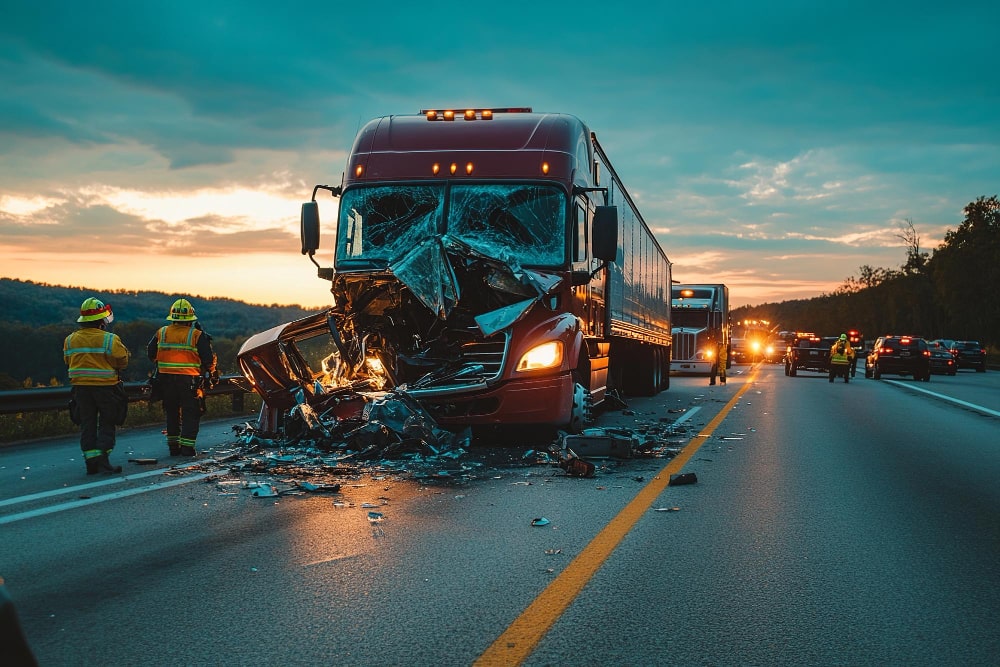
  • Truck Black Box Evidence: How ELD and EDR Data Proves Fault in Chicago Truck Accidents

    Truck Black Box Evidence: How ELD and EDR Data Proves Fault in Chicago Truck Accidents

    Modern commercial trucks carry two very different kinds of “black box” data. One system, the Electronic Logging Device, tracks whether the driver was legally allowed to be on the road. The other, the Event Data Recorder, captures exactly what the truck itself was doing in the seconds before a crash: speed, braking, steering input, airbag deployment. This page is the deep dive on EDR evidence and how it proves fault in a Chicago truck accident. Both types of data can be overwritten or destroyed if nobody acts fast.

    What Are Truck Black Boxes?

    “Black box” is trucking industry shorthand, not a single device. It usually refers to two separate systems that live in different parts of the truck and record entirely different information.

    Electronic Logging Devices (ELDs)

    The FMCSA’s ELD mandate required initial compliance starting in December 2017, and full enforcement arrived in December 2019 once the older AOBRD systems were phased out. Under 49 CFR Part 395, Subpart B, an ELD tracks a driver’s duty status, not the vehicle’s crash dynamics.

    ELD data answers a specific question: was this driver legally allowed to be behind the wheel at the moment of the crash? We cover the hours-of-service limits, how ELD records expose fatigue-related violations, and how those records get subpoenaed in our companion article, Electronic Logging Device (ELD) Data: Proving Trucker Hours Violations. The rest of this page focuses on the other half of the black box: the Event Data Recorder.

    Event Data Recorders (EDRs)

    An EDR is a separate recording function, usually built into the airbag control module or the engine control module, that exists for one purpose: to freeze a snapshot of vehicle performance data around a crash event.

    Unlike an ELD, an EDR does not track duty status or hours behind the wheel. It tracks physics: how fast the truck was going, whether the brakes were applied, how the driver moved the steering wheel, and whether the airbags fired. That data can contradict a trucking company’s version of events in ways eyewitness testimony never can.

    Not every mile a truck drives gets recorded. Most EDRs only lock in data once a triggering event occurs, something close to airbag deployment or an impact hard enough to cross the module’s programmed threshold. A minor fender bender that never crosses that threshold may leave nothing to download at all.

    What an EDR Actually Records

    Every EDR varies somewhat by truck manufacturer and module, but most capture some combination of the following in the seconds before and during a collision:

    • Vehicle speed in the seconds leading up to the crash
    • Accelerator pedal and throttle position
    • Brake switch status, including whether and when the brakes were applied
    • Steering input and steering angle
    • Change in velocity (delta-V) during the crash event
    • Antilock brake system and stability control activation
    • Seatbelt status for the driver
    • Airbag deployment timing and any pre-crash warning signals
    • Engine RPM and cruise control status
    • Time stamps tied to the ignition cycle

    Taken together, that data can rebuild the last several seconds before impact more precisely than any witness statement. A driver who claims he braked hard well before the crash either has the delta-V and brake switch data to back that up, or he does not.

    Which of these fields a given EDR actually stores depends on the truck’s make, model year, and which electronic modules are installed. A newer tractor with driver assistance features may also log whether automatic emergency braking or lane departure warnings activated in the moments before impact. An older truck may record only the basics: speed, brake status, and delta-V.

    How EDR Data Gets Extracted From the Truck

    EDR data does not sit on a screen waiting to be read. Pulling it off the module takes specialized equipment, typically a crash data retrieval tool such as the Bosch CDR system, connected directly to the vehicle’s diagnostic port or the module itself.

    Heavy trucks complicate this further. Many commercial engines store crash-relevant data inside the engine control module, and reading that data can require software specific to that engine manufacturer rather than a standard passenger-vehicle tool. The right technician has to use the right tool on the right module, and getting it wrong can corrupt or wipe the data entirely.

    Extraction also requires access. Someone has to physically connect to the truck, and in a contested case that access has to be authorized, whether through the trucking company’s cooperation, a preservation agreement, or a court order. We do not wait for the trucking company to volunteer this data. We move to secure physical and legal access before the truck goes back into service or gets sold off.

    Extraction is not something we handle from a distance. It means coordinating with an accident reconstruction expert, scheduling access to the vehicle, and downloading the data before repairs, an insurance total-loss sale, or salvage processing puts the module out of reach for good.

    Why the Clock Is Running on EDR Evidence

    EDR data typically captures only a short window before the crash, and that window can be overwritten by a later triggering event. A second hard-braking event, another minor collision, or even continued operation of the truck can push the original crash data out of memory before anyone downloads it.

    ELD records have a regulatory floor. Under 49 CFR 395.8(k)(1), ELD data has to be retained for six months from the date it was generated. EDR data carries no equivalent guarantee. If the trucking company keeps driving that truck, the evidence you need may already be gone by the time a claim gets filed.

    Large trucking companies often have rapid response teams at the scene within hours of a serious crash, working to protect the company’s interests before you have even left the hospital. That head start is exactly why we treat EDR preservation as an emergency rather than a formality.

    That is why we send a spoliation letter immediately, putting the trucking company and its insurer on formal notice to preserve the truck, the module, and every related record. Illinois treats the destruction of evidence a party had a duty to preserve as a form of negligence, under the doctrine set out in Boyd v. Travelers Insurance Co., 166 Ill. 2d 188 (1995). We walk through exactly what a preservation letter needs to say and how fast it needs to go out in Preserving Critical Evidence After a Truck Accident: Time-Sensitive Steps.

    Getting EDR Data Admitted in an Illinois Courtroom

    Pulling the data off the module is only half the job. Getting it in front of a jury means clearing foundational hurdles first.

    The party offering EDR data generally needs a witness, often the technician who performed the extraction, who can testify to how the download was done and that the tool and process were reliable. Chain of custody matters too. If there is a gap between the crash and the extraction where the truck was accessible to someone else, expect that gap to get challenged.

    From there, EDR reports are typically treated like other business and technical records, authenticated through testimony and often explained to the jury by an accident reconstruction expert who can translate raw data fields into a narrative of what the truck was actually doing. Without that expert framing, a printout of delta-V and brake switch values means little to a jury on its own.

    Trucking companies and their insurers often have their own accident reconstruction teams reviewing this data before a lawsuit is even filed. That is one more reason we move quickly to get independent access, rather than relying on the trucking company’s summary of what its own module supposedly shows.

    How Black Box Data Proves Fault

    EDR and ELD data do different jobs, but together they build a fuller picture of what went wrong.

    Say a truck rear-ends a stopped vehicle on I-90. The EDR can show the truck was traveling well above a safe following speed and that the brakes were not applied until less than a second before impact. That alone establishes a following-too-close violation. If the ELD data from the same trip shows the driver was in hour thirteen of a fourteen-hour duty window, the case for fatigue gets stronger without needing an admission from anyone.

    We also gather the physical evidence around the crash itself, including weight tickets, dash cam footage, maintenance logs, and dispatch records, alongside the black box data. Our companion guide on evidence to gather after a truck accident in Chicago covers what else we collect and why timing matters for each piece.

    What EDR Data Commonly Reveals

    The value of EDR evidence becomes clearest when you look at how it plays out in specific crash patterns.

    In a jackknife crash, steering and stability control data can show whether the driver overcorrected or whether the trailer began sliding before any steering input at all, a distinction that often separates driver error from a mechanical or load-related cause.

    In an underride crash, where a passenger vehicle slides beneath the trailer, speed and brake timing data can establish whether the truck driver had any real opportunity to stop or slow before impact.

    In a lane-change or sideswipe crash, steering angle data can show whether the truck drifted gradually, consistent with driver inattention, or moved abruptly, consistent with an evasive maneuver.

    None of these findings mean much in isolation. They matter because they either confirm or contradict what the trucking company’s driver and investigators say happened, and that gap is often where a case gets won.

    Dashcams and Trailer Telematics: A Third Layer of Data

    EDR and ELD data are not the only electronic record generated by a modern commercial truck. Two more sources have become routine in fleet operations over the past several years, and both can matter just as much as the black box itself.

    Forward and Driver-Facing Dashcams

    Many large carriers, and nearly all major parcel and freight companies, now run dual-facing camera systems. One lens watches the road ahead; the other watches the driver. These systems typically run on a rolling buffer, meaning ordinary driving footage gets overwritten within days unless a triggering event, hard braking, a collision sensor, or a manual flag, locks a clip in place.

    That rolling-buffer design cuts both ways. It means footage of the actual crash is often preserved automatically. It also means footage from the hours or days before the crash, showing a pattern of following too close or drifting out of lane, may already be gone by the time anyone thinks to ask for it. A preservation letter needs to specifically name dashcam footage, not just EDR data, or a carrier can plausibly claim it was never asked to hold onto it.

    Trailer Telematics and GPS Tracking

    Trailers increasingly carry their own tracking hardware, separate from the tractor, logging location, speed, and sometimes cargo-door status in real time. For a jackknife or a crash involving a detached or swinging trailer, this data can show exactly when and where the trailer separated from its expected path, information the tractor’s own EDR may not capture at all.

    Fleet management platforms like Samsara, Omnitracs, and Geotab aggregate ELD, dashcam, and telematics data into a single system. Knowing which platform a given carrier uses, something we identify early through the trucking company’s DOT filings and public fleet information, tells us exactly what to demand and from whom.

    When the Trucking Company Won’t Turn Over the Data

    A preservation letter is a request, not a guarantee. Some carriers cooperate. Others slow-walk, claim the data was “automatically overwritten,” or simply ignore the letter until a lawsuit forces the issue.

    Once litigation is filed, Illinois discovery rules give us tools a preservation letter alone does not. A subpoena duces tecum can compel a non-party fleet-telematics vendor to produce data directly. If the carrier itself refuses, a motion to compel puts the question in front of a judge, and a carrier that ignores a valid discovery request risks sanctions.

    If the data turns out to have been destroyed after the trucking company had a duty to preserve it, whether through a preservation letter, actual notice of a potential claim, or simply the foreseeability of litigation after a serious crash, Illinois courts can impose spoliation sanctions. Under the Boyd framework, that can include an adverse inference instruction telling the jury it may assume the missing evidence would have favored the injured party. In practice, that possibility alone often pushes a carrier toward cooperation rather than risk a jury being told to assume the worst.

    Illustrative Example: How the Data Can Change a Case

    The following is a hypothetical, not a claimed result from an actual case, offered only to show how this evidence functions in practice.

    Picture a rear-end collision where the trucking company’s initial position is that the passenger vehicle stopped suddenly and without warning. The EDR download shows the truck was traveling 12 miles per hour over the posted limit in the five seconds before impact and that the brakes were not applied until roughly 0.8 seconds before the collision, well below the reaction time a properly following-distance trucker would need. The trailer telematics confirm the truck had been following at a gap consistent with roughly one second, far under the recommended following distance for a fully loaded semi at highway speed. Combined, that data reframes the story from “sudden stop, unavoidable crash” to “following too close at an unsafe speed,” before a single witness ever testifies.

    Illinois Laws Governing Truck Accident Claims

    Statute of Limitations

    Under 735 ILCS 5/13-202, you have 2 years from the date of the accident to file a personal injury lawsuit. For a deeper look at filing deadlines, see our overview of the Illinois statute of limitations for personal injury.

    Modified Comparative Negligence

    Under 735 ILCS 5/2-1116, you can recover damages as long as you are not more than 50% at fault.

    EDR data plays directly into this fight. If the trucking company’s insurer argues you contributed to the crash, precise speed, braking, and steering data can either support or dismantle that argument long before a jury ever hears from an accident reconstructionist.

    Frequently Asked Questions

    How long do I have before EDR data might be lost?
    There is no fixed deadline written into federal or Illinois law for EDR retention specifically. In practice, treat it as urgent. A second hard-braking event or continued operation of the truck can overwrite the recording within days.

    Can I get this data myself without a lawyer?
    Technically, yes, if the truck is accessible and you have the right extraction tool. In practice, trucking companies rarely grant an unrepresented individual physical access to their vehicle, and any extraction you perform yourself may face a chain-of-custody challenge later.

    What if the police report already mentions black box data?
    A police report noting that data exists is not the same as having the data itself. Officers investigating a crash scene generally do not extract EDR data; that still requires a separate, specialized download.

    Does every commercial truck have an EDR?
    Most newer tractors do, but coverage is not universal, and older trucks or certain trailer configurations may lack one entirely. We confirm what’s actually installed on the specific vehicle involved rather than assuming.

    What happens if the trucking company claims the data was lost through no fault of their own?
    That claim gets tested, not accepted at face value. We look at when the preservation letter went out, what the carrier’s own data-retention policy says, and whether the truck kept operating after the crash. Courts have been willing to find spoliation even where a carrier claims the loss was accidental if a duty to preserve had already attached.

    Related Truck Accident Resources

    Free Consultation: Time Is Critical

    If you or a loved one was injured in a truck accident, contact Phillips Law Offices immediately. The sooner we can send preservation letters and begin evidence collection, the better your chances of securing the black box data that could prove your case.

    Call Phillips Law Offices at (312) 346-4262 today. Don’t let critical evidence disappear.

    Attorney Advertising. This page provides general information about Illinois law and is not legal advice. Reading it does not create an attorney-client relationship. Deadlines and outcomes depend on the specific facts of your case — speak to a licensed Illinois attorney about your situation.

  • Understanding Illinois Truck Accident Laws (Key Statutes You Should Know)

    Understanding Illinois Truck Accident Laws (Key Statutes You Should Know)

    Truck accidents in Illinois are governed by a complex mix of state traffic laws, federal trucking regulations, and local Chicago ordinances. If you have been injured in a collision involving a semi-truck or commercial vehicle, knowing these laws can make the difference between a denied claim and a full recovery. As Chicago truck accident lawyers, we guide our clients through this legal maze every day. Below, we explain the essential Illinois and federal laws that could impact your case in clear and practical terms.

    1. Illinois Statute of Limitations (735 ILCS 5/13-202)

    Under Illinois law, you generally have two years from the date of your accident to file a personal injury lawsuit. This deadline applies to all bodily injury claims, including those caused by truck collisions. If your claim involves property damage only, such as vehicle repairs, the deadline extends to five years under 735 ILCS 5/13-205.

    Why it matters: Missing this window can permanently bar your right to recover compensation, no matter how strong your case is. If you are unsure when your time limit runs out, contact us as soon as possible. We can verify your filing deadline and protect your rights from the very beginning.

    Read more about how timing affects your case in The Truck Accident Claim Process.

    2. Duty to Stop and Report (625 ILCS 5/11-402 and 625 ILCS 5/11-403)

    Illinois law requires every driver involved in a crash, especially those operating large commercial vehicles, to stop immediately at the scene, provide contact and insurance information, render aid if someone is injured, and report the accident to law enforcement.

    Failure to do so is not just negligent—it is a criminal offense. Truck drivers who flee or fail to report can face license suspension, fines, or even jail time. If you were hit by a truck that fled the scene, we can help identify the vehicle through camera footage, black box data, and police reports.

    Learn how evidence is preserved in What Does a Truck Accident Lawyer Do?.

    3. Commercial Insurance Requirements (625 ILCS 5/7-601)

    Trucking companies and drivers must carry higher insurance coverage than typical passenger vehicles. Illinois law requires minimum liability limits that can range from $750,000 to several million dollars, depending on the cargo type and route.

    Federal regulations under the FMCSA (49 CFR §387) also impose additional coverage requirements, especially for hazardous materials, interstate carriers, and passenger transport vehicles. This means there is often more insurance coverage available to pay for your medical bills, lost wages, and pain and suffering.

    However, dealing with multiple insurers can be complicated. We coordinate with all parties to ensure every responsible insurer is held accountable. See how compensation is calculated in How Is Compensation Determined After a Semi-Truck Wreck?.

    4. Comparative Fault in Illinois (735 ILCS 5/2-1116)

    Illinois follows a modified comparative negligence rule, meaning you can recover damages even if you were partly at fault, as long as your share of fault is less than 50%. If you are found 50% or more responsible, you cannot recover damages.

    For example, if your total damages are $200,000 but you are found 20% at fault, your compensation would be reduced to $160,000. Insurance companies often try to overstate fault to reduce payouts. Our team pushes back by using police reports, reconstruction experts, and witness statements to prove the truck driver’s true liability.

    Learn more about liability in Who Is Liable in a Truck Accident?.

    5. Federal Trucking Regulations (FMCSA Rules)

    Truck drivers and carriers operating across state lines must comply with Federal Motor Carrier Safety Administration (FMCSA) regulations. These include:

    • Hours-of-Service Limits (49 CFR §395): Drivers can only operate up to 11 hours after 10 consecutive off-duty hours.
    • Vehicle Maintenance (49 CFR §396): Trucks must be regularly inspected and documented.
    • Drug and Alcohol Testing (49 CFR §382): Mandatory pre-employment, random, and post-accident testing.
    • Weight and Load Restrictions: Overloaded or improperly secured cargo can cause catastrophic crashes.

    We review the driver’s logbooks, electronic records, and inspection reports to identify violations. Even a single FMCSA breach can establish negligence and strengthen your case.

    6. Chicago-Specific Ordinances and Truck Routes

    Chicago enforces specific truck routing rules to control heavy vehicle traffic. The Chicago Municipal Code (Chapter 9-72) restricts truck operations on certain residential streets and mandates designated truck routes. If a truck driver violates these routes, such as cutting through a prohibited area, that can serve as evidence of recklessness or negligence.

    Additionally, city data identifies high-risk intersections such as the I-90/I-94 Kennedy Expressway merge zones, Cicero Avenue near Midway, and the Pulaski Road industrial corridor. We use this data to support accident reconstruction and prove that a crash occurred in a known hazard zone.

    7. Damages and Compensation Under Illinois Law

    Illinois law allows victims of truck accidents to recover both economic and non-economic damages, including medical expenses, lost wages, property damage, pain and suffering, emotional distress, and loss of companionship. Punitive damages may also apply if the trucking company acted with gross negligence, such as forcing drivers to exceed legal hours or falsifying maintenance logs.

    Illinois truck accident laws and legal statute books

    8. Wrongful Death and Survival Actions

    If a loved one was killed in a truck accident, Illinois law provides two legal paths:

    • Wrongful Death Act (740 ILCS 180/1): Allows surviving family members to recover damages for loss of support, companionship, and emotional grief.
    • Survival Act (755 ILCS 5/27-6): Allows the estate to recover damages the deceased could have claimed if they had survived, such as medical expenses and pain.

    We handle both types of cases with compassion and precision to ensure every family receives justice and financial stability after an unimaginable loss.

    Learn more in What To Do After a Truck Accident in Chicago.

    Why These Laws Matter

    Truck accident cases are complex because they combine state, federal, and local laws. If your attorney does not understand how these rules overlap, key evidence can be missed or your claim could be dismissed on a technicality. Our role is to ensure every statute, regulation, and ordinance is leveraged to build the strongest case possible for you.

    Attorney Advertising. This page provides general information about Illinois law and is not legal advice. Reading it does not create an attorney-client relationship. Deadlines and outcomes depend on the specific facts of your case — speak to a licensed Illinois attorney about your situation.