
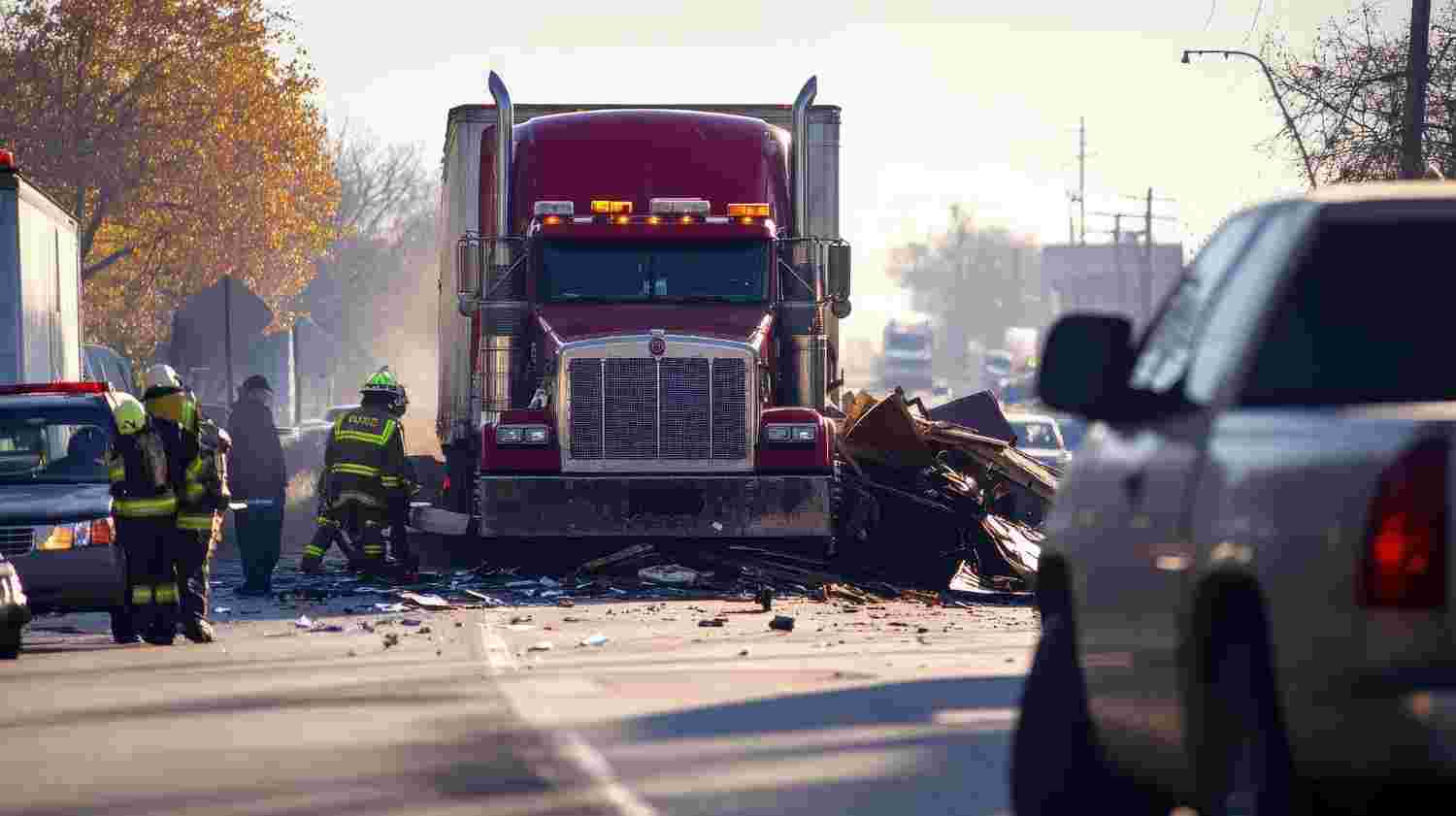
Amazon vans, FedEx trucks, and UPS trucks are everywhere on Chicago streets now. When one of them causes a crash, figuring out who pays gets complicated fast, and that complication is often by design.
We’ve handled these cases long enough at Phillips Law Offices to know how the corporate structures work, and how to get past them. Knowing who’s actually responsible is where every case starts.
For a broader look at this issue across the Chicago area, see our companion guide on Amazon, FedEx and UPS delivery truck crashes in Chicago.
The Rise of Delivery Truck Accidents
Delivery truck accidents have climbed fast, and it’s not one single cause.
- E-commerce growth has put more delivery vehicles on the road than ever before
- Pressure for same-day and next-day delivery creates rushed, fatigued drivers
- Many delivery drivers are inadequately trained or inexperienced
- Drivers face unrealistic delivery quotas that encourage unsafe driving
- Frequent stops and residential neighborhood driving increase accident exposure
Amazon alone delivers billions of packages a year, with thousands of vans working Chicago-area streets on any given day.
Here’s something worth understanding early: these vans and box trucks aren’t regulated like the semis you see on I-90 or I-294. Federal trucking rules, including the Hours of Service limits we cover in our guide to FMCSA violations and trucking negligence, generally apply based on a vehicle’s weight class.
A lot of delivery vans fall under those weight thresholds, which pulls them out of some federal safety rules that apply to heavier trucks. That doesn’t give these companies a free pass. It just means the negligence case usually has to be built on company policy and Illinois law instead of a federal violation.
Amazon Delivery Service Partner (DSP) Liability
Amazon built its delivery network to keep itself a step removed from liability, and the structure is worth understanding before you assume who’s on the hook. The company contracts with Delivery Service Partners, or DSPs: independently owned companies that Amazon selects, trains, and monitors to hire drivers and run routes under the Amazon brand.
When one of those Amazon-branded vans causes a crash, Amazon’s first move is usually the same. The company points to the DSP:
- The driver was employed by the DSP, not Amazon
- Amazon doesn’t control daily operations or driver conduct
- The DSP is solely responsible for any negligence
That shield has cracks in it. Depending on the facts, Amazon can end up on the hook anyway, through a few different legal theories.
How the DSP Model Actually Works
DSPs are not the same thing as Amazon Flex. Flex is the program where individual drivers use their own vehicles and sign up for delivery blocks through an app, working as independent contractors in the traditional gig-economy sense.
DSP drivers are different. They’re employees of a third-party company that Amazon approved to operate, one that runs Amazon-branded vans almost entirely inside guardrails Amazon sets.
Amazon determines the routes, the delivery windows, the uniform, and often the performance scorecard that decides whether the DSP keeps its contract at all. That distinction between Flex and DSP matters in a lawsuit, since both types of vehicles can say “Amazon” on the side but raise very different liability arguments.
Actual Control Over Operations
Amazon’s routing and scanning technology tells DSP drivers exactly what to deliver, in what order, and by when. DSPs that fall short on Amazon’s performance metrics can lose the contract entirely.
That level of day-to-day control is the same kind of evidence courts look at anywhere they’re deciding whether a “contractor” is really an employee in substance, regardless of what the paperwork says.
We’ve made a similar argument on this site around owner-operators and the trucking industry’s independent contractor defense, where federal regulation can make a motor carrier the statutory employer of a driver it technically doesn’t employ. That specific rule, found at 49 CFR 376.12(c)(1), was written for motor carriers operating under federal trucking authority.
Amazon’s DSP network isn’t that. It’s a genuinely different legal relationship, and no court has settled whether that statutory framework carries over to Amazon’s delivery operation. What does carry over is the underlying idea: control matters more than the label on the contract.
Negligent Selection of DSPs
Amazon can also be liable directly, not through the driver at all, if it kept working with a DSP it knew or should have known had a poor safety record. Choosing to keep sending routes to a DSP with a pattern of accidents or skipped training is its own kind of negligence.
Agency Theory
There’s also agency theory. When a driver wears the Amazon uniform, drives an Amazon-branded van, and is delivering an Amazon package to an Amazon customer, a person on the street has no way of knowing the driver technically works for someone else.
Some courts treat that appearance of authority as enough to make Amazon answer for the driver’s conduct.
FedEx Ground Contractor Liability
FedEx Ground runs on a similar independent contractor model, and it’s been fighting over that classification in court for years. Some rulings have gone against the company, and others haven’t.
The outcome tends to turn on how much control FedEx actually exercised over the specific driver in the specific case in front of the court.
The Misclassification Litigation History
FedEx Ground’s contractor model has drawn sustained legal challenges over the years, mostly around whether the “independent contractor” label matches how the company actually runs its operation.
Contractors who wear the uniform, drive a company-specified vehicle, follow a company route, and answer to company performance standards have argued in various states that they were misclassified. The results have not been uniform, with some jurisdictions siding with drivers and others upholding the contractor structure.
We won’t cite you specific case outcomes here, because the law in this area keeps moving and the facts of each dispute matter. What matters for your case is that this litigation history exists, and it gives your attorney real legal ground to stand on when FedEx tries to hide behind the contractor label.
FedEx Ground vs. FedEx Express
Not all FedEx drivers operate under the same model. FedEx Express, the division that handles overnight and time-sensitive shipments, has historically relied on direct employee drivers.
FedEx Ground, which handles standard ground shipping, relies on the contractor network described above. Figuring out which FedEx entity the driver actually worked for, and under which model, shapes the entire liability theory from the start of a case.
Key factors courts consider when determining FedEx liability include:
- Vehicle requirements – FedEx dictates vehicle specifications, appearance, and maintenance standards
- Route control – Contractors must service assigned routes according to FedEx schedules
- Uniform requirements – Drivers must wear FedEx uniforms and follow appearance guidelines
- Training programs – FedEx provides mandatory training that contractors must complete
- Termination authority – FedEx can terminate contractors for performance or safety issues
The more control FedEx keeps for itself, the weaker its case for avoiding vicarious liability, the legal principle that can make a company answer for the negligent acts of the people working under it.
UPS Employee Liability
UPS runs differently. Most UPS drivers are direct employees, not contractors, and many are represented by the Teamsters union under a collectively bargained contract.
That employment relationship simplifies the liability question considerably. When a UPS driver causes a crash while doing their job, the company is typically liable under a doctrine called respondeat superior, Latin for “let the master answer.”
In plain terms: an employer is responsible for the negligent acts its employees commit while working within the scope of their job.
Straightforward doesn’t mean easy. UPS still fights these claims hard, and it has the legal resources to do it.
The Legal Test Illinois Courts Actually Use
Every theory above eventually runs through the same question: was this driver really an employee, or really a contractor? Illinois courts don’t just read the contract and stop there. They look at how the relationship actually functioned, weighing several factors together rather than any single one:
- Right to control the manner of work – not just the end result, but how the job gets done day to day
- Method of payment – a fixed salary looks more like employment than a per-delivery or per-route fee
- Who supplies the tools and equipment – a company-branded van, uniform, and handheld scanner all cut toward employment
- Right to discharge – the more freely a company can terminate the relationship at will, the more that relationship resembles employment
- Whether the work is part of the company’s regular business – delivering packages is Amazon’s and FedEx’s actual business, not an incidental side task
No single factor decides the case. A DSP driver might score as a contractor on paper and as an employee on every factor above once the facts come out in discovery.
That’s the whole game in these cases.
Types of Delivery Truck Accidents
Delivery trucks crash differently than long-haul semis do, because they work differently.
- Backing accidents – Frequent stops require constant reversing in driveways and parking areas
- Door zone collisions – Drivers opening doors into traffic or pedestrians
- Double-parking crashes – Blocking traffic lanes creates hazards for passing vehicles
- Pedestrian strikes – Rushing between stops in residential areas with foot traffic
- Intersection collisions – Running red lights or stop signs to meet delivery quotas
- Distracted driving – Using delivery apps and GPS while operating vehicles
Proving Delivery Company Negligence
A strong case against a delivery company usually rests on a handful of things we go looking for right away.
Unrealistic Delivery Quotas
When a company’s quotas force drivers to speed, skip breaks, or cut corners just to keep the job, that company shares in the liability when someone gets hurt as a result.
Inadequate Training
Delivery companies are supposed to train drivers on defensive driving and safe vehicle operation before putting them on the road. Rushing that process just to fill a route faster creates liability when a poorly trained driver causes a wreck.
Negligent Hiring
Companies are expected to run real background checks before putting someone behind the wheel. A driver with a history of DUIs or repeated accidents on their record is a red flag a company can’t just ignore.
Hours and Fatigue Issues
Smaller delivery vehicles often fall outside the federal Hours of Service rules that govern big rigs, since those rules are generally tied to a vehicle’s weight class. That doesn’t get the company off the hook.
A company that pushes drivers into excessive hours and predictable fatigue is still liable under ordinary negligence principles, federal exemption or not.
Telematics, Cameras, and Digital Evidence
Modern delivery vehicles generate a lot of data. Many run GPS telematics and in-cab monitoring systems that can capture a driver’s speed, braking, and route in the moments before a crash.
That data can make or break a case, and it usually needs to be requested and preserved quickly before it’s overwritten or discarded under a routine retention policy.
We cover how this kind of digital evidence gets used to prove fault in our guide to truck black box and ELD evidence. The same principles apply here, even though these vehicles are smaller than the semis that guide focuses on.
If you’ve been hit by one of these vans or trucks, getting a preservation request out fast is one of the more consequential things your attorney can do in the first days of your case.
Insurance Coverage in Delivery Truck Accidents
How much insurance is actually available depends heavily on which company’s vehicle hit you, and how that company is structured.
- Amazon DSPs – Required to carry minimum liability coverage, but Amazon also maintains umbrella policies
- FedEx contractors – Must carry specified insurance minimums, with FedEx maintaining excess coverage
- UPS – Self-insured with substantial resources to pay claims
- Independent gig drivers – May have only personal auto insurance with commercial exclusions
Finding every layer of available coverage, not just the obvious one, is often what separates an adequate settlement from a real one.
The Independent Contractor Defense
This defense shows up in nearly every one of these cases: the company says the driver was an independent contractor, so vicarious liability doesn’t apply.
Beating that argument means showing the relationship looked a lot more like employment than the paperwork admits:
- The company controls how work is performed, not just results
- Drivers must follow company procedures and guidelines
- The company provides equipment, uniforms, or supplies
- Drivers cannot work for competitors or set their own schedules
- The company can terminate the relationship at will
Illinois courts look at how the relationship actually functions, not just what the contract calls it, when they decide worker classification questions like this one.
A Hypothetical: The Same Crash, Two Different Defendants
The following is an illustrative scenario, not a description of any actual case or guaranteed outcome.
Picture two nearly identical crashes on the same day. In the first, a FedEx Ground contractor’s van rear-ends a car at a stoplight on a residential street. In the second, a UPS driver does the exact same thing three blocks away.
For the UPS crash, liability is close to automatic once negligence is shown. The driver is a UPS employee, driving a UPS-owned truck, doing UPS work. Respondeat superior applies, and the fight moves straight to the value of the claim.
The FedEx Ground crash takes a different path. FedEx’s first move is to point to the contractor’s business entity, hand over a certificate of insurance, and argue the case stops there. It doesn’t, if the facts show FedEx set the route, required the uniform, dictated the vehicle specifications, and could terminate the contract for missed stops. Two crashes, same negligence, same street, and one takes months longer to resolve because of a corporate structure that has nothing to do with what actually happened on the road.
Damages in Delivery Truck Accident Cases
If you’ve been hurt in one of these crashes, compensation isn’t limited to your medical bills.
- Medical expenses and ongoing treatment costs
- Lost wages and reduced earning capacity
- Pain and suffering
- Property damage
- Permanent injuries or disabilities
- Wrongful death damages
When the evidence shows a company chose profit over safety and someone got hurt because of it, punitive damages can come into play to punish that choice specifically.
Frequently Asked Questions
Can I sue Amazon directly, or only the DSP that employed the driver?
Both, in most cases. Naming Amazon alongside the DSP preserves every legal theory available – negligent selection, agency, and direct vicarious liability if the control facts support it – rather than betting the whole case on one theory before discovery is even done.
Does it matter if the DSP carries its own insurance policy?
It affects strategy, not whether Amazon can be named. A DSP’s policy limits are often lower than what a serious injury actually costs, which is exactly why identifying every layer of coverage, including Amazon’s own umbrella policy, matters so much in these cases.
What if UPS or FedEx says the driver was off the clock?
That claim gets tested against real records: dispatch logs, delivery-app timestamps, and the route assignment for that day. “Off the clock” is a defense a company has to prove, not a statement that ends the conversation.
How is FedEx Express different from FedEx Ground for a liability claim?
FedEx Express drivers are typically direct employees driving company-owned trucks, which puts those claims closer to the UPS model above. FedEx Ground relies on the contractor network, which means the independent-contractor fight described throughout this page applies.
Contact Phillips Law Offices After a Delivery Truck Accident
These cases require attorneys who understand the corporate structures these companies build specifically to complicate your claim. At Phillips Law Offices, we’ve built the experience to take on Amazon, FedEx, and other major delivery companies directly.
Contact us at (312) 346-4262 for a free consultation. We’ll investigate what happened and identify everyone who’s legally responsible.
Then we fight to hold them accountable, and we don’t let corporate legal tactics stand between you and the compensation you’re owed.
Attorney Advertising. This page provides general information about Illinois law and is not legal advice. Reading it does not create an attorney-client relationship. Deadlines and outcomes depend on the specific facts of your case — speak to a licensed Illinois attorney about your situation.