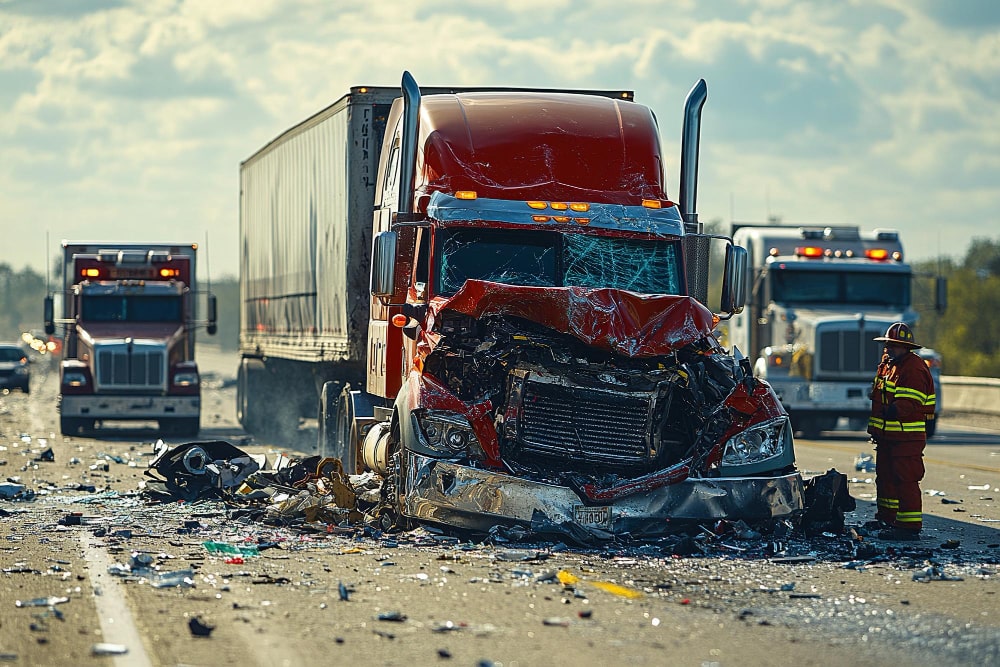
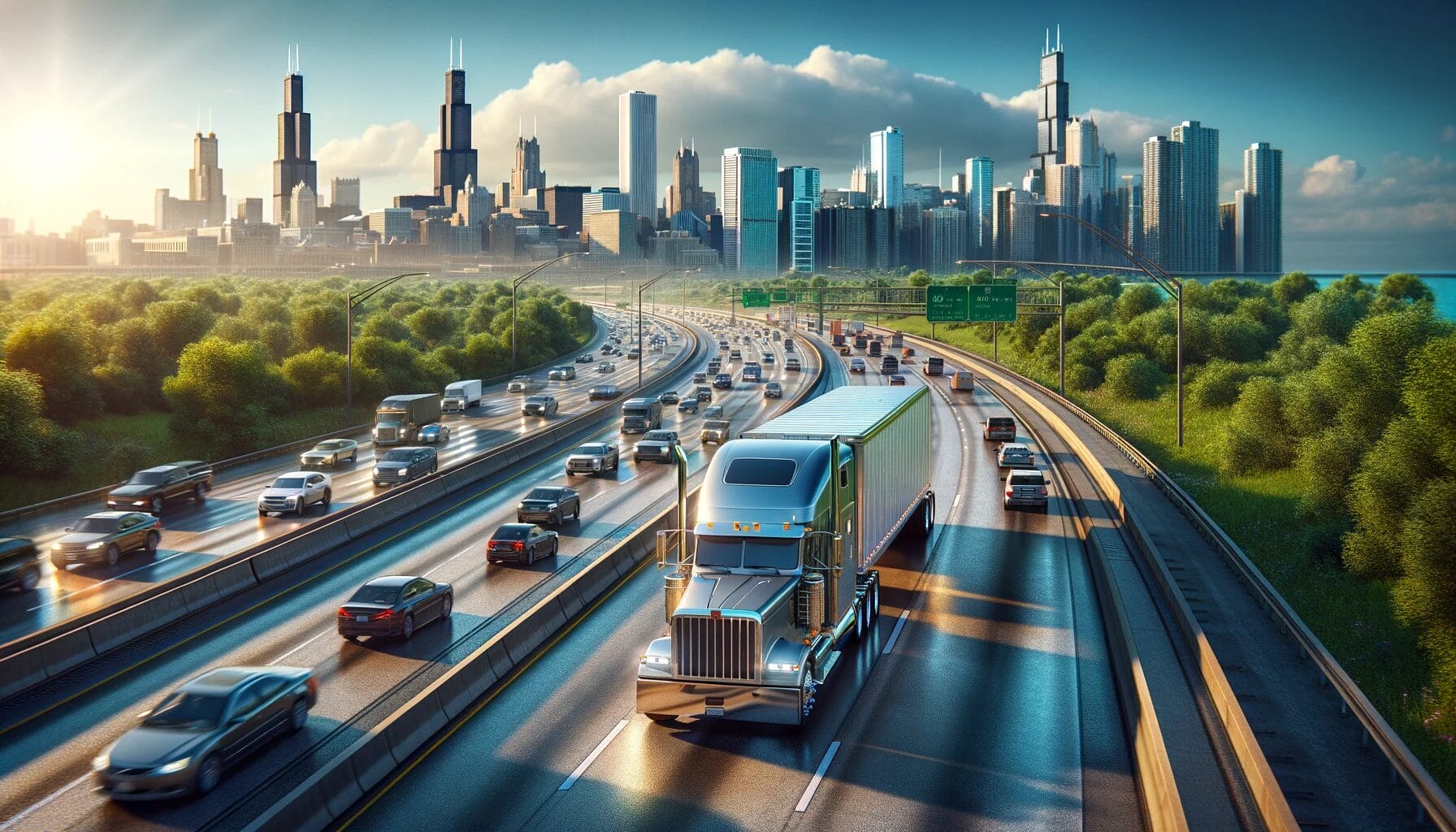
Chicago’s expressway system carries more commercial truck traffic than almost any other metro area in the country. Where I-90, I-94, and I-294 come together, you get one of the busiest freight corridors in the nation, and one of the most dangerous for truck crashes.
We’ve represented clients hurt in truck crashes on all three of these highways. Knowing where and why these wrecks happen matters if you drive these roads every day, and it matters even more once one of them has already put you in the hospital.
Why Chicago Is the Trucking Capital of America
Chicago sits at the center of the country’s freight network, and that position creates real danger for everyone sharing the road. According to the Illinois Department of Transportation (IDOT), Illinois highways move more than 500 million tons of freight every year, and a large share of it funnels through the Chicago metro area.
- Six major interstate highways converge in Chicago
- The region is home to the nation’s largest intermodal rail facilities
- O’Hare International Airport generates substantial truck traffic
- Distribution centers in the I-55, I-80, and I-88 corridors feed trucks into the system
- East-West and North-South freight routes all pass through Chicago
No other city in the Midwest asks its highways to do this much work. That concentration of trucks is exactly what turns an ordinary rush hour into a serious accident risk.
I-94: The Dan Ryan and Kennedy Expressways
I-94 through Chicago, made up of both the Dan Ryan and Kennedy expressways, consistently ranks among the most dangerous truck corridors in Illinois.
Dan Ryan Expressway Dangers
The Dan Ryan carries an average of 300,000 vehicles daily, with commercial trucks making up a meaningful share of that count. The danger here isn’t just volume. It’s geometry.
The Circle Interchange stacks ramps from I-90, I-94, and I-290 into a tight footprint with short weave distances, so a truck entering from one direction has very little room to merge before the next lane change is already on top of it. The Chinatown curve compounds that problem. Its radius forces a speed reduction that a loaded semi, with a center of gravity well above a passenger car’s, can misjudge and roll.
Key danger zones include:
- The Circle Interchange – Where I-90/94 meets I-290, featuring tight curves and merging traffic
- The 95th Street interchange – Heavy truck traffic accessing the Chicago Skyway
- Express/local lane transitions – Trucks moving between lanes create dangerous weaving patterns
- Chinatown curve – Sharp turns that have caused numerous truck rollovers
Kennedy Expressway Hazards
The Kennedy sees intense truck traffic serving O’Hare Airport and connecting to I-294. The O’Hare interchange itself is a knot of ramps feeding I-190 and terminal-bound traffic, and trucks trying to find their lane in that mix don’t get much warning before they need to commit. Common accident locations include:
- The O’Hare interchange – Complex merging with I-190 and airport-bound traffic
- Montrose Avenue curves – Where trucks must navigate tight bends at highway speed
- Express lane access points – Limited merge areas create dangerous conditions
I-90: The Jane Addams and Skyway
I-90 handles heavy truck traffic connecting Chicago to Wisconsin and the northwest suburbs. The Jane Addams Memorial Tollway sees some of the highest truck percentages in the state, and a lot of that traffic is coming off long, monotonous stretches of interstate where fatigue quietly sets in before a driver ever notices.
High-Risk Segments
- Elgin area interchanges – Where I-90 meets Route 20 and Route 25
- Rockford vicinity – Long-haul trucks entering from Wisconsin often show fatigue
- O’Hare-area convergence – Where I-90 joins I-94 and I-294
Chicago Skyway
The Skyway connects Chicago to Indiana and sees heavy truck traffic serving the Indiana toll road. It’s also an elevated structure over the Calumet River, and elevation changes everything for a high-profile trailer. Crosswinds that a car driver barely feels can push a loaded trailer sideways enough to matter. The elevated structure presents unique dangers:
- Wind exposure makes trucks difficult to control
- Limited shoulders leave no room for error
- Toll plazas create sudden speed changes
I-294: The Tri-State Tollway
I-294 circles Chicago’s western suburbs and handles enormous truck volumes connecting I-80, I-88, I-90, and I-94. IDOT data consistently shows I-294 among the highest crash corridors in the state.
Critical Danger Zones
The Northbrook Court area is a good example of how a highway can turn dangerous without anyone changing the speed limit. Three lanes narrow into a shorter section, traffic that was spread out gets funneled together, and a truck that was maintaining safe following distance a mile back suddenly has none. Critical danger zones include:
- I-294/I-80 interchange – One of the busiest freight intersections in the Midwest
- I-294/I-88 junction – Where trucks from the East-West Tollway merge onto the Tri-State
- O’Hare vicinity – Airport freight traffic creates congestion and accident risk
- Northbrook Court area – Where three-lane sections narrow, creating bottlenecks
Why Truck Accidents Are More Severe on These Highways
Several factors make truck crashes on Chicago expressways particularly catastrophic.
High Speed Differentials
When traffic slows suddenly, fully loaded trucks traveling at 65+ mph cannot stop in time. The speed differential between stopped traffic and an approaching truck is what turns a routine slowdown into a devastating rear-end collision.
Limited Escape Routes
Many Chicago expressway sections have concrete barriers on both sides. Those barriers exist to keep out-of-control vehicles from crossing into oncoming traffic, but they also mean that when a truck loses control, there’s nowhere for it, or the cars around it, to go.
Multi-Vehicle Pileups
High traffic density means truck accidents often involve multiple vehicles. A single truck crash can trigger chain-reaction collisions involving dozens of cars, and fog or black ice on an elevated section only makes that chain longer.
Hazardous Cargo
Industrial chemicals, fuel, and other hazardous materials regularly travel these routes under federal hazmat placarding rules. Crashes involving hazmat loads can create secondary dangers including fires, explosions, and toxic releases, on top of the impact injuries themselves.
Construction Zones and Lane Closures
Chicago’s tollway system is more or less permanently under construction somewhere. Widening projects on the Jane Addams corridor and periodic rebuilds around the Circle Interchange have narrowed lanes and shifted traffic patterns for years at a stretch. A truck that has no margin for error on a normal day has even less when a concrete barrier sits eighteen inches from its mirror.
Weather Exposure
Lake Michigan does not make Chicago winters easier on truckers. Lake-effect snow bands can hit the Kennedy and the Skyway hard while inland sections stay clear, and bridge decks and elevated ramps ice before the pavement around them does. A driver who left Milwaukee in clear weather can hit a wall of snow squall with no warning by the time they reach the O’Hare-area convergence.
Common Causes of Truck Accidents on Chicago Highways
Our investigation of Chicago expressway truck crashes turns up the same causes again and again:
- Driver fatigue – Long-haul drivers pushing through Chicago after hours on the road
- Congestion-related crashes – Trucks unable to stop for sudden traffic slowdowns
- Lane change accidents – Trucks changing lanes without seeing vehicles in blind spots
- Construction zone crashes – Narrow lanes and barriers leave no margin for error
- Weather-related incidents – Snow, ice, and rain affect truck handling on curves
- Mechanical failures – Brake problems, tire blowouts, and steering failures
- Distracted driving – Truckers using phones, GPS, or dispatch systems while driving
IDOT Crash Data: The Numbers
According to Illinois Department of Transportation crash reports, Cook County consistently leads the state in commercial vehicle accidents. We want to be upfront about these figures rather than just repeat them: they’re the numbers that show up most often across state and industry crash reporting, but we haven’t traced every one back to a single published report, so treat them as commonly cited rather than gospel. Figures you’ll see include:
- Illinois averages over 10,000 truck crashes annually statewide
- Approximately 30% of fatal truck crashes occur in the Chicago metropolitan area
- Truck crashes on interstates are more likely to result in fatalities than crashes on other roads
- Peak accident times coincide with rush hour congestion and overnight freight movements
Jurisdiction and Venue: Which Court Hears Your Case
Here’s something most drivers never think about until they need a lawyer: a crash on I-294 doesn’t automatically belong to any one courthouse.
I-294 alone crosses Cook, DuPage, and several collar county lines as it loops around the city. I-90 runs through Cook, Kane, and DuPage counties on its way to the Jane Addams corridor. I-94 stays mostly in Cook County within the city but continues into Lake County to the north. Under Illinois venue law, a lawsuit generally has to be filed either in the county where a defendant resides or does business, or in the county where the crash itself happened. On a highway that changes counties every few miles, the exact interchange or mile marker where the collision occurred can decide whether your case lands in the Daley Center in Cook County or a courthouse in Wheaton, Waukegan, or somewhere else entirely.
Most Chicago-area truck crashes we handle do end up in Cook County Circuit Court, simply because that’s where most of these corridors run and where most trucking defendants can be served. But venue isn’t the only fork in the road. If the trucking company or driver is based outside Illinois, and the amount at stake is large enough, the defense can often move the case into federal court instead of state court. We’ve written separately about why a truck accident case may end up in federal court, and it’s worth understanding before you assume your case will be heard where you filed it.
None of this is something you should try to work out on your own after a crash. Which courthouse hears your case can affect everything from the jury pool to how long the case takes, and getting it wrong can cost you time you don’t have.
Gathering Evidence After a Highway Truck Crash
Highway crashes leave behind more evidence than a typical fender bender, and almost all of it has a clock running on it.
IDOT and the Illinois Tollway both run traffic camera networks along these corridors, mainly for monitoring congestion rather than for permanent recordkeeping, and the footage from any given camera typically only sits on the system for a limited window before it’s overwritten. Exactly how long that window is depends on the agency and the specific camera, so we don’t treat any single number as reliable until we’ve confirmed it with the agency that controls that footage. What we do know is that waiting even a couple of weeks to ask can mean the footage is already gone.
Beyond camera footage, a serious highway crash usually generates an official incident record, whether from IDOT’s emergency traffic patrol response or from the Illinois State Police, who patrol the expressway and tollway system rather than local city police. Serious and fatal crashes are often handled by dedicated state police crash reconstruction personnel, who document skid marks, debris fields, and vehicle positions before the roadway reopens to traffic. That documentation can disappear the moment the scene gets cleared, which is exactly why we push to request it fast.
We’ve put together a more detailed breakdown of the time-sensitive steps for preserving evidence after a truck accident, and it applies directly to a highway crash. The short version: the sooner a preservation letter goes out to the trucking company, the camera operator, and the investigating agency, the better the odds that the evidence still exists when your case needs it.
Protecting Yourself on Chicago Expressways
You can’t control how a truck driver handles the Circle Interchange or the Skyway in a crosswind. You can control some of your own exposure:
- Avoid truck blind spots – If you can’t see the truck’s mirrors, the driver can’t see you
- Never cut off trucks – They need significantly more distance to stop than passenger cars
- Pass trucks quickly – Don’t linger alongside a semi-truck
- Leave extra following distance – Allow room to stop if a truck has problems ahead
- Watch for tire blowouts – Keep distance to avoid flying debris
- Be extra cautious in construction zones – Trucks have less room to maneuver
Contact Phillips Law Offices After a Highway Truck Accident
If you’ve been injured in a truck accident on I-90, I-94, I-294, or any Chicago-area expressway, you need experienced legal representation. These cases involve complex investigations, multiple potentially liable parties, and aggressive insurance company tactics.
Contact Phillips Law Offices today for a free consultation. We’ve successfully represented truck accident victims throughout the Chicago area and will fight to secure the compensation you deserve.
Attorney Advertising. This page provides general information about Illinois law and is not legal advice. Reading it does not create an attorney-client relationship. Deadlines and outcomes depend on the specific facts of your case — speak to a licensed Illinois attorney about your situation.