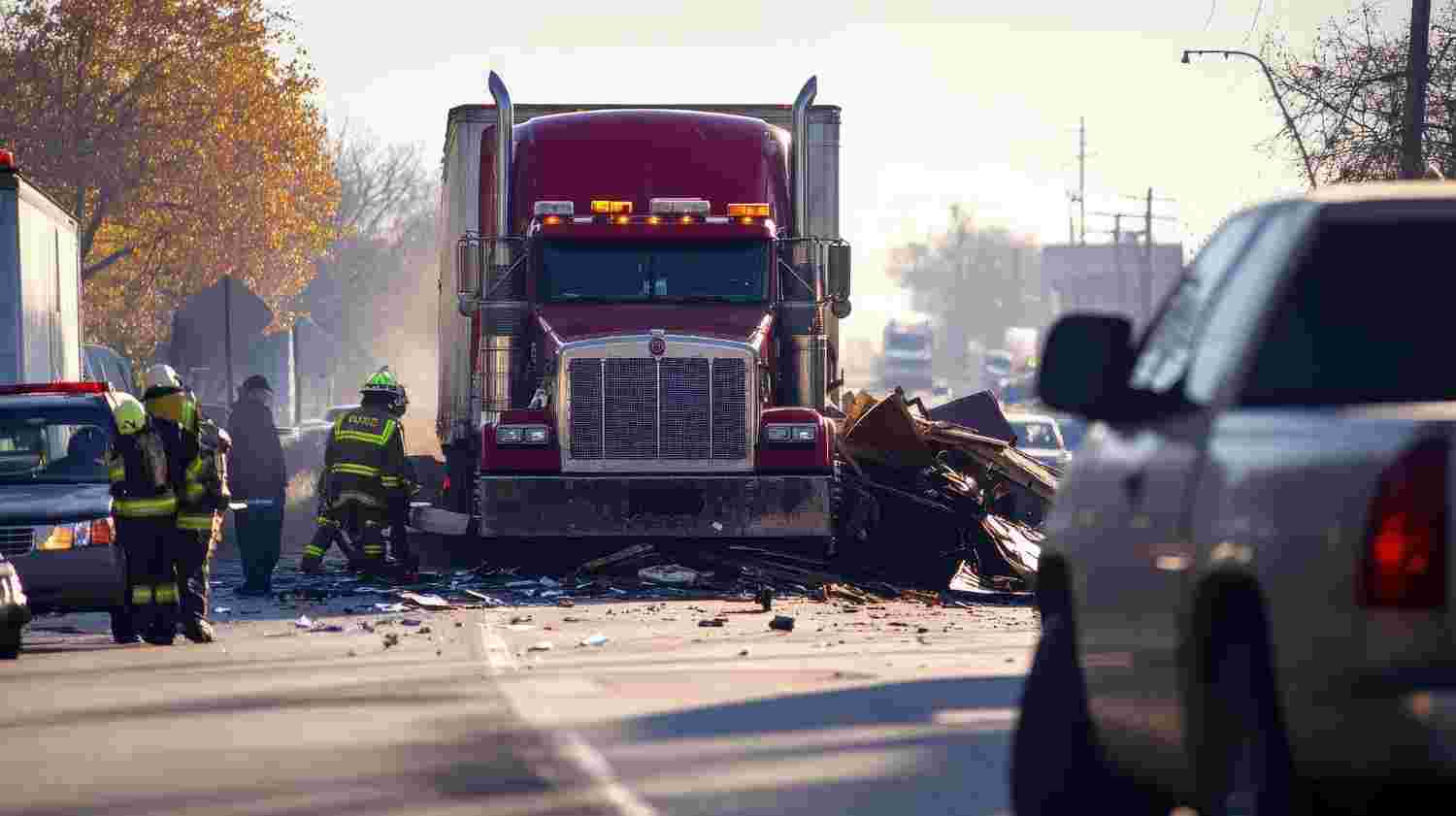
Tag: truck accident evidence

  • Truck Brake Failure Accidents: When Maintenance Records Tell the Story

    A truck brake failure accident rarely comes out of nowhere. In case after case we’ve handled, the brakes didn’t fail on their own. They were allowed to fail, through skipped inspections, ignored repair orders, or maintenance nobody wanted to pay for.

    Understanding truck brake failure accident liability means looking past the crash itself and into the maintenance history that came before it. Federal regulations set clear standards for brake performance and upkeep. When a carrier ignores those standards, the records almost always show it.

    This article offers general legal information. Talk to a licensed Illinois attorney about the specifics of your situation.

    Federal Brake Standards Are Not Suggestions

    Commercial trucks running interstate have to meet the brake performance standards in 49 CFR Part 393, Subpart C. Those rules set stopping distances based on a vehicle’s weight and speed, cap how far a brake can be out of adjustment, and define the mechanical condition every part of the brake system has to be in.

    A truck that can’t stop within the required distance is operating illegally. So is a truck whose brakes are adjusted past the allowed slack limits. Neither one is a gray area.

    Part of that subpart requires brake lines to be protected from heat, abrasion, and road hazards. Another section sets the adjustment limits that determine when a brake counts as out of adjustment.

    These aren’t fine print buried in a rulebook nobody reads. They’re the floor. A carrier operating below that floor has already broken federal law before a single truck leaves the yard, let alone before it hits another vehicle on the road.

    Pre-Trip Inspections and What Drivers Are Required to Do

    Under 49 CFR Part 396, every driver has to complete a pre-trip inspection at the start of each day the vehicle is used and write down anything wrong with the truck. If a driver flags a brake problem on the Driver Vehicle Inspection Report, known as a DVIR, the carrier has to fix it before that truck goes back into service, or put in writing that no repair was needed.

    That paper trail matters more than most people realize.

    If a driver flagged a brake issue two days before your crash and the truck rolled out anyway, that DVIR is direct evidence the carrier knew and sent the truck out regardless.

    The opposite pattern is just as telling. When DVIRs show months of clean brake reports right up until a catastrophic failure, that raises a different question: were inspections actually happening, or were drivers signing off without really looking at the brakes?

    We’ve seen both versions of this play out in real cases.

    Maintenance Records: What They Show and Why They Disappear

    49 CFR § 396.3 requires carriers to keep inspection, repair, and maintenance records on every vehicle they operate, for as long as the vehicle is in their control and for one year after it leaves their fleet.

    One year sounds like plenty, until you remember that a crash investigation often starts months after the underlying problem, deferred maintenance the carrier never got around to, was already sitting in those files.

    Maintenance records can tell a story of neglect: brake adjustments that ran late, lining replacements that got skipped, repeated out-of-adjustment findings with no repair order to follow.

    They can also tell a different story. Records that look suspiciously clean sometimes mean the opposite of what they appear to show, not proof of compliance, but a sign the paperwork got cleaned up after the fact.

    This is why attorneys representing crash victims send preservation letters to carriers right after a serious collision. Once a carrier gets notice that a lawsuit is coming, letting those records disappear becomes spoliation, a legal term for destroying evidence you had a duty to keep, and it creates real problems for that carrier at trial.

    If you are pursuing Chicago truck accident claims, how fast your attorney moves on evidence preservation is often the difference between having the maintenance records and not having them at all.

    CVSA Data: Brake Violations Are the Leading Out-of-Service Reason

    The Commercial Vehicle Safety Alliance (CVSA) runs an annual Brake Safety Week, when inspectors across North America pull trucks off the road and check their brakes against federal standards. Year after year, brake-related violations account for a large share of all out-of-service orders issued during that week. That means trucks pulled off the road because their brakes were too dangerous to keep driving on.

    These aren’t outlier trucks that got unlucky. They point to an industry-wide pattern, brakes that don’t get maintained on schedule and drivers running equipment they already suspect is marginal.

    Here’s where it gets uncomfortable: when a CVSA inspector finds a brake out of adjustment during a random roadside stop, that brake was almost certainly out of adjustment well before the inspector ever showed up. It didn’t happen that morning.

    An attorney can pull a carrier’s roadside inspection history through the FMCSA’s SAFER system and use it to show a pattern of violations that existed before your crash, not just after it.

    Who Is Responsible When Brakes Fail

    Liability in a brake failure crash usually doesn’t land on just one party.

    The motor carrier carries primary responsibility for keeping the vehicle maintained under Part 396. The driver may share in that responsibility if pre-trip inspection duties were ignored. A third-party maintenance contractor can be liable if the repair work itself was done negligently. And in rarer cases, a parts manufacturer may face product liability exposure if a defect in the brake component caused or contributed to the failure.

    Illinois courts apportion fault among everyone responsible. That means even when a carrier insists the brakes were just serviced, a real investigation can turn up other defendants who share in what happened.

    Talk to a Chicago Attorney: Free Consultation

    If you were hurt in a crash and suspect brake failure played a role, the most useful thing you can do right now is talk to an attorney before the maintenance records that matter age out or disappear for good.

    Phillips Law Offices handles truck accident cases in Chicago and throughout Illinois. Call (312) 346-4262 or visit our contact page to schedule a free consultation. Reviewing your case costs you nothing and commits you to nothing.

  • Why the Trucking Company’s Investigators Show Up Before You Leave the Hospital

    A serious truck crash happens. Within hours, sometimes before the injured person has even been treated at the hospital, a trucking company investigator is already standing at the scene.

    That is not a coincidence. It is not the carrier checking in out of concern.

    Large carriers send rapid-response teams to serious crashes as standard operating procedure. We’ve watched it happen the same way, case after case: while the injured person is still in an exam room, someone from the trucking company is already working the scene.

    Understanding why matters. It changes how you should think about everything that happens in the days after the crash.

    This article provides general legal information. Consult a licensed Illinois attorney for advice specific to your situation.

    Carriers Are Required to Investigate Serious Accidents

    There’s a legitimate reason carriers investigate. Federal law requires it.

    Under 49 CFR 390.15, every motor carrier has to keep an accident register: a log of crashes involving a fatality, an injury serious enough to need treatment away from the scene, or property damage above a set dollar threshold. Carriers have to hold onto these records for three years and hand them over to federal or state officials on request.

    That’s a real institutional duty. Trucking companies are required to document what happened and gather the facts.

    The team that shows up to do that documenting is usually not one person. It’s an attorney, someone whose job is reconstructing how the crash happened, and a claims investigator working for the carrier’s insurer.

    They photograph the scene. They pull the truck’s electronic data. They talk to witnesses. They document the physical evidence, thoroughly and fast.

    None of that is improper. It’s competent, professional work.

    Here’s where it gets uncomfortable: that same competent work serves the carrier’s legal defense just as much as it serves its regulatory compliance.

    The Litigation Interest Behind the Investigation

    A rapid-response team is not a neutral referee.

    The carrier or its insurer puts the team together, directs it, and receives its findings. Everything that team documents gets written down in a way that supports the carrier’s account of the crash.

    Here’s the flip side: evidence nobody on your side asks for in time can simply disappear.

    This imbalance shapes truck accident cases more than almost anything else.

    The carrier’s team shows up funded, organized, and already briefed on what to do. Meanwhile you’re in a hospital bed, and your family is trying to hold everything together.

    By the time a lawyer is retained and starts digging, days or weeks have often gone by. Data gets overwritten. Rain washes away skid marks. Witnesses move on with their lives.

    Whatever the carrier wrote down on day one becomes the starting point for the whole case. Sit with that for a second: the side that may be at fault got to write the first draft of what happened, uncontested, while you were still in a hospital gown.

    Illinois Spoliation Law and the Duty to Preserve Evidence

    Illinois doesn’t treat spoliation, the destruction or loss of evidence relevant to a legal claim, as its own standalone claim. It’s analyzed as a form of negligence, following the Illinois Supreme Court’s decision in Boyd v. Travelers Insurance Co., 166 Ill. 2d 188 (1995): a party who owed a duty to preserve evidence, breached it, and thereby cost the other side the ability to prove their case, can be held responsible.

    Beyond that negligence theory, a court also has its own tools. In Shimanovsky v. General Motors Corp., 181 Ill. 2d 112 (1998), the Illinois Supreme Court addressed sanctions for destroying evidence relevant to anticipated litigation, real consequences that can range from evidentiary penalties to dismissal or a default judgment.

    The standard the court set is straightforward. The duty to preserve evidence kicks in once a party knows, or reasonably should know, that the evidence matters to litigation that’s coming.

    Think about what it means when a carrier sends a rapid-response team to your crash scene within hours.

    It’s hard for that carrier to later claim it didn’t see litigation coming. The team’s presence is the proof.

    That means the duty to preserve everything relevant, electronic logging device data, ELD records, maintenance logs, driver qualification files, dispatch communications, and dashcam footage, attaches immediately. Not eventually. Immediately.

    If any of that gets destroyed, altered, or quietly overwritten after the duty attaches, the carrier is exposed to significant legal consequences in Illinois courts.

    What a Preservation Letter Does and Why Timing Matters

    A preservation letter is exactly what it sounds like: a formal written demand from your attorney to the trucking company and its insurer.

    It spells out precisely what has to be retained and puts everyone on notice that destroying or overwriting it is not an option. It typically points to the carrier’s existing duty under federal regulations, the Illinois spoliation doctrine from Shimanovsky, and the civil claim that’s coming.

    It goes out to the carrier, the driver, the insurer, and any third-party maintenance provider that might be holding inspection records.

    Here’s why the timing matters so much. Electronic logging device data is often stored on a rolling basis. If the truck stays in service, it can be overwritten within days.

    Dashcam footage on a continuous-loop system can be gone in 24 to 72 hours.

    A preservation letter creates a clear, dated record that the carrier knew exactly what it had to hold onto. After that letter goes out, it gets much harder for a carrier to explain away a lost hard drive as an innocent accident.

    In our experience, understanding truck accident liability starts here. Preserving evidence is often the single most time-sensitive step in the entire case.

    What Evidence Your Attorney Will Seek to Preserve

    A preservation letter covers a lot more than the black box.

    In a truck accident case, it typically demands the driver’s hours-of-service logs for the 30 days before the crash. The driver’s qualification file: drug and alcohol testing records, medical certificates, training history. Every vehicle inspection and maintenance record required under 49 CFR Part 396. Dispatch communications with the driver from the day of the crash. The carrier’s accident register under 49 CFR 390.15. Dashcam and telematics footage. Even the photos the carrier’s own response team took at the scene.

    That breadth is the difference between a case built on real facts and one built on whatever happened to survive.

    The carrier’s team is already collecting all of it, for the carrier’s benefit. A preservation letter is what stops that material from being selectively kept or quietly thrown away.

    Talk to a Chicago Attorney: Free Consultation

    If you or a family member has been harmed, the attorneys at Phillips Law Offices are ready to help. Call (312) 346-4262 or contact us online for a free, no-obligation consultation.

  • Preserving Critical Evidence After a Truck Accident: Time-Sensitive Steps

    Preserving Critical Evidence After a Truck Accident: Time-Sensitive Steps

    Critical evidence in a truck accident case can disappear within hours. Trucking companies know this. Their insurers dispatch investigators to the scene before you’ve even left the ambulance, while back at the terminal, routine data cycles keep erasing the records that could prove what actually happened.

    At Phillips Law Offices, we treat evidence preservation as the first move in a truck accident case, not an afterthought. Below, we explain what evidence exists, how quickly it vanishes, and what we do to lock it down before it’s gone.

    Why Evidence Preservation Is Critical in Truck Cases

    Car accident cases usually come down to two drivers’ accounts and a police report. Truck accident cases are different. Commercial trucks are rolling data centers, and most of what they generate has a short shelf life:

    • Electronic logging device (ELD) data may be overwritten after 6 months
    • Black box data can be erased or overwritten the next time the truck is driven
    • GPS and telematics data has limited storage capacity
    • Dispatch communications may be routinely deleted
    • Driver qualification files may be altered or “lost”
    • Maintenance records can conveniently disappear

    Miss the window on any one of these, and the proof that could win your case is gone before your case even starts. Without immediate legal intervention, the evidence that once existed may no longer exist when you need it.

    Critical Evidence in Truck Accident Cases

    A serious truck accident investigation pulls from more sources than most people expect.

    Electronic Logging Device (ELD) Data

    ELDs automatically record driving time, duty status changes, and location data, without a driver getting a chance to reconstruct the day after the fact. That makes them powerful proof of Hours of Service violations, one of the most common causes of fatigue-related crashes. Under 49 CFR 395.8(k)(1), motor carriers are required to retain ELD records for six months from the date they’re generated. Once that window closes, the carrier has no ongoing legal duty to keep the data, and many systems are configured to purge automatically once the clock runs out.

    Event Data Recorder (Black Box)

    Most commercial trucks have event data recorders that capture:

    • Speed at the time of crash and seconds before
    • Brake application timing and force
    • Throttle position
    • Steering inputs
    • Seatbelt status
    • Engine RPM and gear selection
    • ABS and stability control activation

    These recorders don’t hold unlimited history. Many only capture a short window around a triggering event, like a hard brake or an airbag deployment, and the next similar event can overwrite it. If the truck goes back into service and the driver brakes hard again on the very next haul, the data from your crash can be gone for good. Once the truck is repaired, recovering that data gets much harder. Once it’s scrapped, recovery may not be possible at all.

    Dashcam and Fleet Telematics Footage

    Large carriers increasingly run forward-facing and driver-facing cameras through fleet safety platforms. These systems typically hold footage on a rolling cycle, often somewhere in the range of thirty to ninety days, before older clips are automatically overwritten to free up storage. Footage tied to a flagged safety event may be saved longer, but a routine crash with no internal trigger can fall through that gap fast. This is exactly the kind of evidence a spoliation letter needs to name by system and date range. Ask generally for “video evidence” and the carrier may claim it searched and found nothing.

    GPS and Telematics Data

    Many trucking companies use fleet management systems that track real-time vehicle location, speed, and routing. This data can prove the truck was speeding, took an unsafe route, or that the driver deviated from an assigned path.

    Driver Qualification Files

    Under 49 CFR Part 391, carriers must maintain comprehensive files documenting driver qualifications, including:

    • Employment applications and history
    • Previous employer inquiries
    • Motor vehicle records
    • Medical certifications
    • Road test results
    • Drug and alcohol testing records

    When these files are incomplete, backdated, or missing outright, it’s often because the carrier hired a driver it should have turned away. A thin qualification file can be some of the clearest evidence of negligent hiring we see in these cases.

    Maintenance and Inspection Records

    Federal rule 49 CFR 396.3(b) requires motor carriers to keep vehicle maintenance records for as long as the vehicle is in their control, and for at least one year after it leaves the fleet. Daily pre-trip and post-trip inspection reports, required under 49 CFR 396.11 and 396.13, generally have to be kept for a minimum of three months. Missing or falsified records can prove negligent maintenance on their own, but a pattern of ignored defects across several of those reports can turn a single brake failure into proof that a carrier was running trucks past the point of safety. We’ve written more about how maintenance records tell the story in brake failure cases specifically.

    Dispatch and Communication Records

    Text messages, emails, and dispatch communications between drivers and their companies can prove:

    • Pressure to meet unrealistic delivery schedules
    • Instructions to violate Hours of Service rules
    • Knowledge of safety issues before the crash
    • Attempts to coordinate stories after the accident

    Cargo and Loading Documentation

    Bills of lading, weight tickets, and loading records can prove overweight or improperly loaded cargo contributed to the crash.

    Federal Recordkeeping Rules Work in Your Favor

    The trucking industry runs on federal paperwork. 49 CFR Part 390 sets the general recordkeeping duties for motor carriers, and Part 396 covers the vehicle side: inspection, repair, and maintenance. Congress didn’t write these rules to help injury victims. That’s often exactly what they end up doing anyway.

    Every record a carrier is federally required to generate is a record its own regulations say has to exist. That makes it much harder for a company to later claim it never had the document in the first place, or that the document was never created.

    The catch is that most of these retention periods are short. Three months here, six months there, twelve months on the outside. A carrier that destroys a required record five months after your crash isn’t necessarily breaking federal law. It just means nobody sent a letter in time to stop them.

    The Spoliation Letter: Your First Defense

    A spoliation letter, also called an evidence preservation letter, is a formal legal notice demanding that the trucking company preserve all evidence related to the crash. This letter:

    • Identifies specific evidence that must be preserved
    • Creates a legal obligation to retain records
    • Establishes consequences for evidence destruction
    • Puts the carrier on notice that litigation is anticipated

    A spoliation letter works because it changes the carrier’s legal position. Before the letter, a company can argue it had no reason to think this particular truck, or this particular data, mattered to anyone. After the letter arrives, that argument disappears. The carrier is on notice, in writing, that litigation is anticipated and that specific items need to be locked down now.

    Illinois treats the destruction of evidence as a form of negligence rather than a standalone legal claim. In Boyd v. Travelers Insurance Co., 166 Ill. 2d 188 (1995), the Illinois Supreme Court held that a spoliation claim has to be pursued under ordinary negligence principles: a duty to preserve the evidence, a breach of that duty, and damages caused by the loss. That duty can come from a statute, a contract, an agreement, or a voluntary undertaking, and a properly worded preservation letter is one of the clearest ways to establish it.

    If evidence is destroyed after a spoliation letter is sent, courts may impose severe sanctions, including:

    • Adverse inference instructions – Telling the jury to assume the destroyed evidence would have been unfavorable to the trucking company
    • Exclusion of certain defenses – Preventing the carrier from making arguments the destroyed evidence might have supported
    • Monetary sanctions – Fines and payment of the victim’s attorney fees
    • Default judgment – In extreme cases, automatic liability findings

    What a Spoliation Letter Should Demand

    An effective spoliation letter in a truck accident case should demand preservation of:

    • The truck and trailer involved in the crash (not to be repaired or destroyed)
    • All electronic data from ELDs, ECMs, and telematics systems
    • The complete driver qualification file
    • All Hours of Service records for the 30 days preceding the crash
    • Maintenance records for the 12 months preceding the crash
    • Pre-trip and post-trip inspection reports
    • Dispatch records and driver communications
    • Cargo documentation and weight records
    • Company safety policies and training materials
    • Drug and alcohol testing records
    • Dashcam or in-cab camera footage
    • ECM download reports and any diagnostic trouble codes retrieved after the crash
    • Any photographs or video of the crash scene
    • Insurance policies and coverage information

    Time Is Your Enemy

    Evidence disappears quickly after truck accidents:

    • Within hours – The truck may be towed and returned to service; black box data can be overwritten
    • Within days – Routine data purges may delete dispatch communications and GPS data
    • Within weeks – Driver memories fade; witnesses become hard to locate
    • Within months – ELD data may be deleted after the 6-month federal retention period

    Physical evidence at the scene starts degrading before the tow trucks even leave. Skid marks fade with the next hard rain, and on a busy Chicago expressway, a single afternoon of traffic can wear them away entirely. Debris fields get swept off the roadway by the same crews clearing the lanes, often within hours, because keeping a highway shut down for evidence collection isn’t a priority for anyone but you.

    Witnesses are just as perishable. People who saw the crash from another lane rarely think to write anything down, and phone numbers exchanged at the scene get lost within days. The sharpest drop in recall detail tends to happen in the first day or two after witnessing an event, which is exactly why we try to reach witnesses while the crash is still the most vivid thing that happened to them all week.

    The trucking company’s insurance adjuster and legal team typically arrive at the crash scene within hours. Their investigators are photographing evidence and interviewing witnesses while you’re still receiving medical treatment, a pattern common enough that we wrote a separate breakdown of why the trucking company’s investigators show up before you leave the hospital.

    Steps to Protect Evidence Yourself

    While waiting for legal representation, take these steps if you’re able:

    • Photograph everything – The truck, trailer, cargo, damage, skid marks, road conditions, traffic signs
    • Get truck identification – Note the truck’s DOT number, company name, and license plates
    • Collect witness information – Names and phone numbers of anyone who saw the crash
    • Don’t give recorded statements – The trucking company’s insurer will try to lock you into statements before you understand your injuries
    • Preserve your own records – Keep all medical records, receipts, and documentation of your injuries and expenses, including any hospital liens filed against your claim

    Independent Accident Investigation

    At Phillips Law Offices, we often dispatch our own investigators to crash scenes to:

    • Document physical evidence before it’s cleared
    • Interview witnesses while memories are fresh
    • Photograph the truck before it’s repaired or destroyed
    • Identify surveillance cameras that may have captured the crash
    • Preserve perishable evidence like skid marks and debris patterns

    This independent investigation, run in parallel with the spoliation letter, ensures we have evidence the trucking company can’t control or suppress.

    Contact Phillips Law Offices Immediately After a Truck Accident

    Every hour that passes after a truck accident is an hour that critical evidence may be lost. At Phillips Law Offices, we understand the urgency of evidence preservation and act immediately to protect your rights.

    Contact us now for a free consultation. We’ll send a spoliation letter, dispatch investigators, and take every step necessary to preserve the evidence that proves your case. Don’t let the trucking company’s head start cost you the compensation you deserve.

  • Evidence to Gather After a Truck Accident in Chicago

    Evidence to Gather After a Truck Accident in Chicago

    Truck accidents in Chicago are rarely minor. Between the size of commercial trucks and the busy city streets, these collisions often cause serious injuries, major property damage, and long-term emotional and financial stress.

    If you’ve been involved in a truck accident, there’s a lot happening at once. You’re dealing with pain, paperwork, phone calls from insurance companies, and trying to figure out what happens next. In the middle of all that, the evidence you personally see, photograph, and write down in the first hours and days can matter more than you’d expect.

    This isn’t about the formal legal side. Your attorney handles preservation letters, subpoenas, and the deadline-driven fight to lock down the trucking company’s records before they disappear. If you want the details on that process, we cover it in Preserving Critical Evidence After a Truck Accident: Time-Sensitive Steps.

    What we’re covering here is different. It’s what an ordinary person, you, at the scene or in the days after, can personally do to protect a future claim. No legal training required. Just a clear list of what to notice, what to write down, and what to avoid.

    1. What You Should Try to Capture at the Scene

    If you’re physically able to move around after the crash, your phone is one of the most useful tools you have. Take photos and short videos before vehicles get moved or towed away.

    Try to capture:

    • The position of every vehicle involved
    • Skid marks, debris, and road conditions
    • Traffic signals or signs near the crash
    • Your visible injuries
    • License plates and the damage to each vehicle

    Here’s why this matters. Vehicles get repaired, roads get cleaned, and skid marks fade within days. Once that physical scene is gone, it’s gone. A photo you took on your phone can end up being the clearest record of what the road actually looked like that day, months later when your case is still being negotiated.

    If you can’t safely document the scene yourself, that’s understandable, and it’s not the end of the road. Traffic cameras and nearby business surveillance footage sometimes capture the crash too, but that footage gets overwritten fast. This is one area where getting a lawyer involved quickly makes a real difference, especially on corridors like the Dan Ryan Expressway, I-90, or busy downtown streets.

    Photographing evidence at a truck accident scene in Chicago

    2. Get the Other Driver’s Information Yourself

    Exchange information with the truck driver just like you would in any accident, but don’t stop at the basics. Write down:

    • The driver’s full name and contact details
    • Commercial driver’s license (CDL) number
    • The trucking company’s name
    • Truck registration and insurance details

    The driver isn’t obligated to volunteer all of this, and in the chaos after a crash, it’s easy to walk away with half the picture. Getting it in writing, in your own notes, on your own phone, means you’re not relying entirely on someone else’s paperwork later.

    Always call 911. A responding officer documents the scene, records statements, notes visible injuries, and issues citations when laws were broken. That police report becomes an official record you can request from the Chicago Police Department, and it often lists exactly the driver and witness information you need if you missed anything at the scene.

    3. Write Down What Happened While It’s Still Fresh

    Memory fades faster than people expect, especially after a traumatic event. Within a day or two, take a few minutes to write down everything you remember: the time, the weather, what you were doing right before impact, what the truck was doing, and anything the driver or witnesses said at the scene.

    This isn’t a formal statement and it doesn’t need to be polished. It’s a note to yourself. Six months from now, when an insurance adjuster asks detailed questions about a moment that lasted three seconds, having your own contemporaneous notes to refer back to is far more reliable than trying to reconstruct it from memory.

    4. Collect Names and Numbers From Anyone Who Saw It

    Eyewitnesses can describe things you couldn’t have seen from inside your own vehicle, whether the truck ran a red light, drifted out of its lane, or was moving too fast for conditions.

    If people stop or stick around, ask for their name and phone number. You don’t need to interview them or ask them to write a statement. That’s a step your attorney will handle later, often through a formal recorded statement. Your job in the moment is simpler: don’t let a willing witness walk away without a way to reach them.

    Independent witnesses tend to carry real weight in a claim because they have nothing to gain either way.

    5. See a Doctor, Even If You Feel Fine

    Adrenaline masks pain. It’s common to walk away from a truck accident feeling shaken but not badly hurt, only to wake up the next morning barely able to move.

    Get checked out regardless. This does two things. It gets you the treatment you may need, and it creates a medical record that ties your injuries to the date of the crash. If you wait a week or two to see a doctor, the trucking company’s insurer will seize on that gap and argue your injuries came from something else entirely.

    Follow through on every referral, too. If a doctor recommends physical therapy, imaging, or a specialist visit and you skip it, the insurer can point to that gap as proof the injury wasn’t serious enough to warrant treatment. It doesn’t matter that you skipped it because you couldn’t afford another copay or couldn’t take more time off work. What matters to the adjuster reading the file is the gap itself. Keep every appointment you can, and if cost is the barrier, tell your attorney. There are often ways to bridge that gap so your treatment record stays consistent.

    6. Keep a Personal Injury and Pain Journal

    This is one of the most overlooked pieces of evidence, and one of the easiest for you to control. Medical records show diagnoses and treatment. They don’t show what your daily life actually looks like now.

    A pain journal fills that gap. A few times a week, write down:

    • Your pain level and where you feel it
    • How your injuries affected sleep, work, or basic tasks that day
    • Any activities you had to skip, from picking up your kids to driving yourself to appointments
    • Your mood and any emotional toll, including anxiety about driving or being near trucks

    Keep it dated and honest. Don’t exaggerate and don’t downplay it either. When your attorney negotiates pain and suffering damages, this kind of detail is often what turns a generic injury claim into a specific, believable account of how the crash changed your life.

    Pair the journal with photos. Bruising, swelling, road rash, and surgical scars all change over time, and a single photo from the emergency room doesn’t show that progression. Take a picture every few days during the first month, especially of anything visible. A folder of dated images showing a bruise darken and then fade over three weeks tells a more convincing story than a written description ever could.

    7. Save Every Bill, Receipt, and Piece of Paper

    Truck accident claims add up in ways that are easy to lose track of. Keep a folder, physical or digital, for:

    • Hospital and doctor bills
    • Prescription receipts
    • Mileage or parking costs for medical appointments
    • Pay stubs or a letter from your employer confirming missed work

    None of this needs to be organized perfectly. It just needs to exist. Every receipt you save now is one less argument later about whether an expense was actually related to the accident.

    8. Hold Onto Every Message From the Trucking Company or Its Insurer

    Save every text, email, voicemail, and letter you receive after the crash, including any early settlement offers. Don’t delete anything, even messages that seem unimportant.

    These communications often show a pattern. Insurers sometimes use friendly-sounding calls or quick lowball offers to close a claim before you understand the full extent of your injuries. Your attorney will want to see exactly what was said and when.

    9. What Not to Do While You’re Gathering Evidence

    Protecting your claim isn’t just about what you collect. It’s also about what you avoid.

    • Don’t give a recorded statement to the trucking company’s insurance adjuster. They may call within days, sometimes hours, sounding helpful. Recorded statements are not helpful to you. Speak with an attorney before you agree to one.
    • Don’t post about the accident on social media. A photo of you smiling at a family event, even weeks later, can be twisted into an argument that your injuries aren’t as serious as you claim.
    • Don’t sign anything from the trucking company or its insurer without your attorney reviewing it first, including medical authorization forms that may give them broader access to your records than they’re entitled to.
    • Don’t throw away damaged property. Torn clothing, a cracked phone, a damaged car seat, these are all physical evidence. Keep them until your attorney tells you it’s safe to let them go.

    10. What Your Attorney Handles From Here

    Everything above is what you can reasonably do on your own. It’s not a replacement for a formal investigation, it’s the foundation that makes one possible.

    Once you bring in a truck accident lawyer, the legal side of evidence gathering kicks in. That includes sending formal preservation letters to stop the trucking company from destroying records, something we walk through in detail in Preserving Critical Evidence After a Truck Accident: Time-Sensitive Steps.

    It also includes recovering data from the truck’s electronic logging device and event data recorder, often called the “black box.” That data can show speed, braking, and hours of operation in the moments before the crash, but it’s frequently overwritten within weeks unless an attorney intervenes quickly. We break down exactly how that works in Truck Black Box Evidence: How ELD and EDR Data Proves Fault in Chicago Truck Accidents.

    Speed matters on both sides of this. While you’re writing down what you remember and photographing the scene, the trucking company is often already building its defense. Some carriers send rapid response investigators to the crash site within hours. We explain why in Why the Trucking Company’s Investigators Show Up Before You Leave the Hospital. That’s exactly why having someone on your side just as fast makes such a difference.

    The Bottom Line: You Don’t Have to Do This Alone

    Gathering evidence after a truck accident isn’t about becoming your own investigator. It’s about protecting the small, perishable details, a photo, a witness’s number, a note about how you felt that morning, that no one else is going to capture for you.

    The rest, the subpoenas, the preservation letters, the fight over black box data, is what our legal team at Phillips Law Offices handles once you bring us in. You’ve already been through enough. Let us focus on the fight, so you can focus on healing.

    Related Resources

    What Does a Truck Accident Lawyer Do? Inside Our Legal Process

    What To Do After a Truck Accident in Chicago: Our Step-by-Step Legal Guide

    Who Is Liable in a Truck Accident? Understanding Responsibility Under Illinois Law

    The Truck Accident Claim Process in Illinois: Step-by-Step Legal Timeline

  • What To Do After a Truck Accident in Chicago: Our Step-by-Step Legal Guide

    What To Do After a Truck Accident in Chicago: Our Step-by-Step Legal Guide

    When we first started handling truck accident cases in Chicago, we noticed something troubling. Most victims did not know what to do in the critical minutes and days after the crash. They were in pain, confused, and often relied on advice from insurance adjusters or friends who meant well but did not understand Illinois truck accident law. We created this guide not as lawyers pitching services, but as professionals who have seen what happens when victims are misled or delay the right steps. If you have just been involved in a truck accident in Chicago, here is exactly what we tell our clients to do, step by step.

    Step 1: Check for Safety and Call 911

    The first priority after any truck accident is safety. If you are conscious and able to move, get to a safe spot away from traffic, especially on highways such as I-90, I-290, or I-55, where secondary collisions are common. Even if injuries seem minor, always call 911.

    Emergency responders will provide medical assistance, secure the scene, and create an official police report that later becomes vital evidence. That report, known as the Illinois Traffic Crash Report, is often the foundation of your case. We use it to verify times, weather, witnesses, and officer observations, all of which support your claim.

    If you are unsure what details matter most in that report, we explain it in detail in The Truck Accident Claim Process.

    Step 2: Gather as Much Evidence as Possible

    Truck accident scenes change quickly as tow trucks arrive, debris is cleared, and witnesses leave. That is why we tell every client that if it is safe, they should document everything. Take photos or videos of the truck, including company name, DOT number, and license plate, all vehicles involved, road conditions, skid marks, debris, traffic lights, intersections, signs, and visible injuries.

    Also, try to get contact information from witnesses before police clear the area. These statements often make a major difference later, especially when a trucking company tries to shift blame. Once we are hired, we immediately send preservation letters to secure black box data, driver logs, and dashcam footage. You can read more about that process in What Does a Truck Accident Lawyer Do.

    Step 3: Get Medical Attention Even If You Feel Fine

    After a truck accident, go to the hospital immediately. In many cases, victims refuse medical care at the scene because they feel fine, only to develop serious issues days later such as internal bleeding, back injuries, or brain trauma. Getting checked right away protects your health and creates medical documentation that directly connects your injuries to the crash.

    At this stage, save every hospital or urgent care record, ambulance bill, prescription or therapy receipt, and follow-up summary. These records allow us to calculate medical damages when pursuing compensation later. We explain this process in How Is Compensation Determined After a Semi-Truck Wreck.

    Step 4: Do Not Talk to Insurance Companies Yet

    This is where many victims unintentionally harm their case. Shortly after an accident, an insurance adjuster representing the trucking company will likely call. They may sound sympathetic and ask for a statement or confirmation of details. We tell every client the same thing: you are not legally required to speak to the other insurer, and you should not until you have talked to a lawyer.

    Everything you say can be used to minimize your claim. Adjusters are trained to get you to admit partial fault or accept a quick settlement before the full extent of your injuries is known. Once we represent you, we take over all insurer communication so you can focus on recovery while we handle every call, email, and negotiation. To understand what happens behind those calls, see What Does a Truck Accident Lawyer Do.

    Driver calling for help after a truck accident in Chicago

    Step 5: Keep All Documents Organized

    We encourage our clients to maintain a folder, digital or physical, for every document related to the accident. This includes police reports, photos, videos, insurance correspondence, medical bills, car repair invoices, and employment records showing missed work. When we begin building your claim, these documents save time and help calculate damages such as lost wages and property loss.

    We also advise clients to keep a simple journal of pain, stress, and limitations in daily life. These personal notes are powerful evidence for non-economic damages when negotiating settlements.

    Step 6: Contact a Chicago Truck Accident Lawyer Early

    The sooner we become involved, the stronger your case becomes. Trucking companies are legally allowed to begin their own investigations immediately, often sending private investigators to the scene or retrieving black box data before victims even leave the hospital. Once retained, we send legal preservation notices, obtain police and DOT reports, request ELD data, identify all potentially liable parties, and start negotiating with insurers based on evidence.

    Step 7: Understand the Timeline and Laws That Affect Your Case

    Illinois law gives you two years from the date of the accident to file a personal injury lawsuit under 735 ILCS 5/13-202. That may seem like plenty of time, but truck accident cases often require months of investigation and evidence gathering. We have seen cases where victims waited too long, losing critical evidence such as dashcam footage or driver logs, or even missing the filing deadline entirely.

    If your case involves a government vehicle or city truck, the timeline may be even shorter, requiring a notice of claim within months. That is why we always advise taking action immediately. Even a few days can make a difference.

    Step 8: Document All Financial and Emotional Losses

    Your truck accident claim should reflect the full impact of the crash on your life. When we build a case, we calculate lost wages and future earning capacity, medical expenses, pain and suffering, emotional distress, and, for spouses, loss of consortium. In wrongful death cases, we also pursue compensation for funeral costs, loss of support, and companionship damages. We explain these categories further in How Is Compensation Determined After a Semi-Truck Wreck.

    Step 9: Know Your Rights Under Illinois Law

    Illinois follows a modified comparative negligence system under 735 ILCS 5/2-1116. You can recover damages as long as you are less than 50 percent at fault. For example, if the truck driver was speeding and you were slightly over the limit as well, you may still recover compensation reduced by your percentage of fault. However, if you are found 50 percent or more at fault, you cannot recover damages.

    This rule often becomes a major issue during insurance disputes. That is why we focus on building clear, evidence-based cases that prove the truck driver or company bears the majority of responsibility. For more details on liability, see Who Is Liable in a Truck Accident.

    Step 10: Focus on Recovery While We Handle the Rest

    The aftermath of a truck accident is painful and chaotic. Between medical treatments, physical therapy, and financial strain, handling legal issues can feel overwhelming. That is where we step in. Our clients know they can contact us anytime. We keep them updated, explain every step clearly, and fight to secure the maximum possible compensation.

    If you are unsure whether you have a valid claim, remember this: it costs nothing to ask, but waiting could cost you your entire case. You can start by reading our full overview here Expert Truck Accident Lawyers in Chicago Fight for Your Rights.

    Key Takeaways

    • Always call 911 and ensure safety first after a truck accident.
    • Document evidence at the scene and get immediate medical care.
    • Avoid speaking with insurance companies until you have legal representation.
    • Organize all records and contact a Chicago truck accident lawyer early.
    • Illinois law gives two years to file a personal injury claim under 735 ILCS 5/13-202.
    • Our team handles everything from investigation to trial, allowing you to focus on recovery.